
How Do I Help My 1st Grader?
-
The 1st grade classroom is designed to apply all the letter sounds and spellings they learned in Kindergarten to begin to read “real” books:
Reading: Students move from simple books with pictures and a few sentences per page, to books with a much expanded range of words written in paragraphs. They will now be reading for a purpose and will start to see the author at work. Are they trying to be funny? Are they trying to convince me?
Writing: Students are now asked to write multiple sentences and will begin to understand how to organize and express their ideas clearly.
Math: The curriculum pushes your student to work with numbers up to 120, and begin to have their addition and subtraction facts down. By year's end, students begin to add two-digit numbers and “carry” the ones column into the tens.
-
Help them develop a love of reading:
You will see your student being challenged to read and write much more frequently. They will begin to shift their brain’s energy to word meanings as decoding the letters and sounds gets easier.
They will be given tools to read all the vowel sound spellings, which will take practice. English is a quirky language!
Your student will be learning the fundamentals of a grammatically correct sentence. They most likely will have a research report or longer writing assignment that will involve your support. Focus on having them say their sentence out loud before writing and reread it afterward.
By now, you should start engaging your student in reading chapter books without pictures together. Click here. It is important for them to create the “movie in their mind” as you read the words. There are so many great ones to choose from!
Math will be focused on working with larger numbers by understanding how the hundreds, tens, and ones place work.
1st grade: Learning to Read and Write
Here you will find parent resources for all the habits, lessons, projects, and social emotional learning cards in your set.
This includes:
prompts for you to say
examples of what your modeling
links to generate texts, problems and other resources you might need.
If you are looking for more support, please try our online courses or our personal learning audit.
Math Habits
Select a learning target below. Prepare before you hand the companion card to your student and give it a try!.
Language Habits
Select a learning target below. Prepare before you hand the companion card to your student and give it a try.
Projects
Select a learning target below. Prepare before you hand the companion card to your student and give it a try!.
Social Emotional Learning
Select an activity below.

The 1st Grade Habits
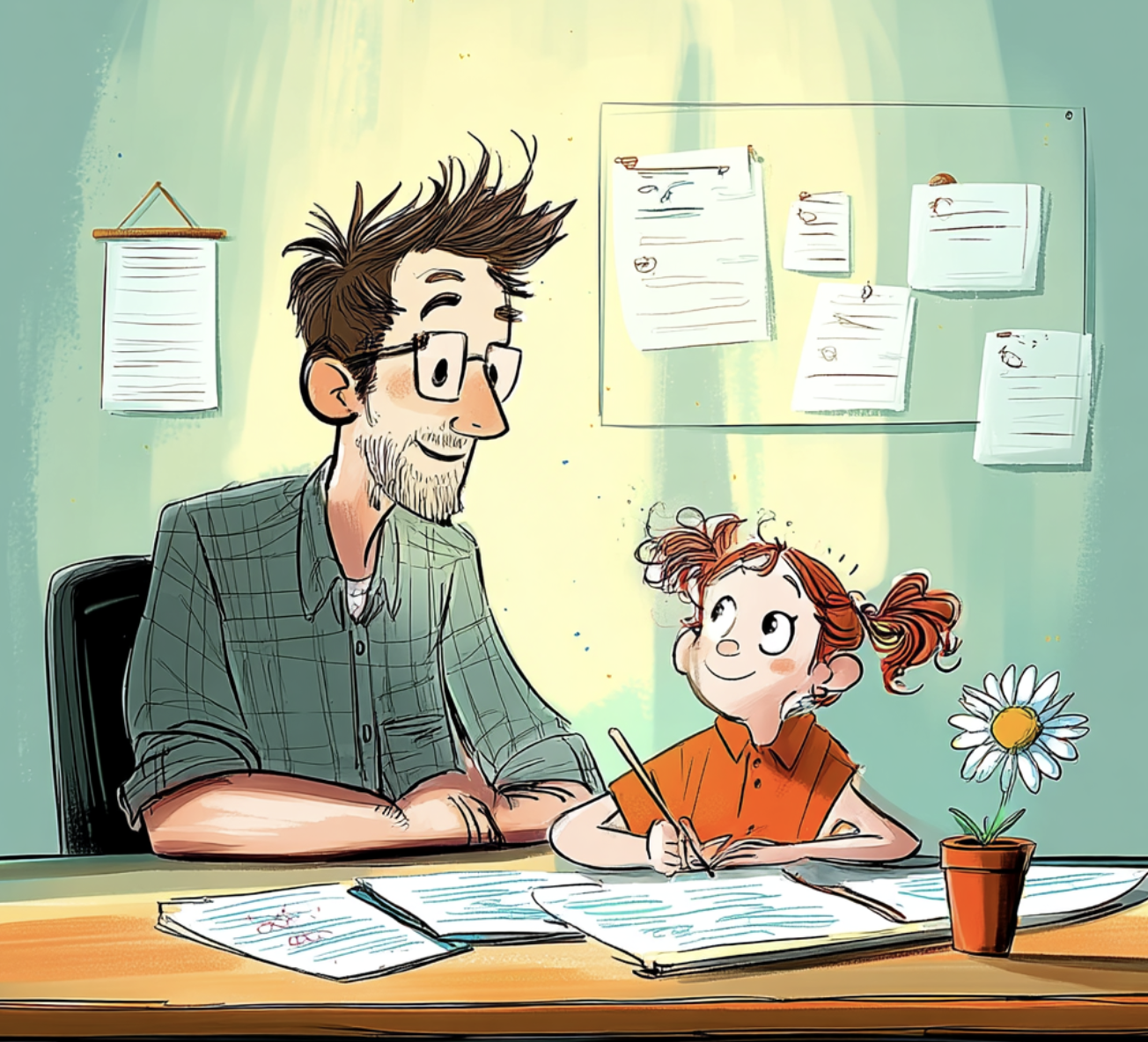
In 1st grade,
Use Listen and Write to help build a solid foundation
You will be able to use CarTalk to practice mental math and build vocabulary.
In the long run, modeling word problems will give confidence to your child as they face many more to come in their educational career!

Math 1: Mental Math

Goal: I can add and subtract larger numbers in my head using new strategies.
CA Standards: OA.1.1 NBT.1.4 NBT.1.6

Prompt 1
-
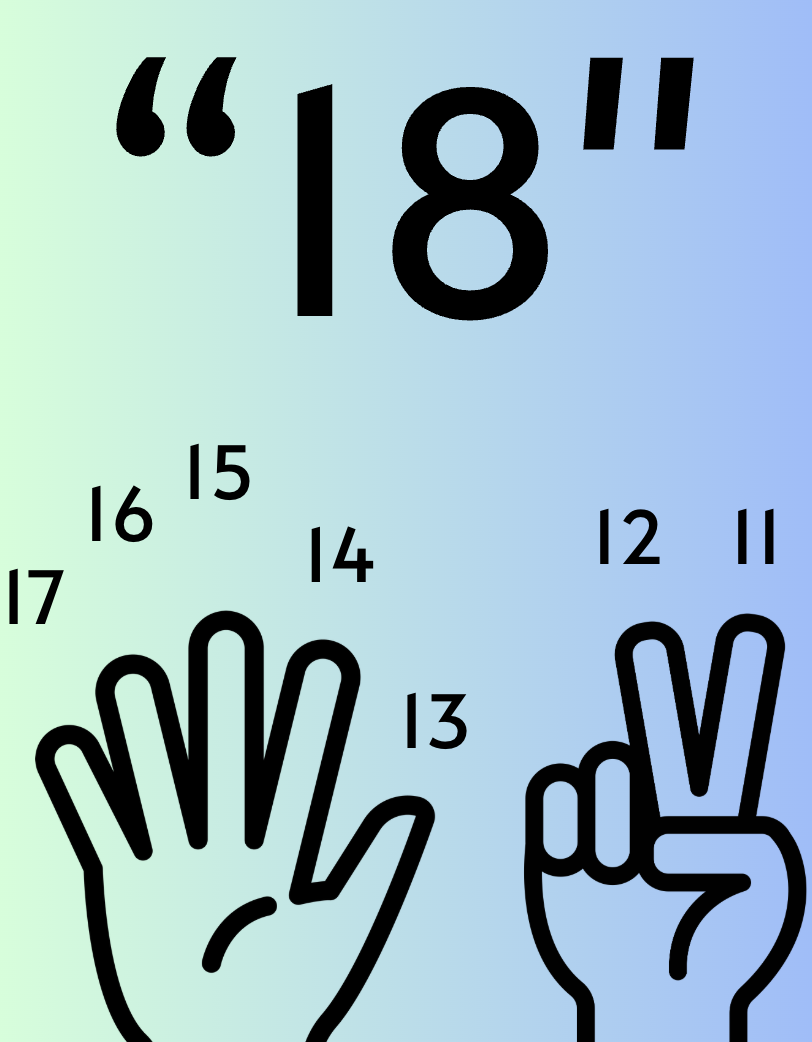
Model how to solve addition and subtraction problems by counting to and from 20 using your fingers. Here are a few examples:
10 + 7
Say 10 and then use 7 fingers to count up to 17.
15 - 7
Say 15 and then use 7 fingers to count down to 8.
Give them more problems, and let them give you one back, using the “tennis” game.
Your goal is for them to fade from using their fingers.
Prompt 2
-
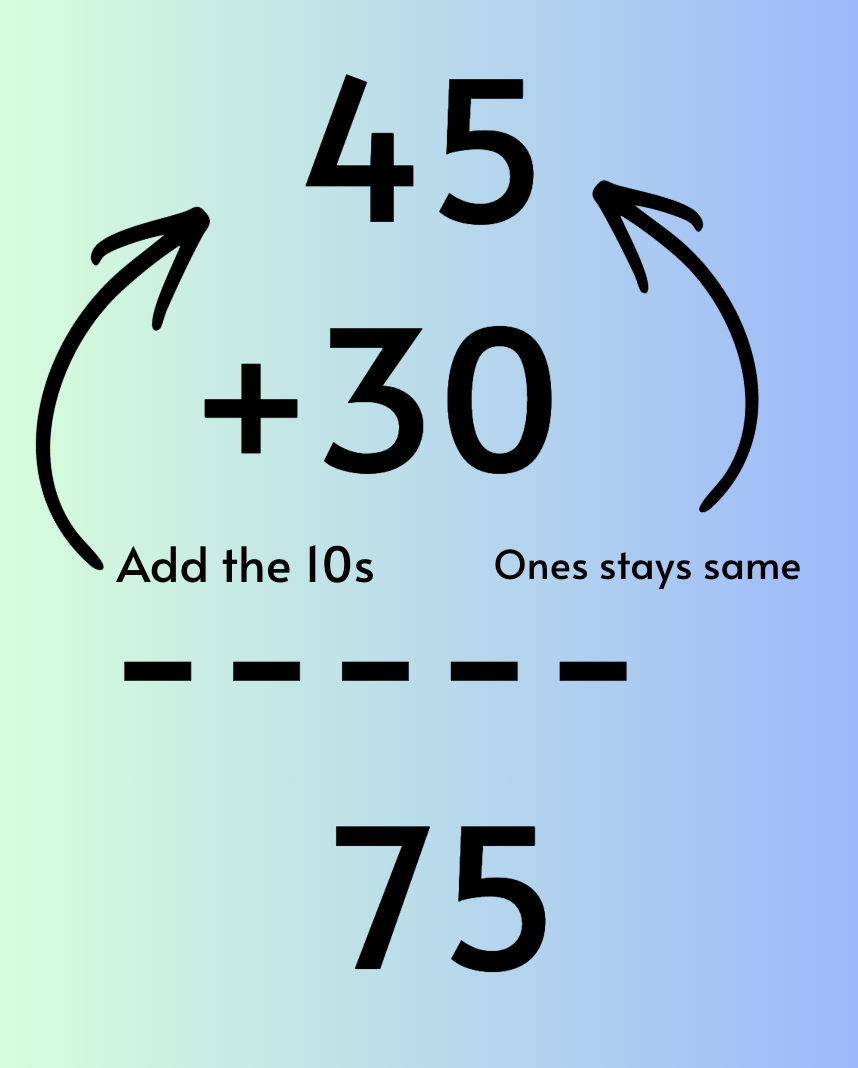
Give them examples of adding and subtracting by tens and discuss the patterns they see.
Which numbers change and which stay the same?
45 - 10 = 35
53 + 10 = 63
18 + 30 = 48
Give them problems, and let them give you one back, using the “tennis” game.
Math 2: Number Bonds

Goal: I can use number bonds to solve all types of addition and subtraction problems.
CA Standards:OA.1.3 OA.1.4, OA 1.8, OA.1.5
Skill 1
-
I DO
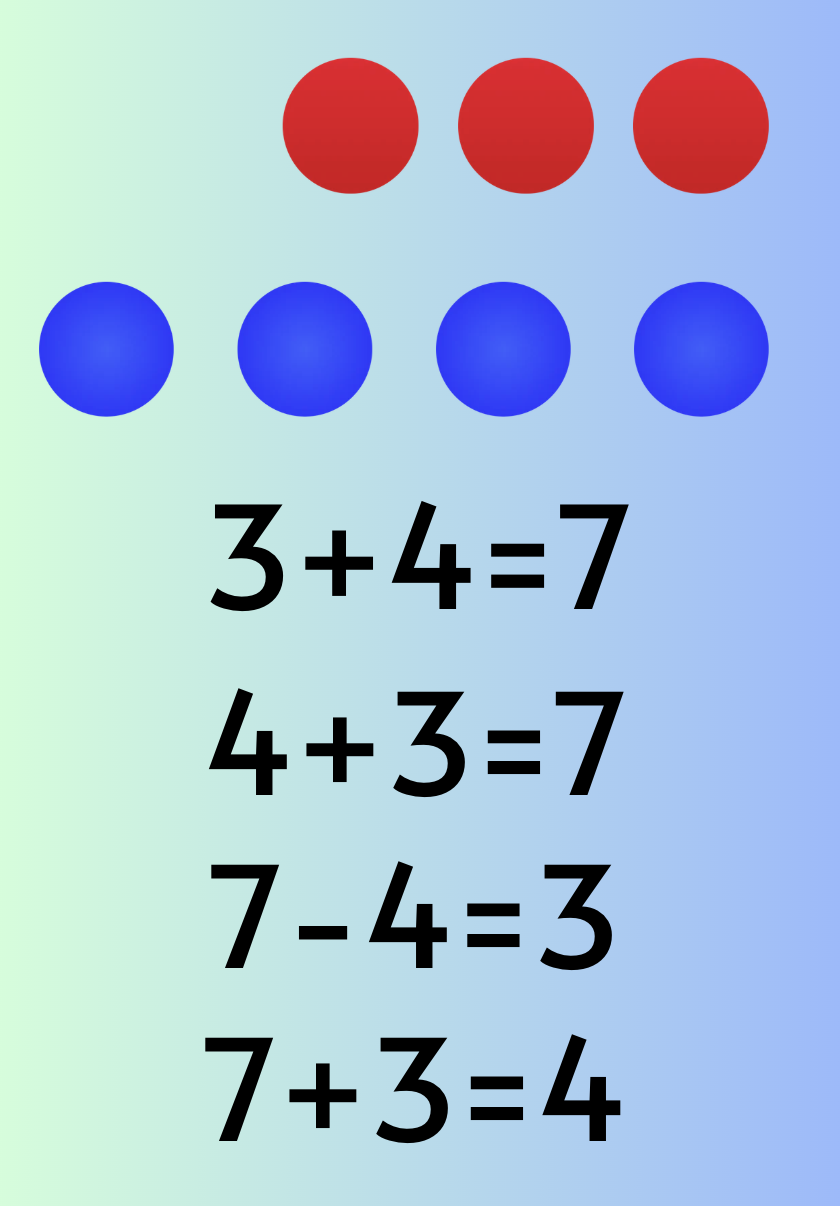
Show how 2+3= 5 and 3+2 =5 relate using this:
Show how when you cover the blue you can see 5-2=3 and when you cover red 5-3=2
This is a Number Bond or Fact Family. (depending on the school’s curriculum)
Notice the pattern of the largest number (whole) and the two smaller numbers. (parts)
WE DO
Brainstorm other fact families and write them out
6+4=10, 4+6=10, 10-4=6 10-6=4
This works great for a tennis game!
Skill 2
-
II DO
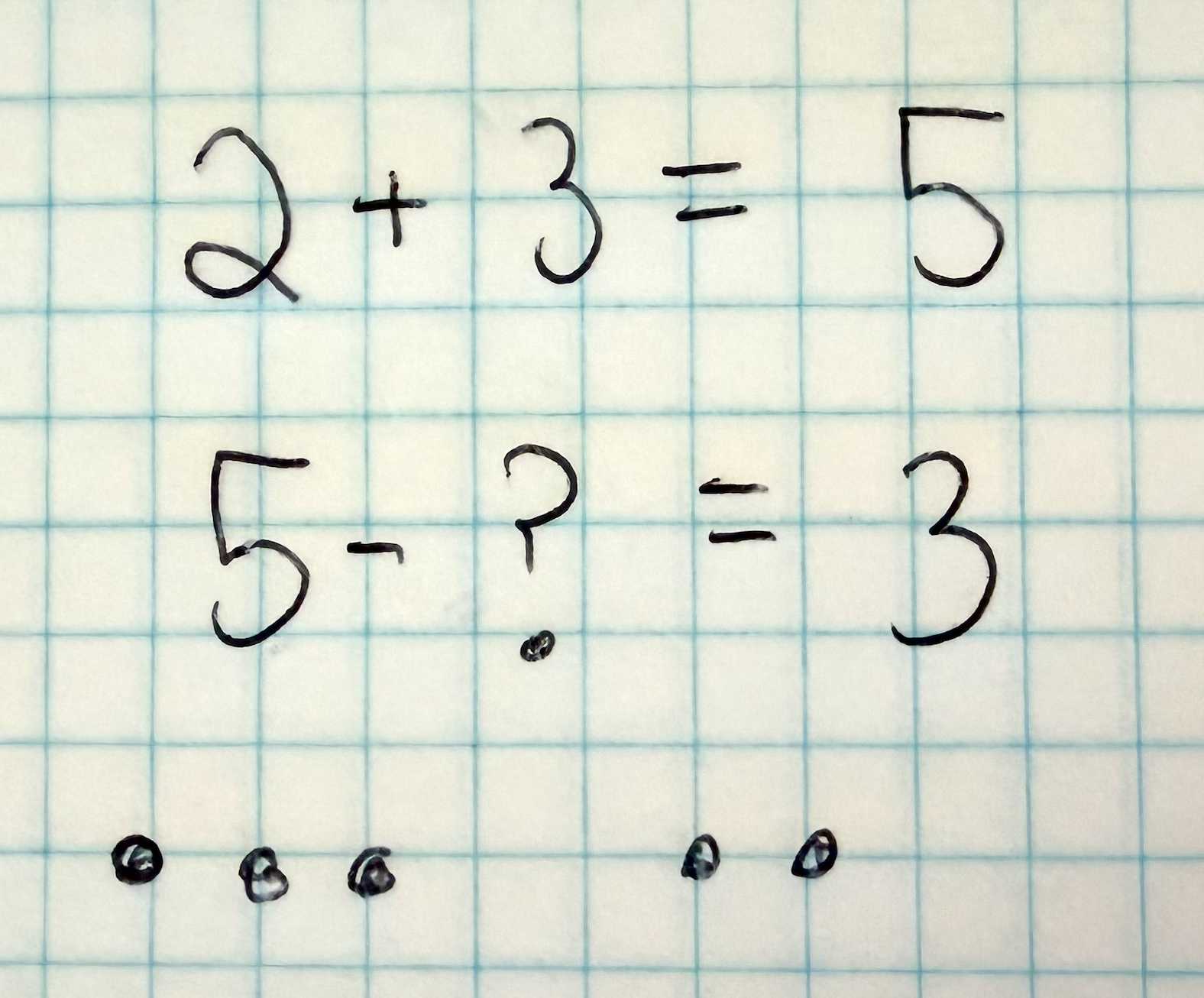
Show how using Fact Families you can uncover a missing number. This is the foundation for algebraic thinking.
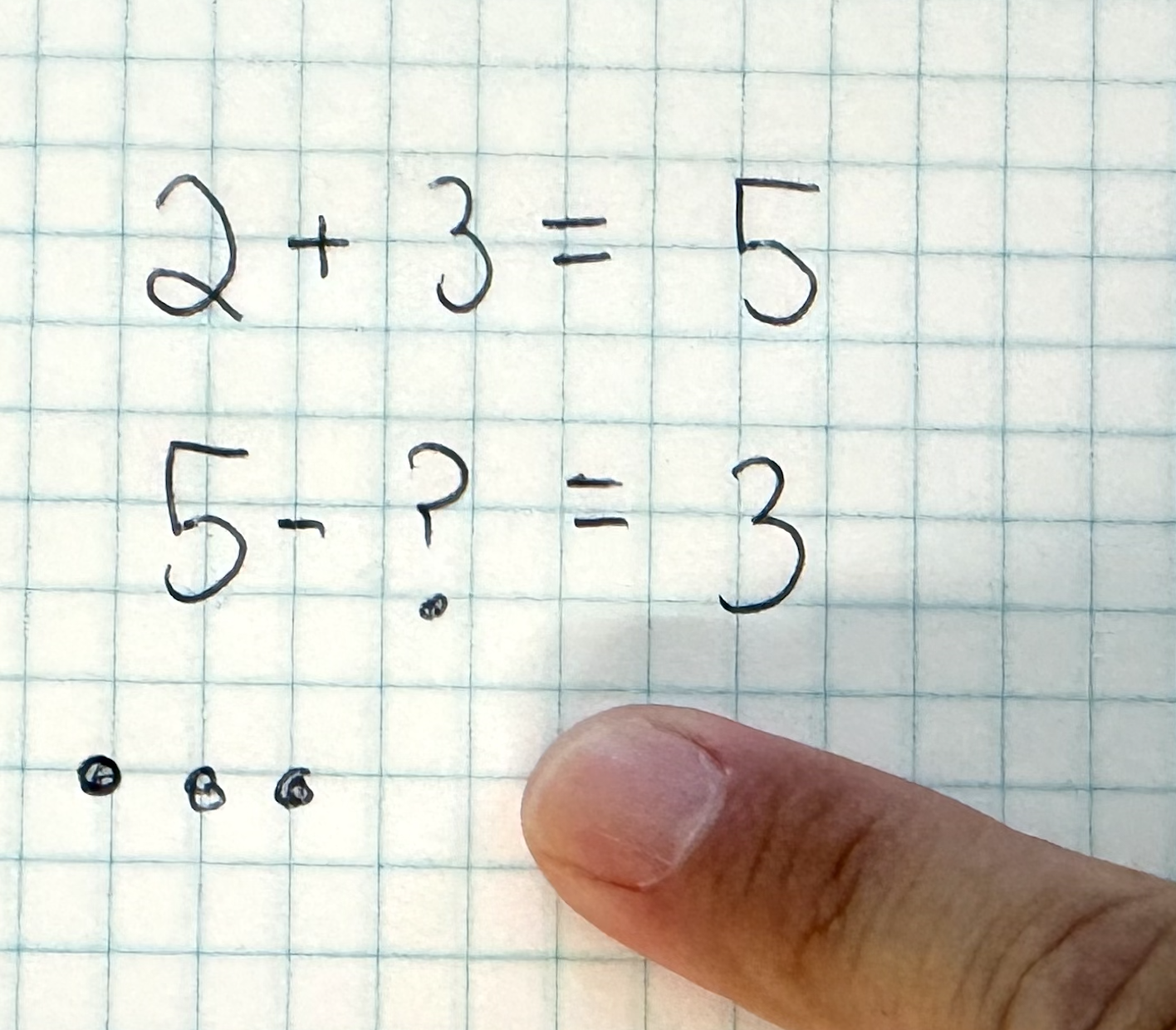
If you know 2 + 3 = 5, then you can find the missing number in 5-?= 3
If you get a problem like 5 + ? = 8 then you can use the fact family partner 8 - 5 = ? to find the missing number.
WE DO
Practice with more examples like:
4+ ?= 10 9- ?= 2 7+ ? = 13
Have them test you in a game of tennis.
Skill 3
-
I DO
As you model the example, make sure to emphasize how useful the strategy is when adding many numbers together.
“This sounds fancy, but this property tells us that the order in which we add numbers does not change the answer.”
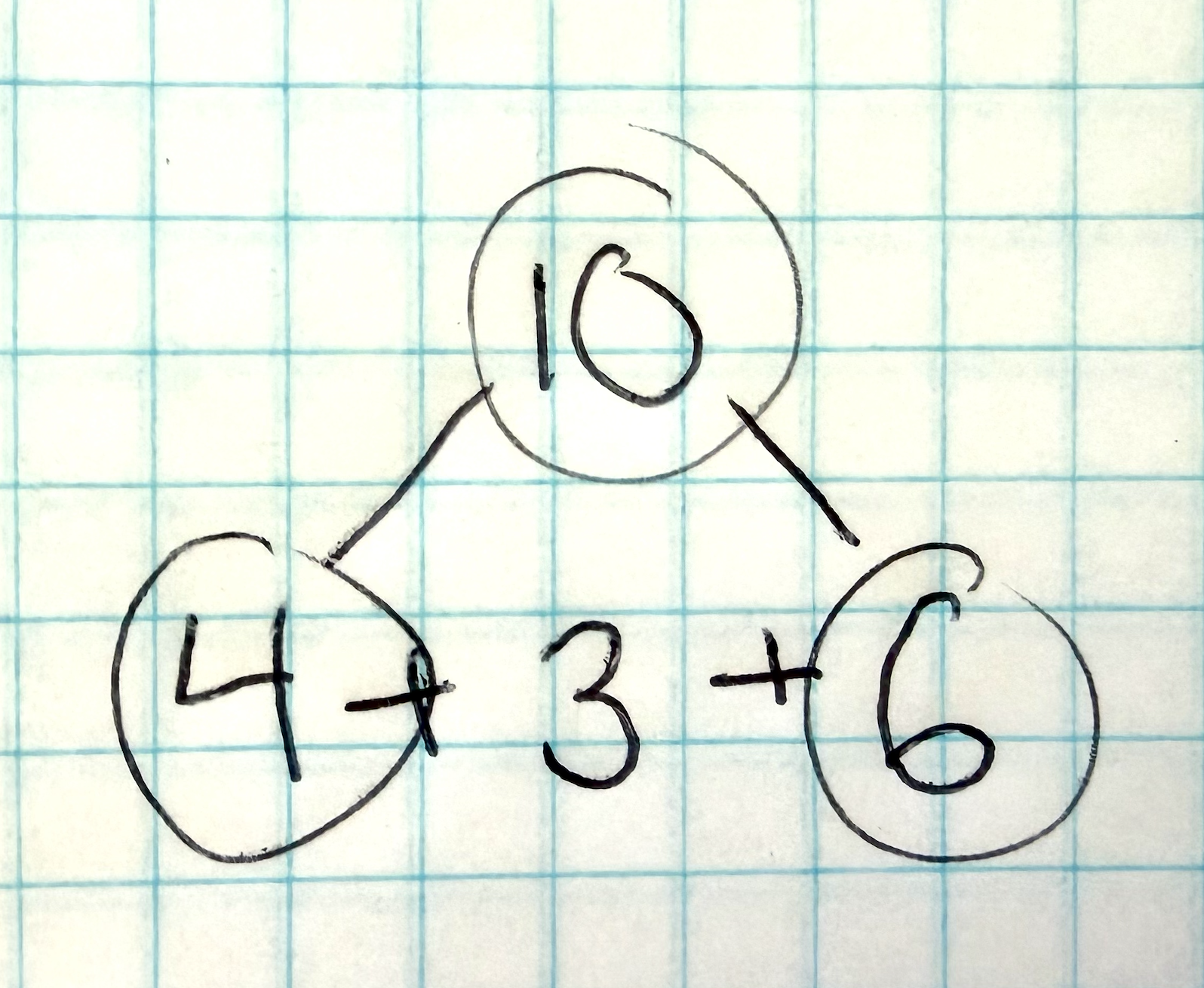
This becomes helpful when we add three or more numbers. Watch as you can find the fact families that involve 10 and “make 10” first.
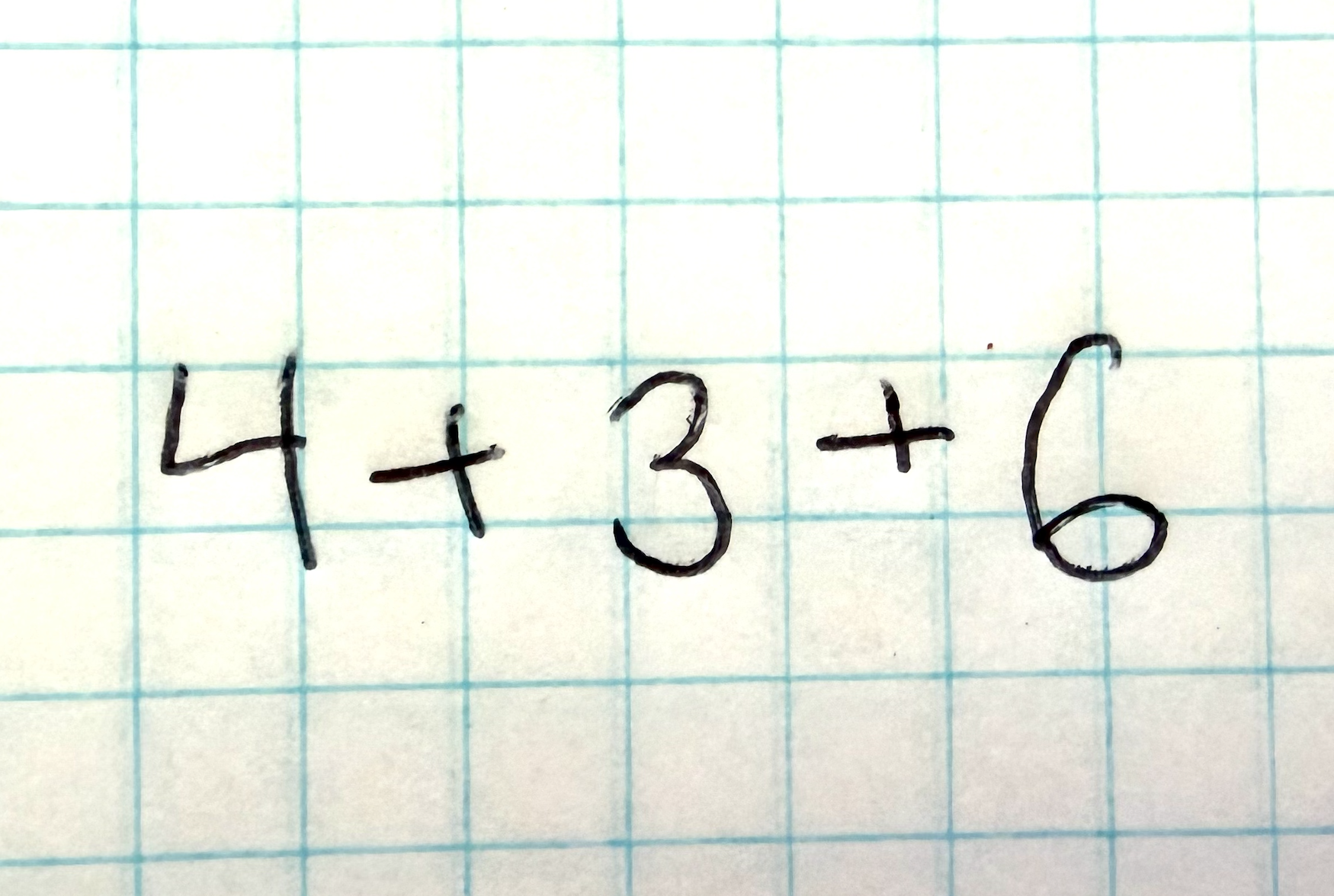
Let’s say you need to add 4+3+6
You spot that 6+4=10 so:
3 + 4 + 6 = 3 + (4 + 6) = 3 + 10 = 13
WE DO
Give them more examples like:
2+6+8 3+9+7. 5+6+5
Challenge: Try to add four or more digits using this strategy to find how to make 10 and manipulate the order of numbers in the equation.
Math 3: Place Value
Goal: I understand how to use ones, tens and hundreds place values to read, write and expand numbers.
CA Standards: NBT.1.1 OA.1.5 OA.1.6 NBT.1.2 NBT.1.3

Skill 1
-
I DO
Model writing any number between 20 and 120
Write H/T/O on top of each of the place values Hundred, Tens and Ones.
WE DO
Use Listen and Write to have them practice:
67 79 111 23 108
Challenge them to write numbers like:
387 and 459.
Make sure you say them slowly as “three hundred eighty-seven.”
Skill 2
-
I Do
Using your graph paper notebook, draw a box 10 squares across and 3 squares down.
Model writing dots for the number 26 by quickly putting dots in all 10 squares of the first two rows and then counting as you do the 6 ones on the 3rd row.
NEED IMAGE
We Do
Make some more “10 frame” boxes with them and try more numbers between 20 and 90.
Watch as they begin to master adding the 10s rows and identify when they get to the ones.
Challenge, when ready, have them make a box 10x10 on the graph paper. Ten tens are 100.
Have them try to draw an array boxing 125
Skill 3
-
I Do
NEED IMAGE
Show how to write 47 in Expanded Form:
40 + 7 = 47
Say there are 4 tens and 7 ones and point to the four ten frames and 7 ones.
We Do
Have them try some more examples like
84, 59, 95
Move them into
134= 100+30+4
I Do
Remind them that we use <. > to compare two numbers, and that the “alligator” eats the bigger number.
Compare the numbers 92 and 59 by expanding them first to show that the tens column is what matters.
90+2 > 50+9
We Do:
Practice comparing more first with them writing out the expansion, and then with just the numbers
Move into comparing numbers with the 100s place.
Math 4: Add and Subtract to 120
Goal: I understand how to use Place Value to add and subtract large numbers.
CA Standards: NBT.1.4 OA.1.6
Skill 1
-
NEED IMAGES
I Do:
After creating an array for a number like 26, write an addition equation like 26+8.
Show how you can add 8 dots, completing one of the 10s and continuing to the next row to 34.
Using a previous 10 frame number, model a subtraction equation like 34-6.
Show how you can cross out 6 dots and move up to the previous row.
Count the remaining dots to find 28.
We Do:
Watch that they keep track of the amount of 10s and ones as they count backwards and forwards.
This may take some time to master, so keep watching until they are finding the correct answer 3 times in a row.
Skill 2
-
NEED IMAGES
I Do:
Use the vertical lines of the graph paper to line up the two numbers you are adding. (often called “stacking”) 45+23 Put T/O above the ones and tens.
First add the ones column to get 8 and then add the tens column to get 6. 45+23= 68
We Do:
As you practice more problems, ensure that they are not having to regroup 10 yet unless you feel very confident. (This will come in 2nd grade)
Practice subtraction problems the same way 45-23
First the ones column 5-3= 2 and then the tens column 4-2=2, So 45-23=
Math 5: Shapes
Goal: I understand the different properties and names of more shapes.
CA Standards: G.1.A.1 G.1.A.2 G.1.B.1
Skill 1
-
I DO:
Describe the properties of a triangle. It has 3 sides and 3 angles.
Describe the properties of a pentagon. It has 5 sides and 5 angles.
Using a ruler, try to draw the different types of pentagons on the graph paper.
We Do:
Have your child use a ruler and try to draw different versions of a triangle
Discuss how when some angles are bigger, the others must get smaller.
I Do: NEEED IMAGE
Introduce the idea of a quadrilateral as a category for all 4-sided shapes.
Review the examples of rectangles, diamonds, rhombus, squares
We Do:
Discuss how these shapes are different and how they are the same.
Have them try to draw and label their own version of each, looking at angles and lengths of sides to match up.
See if they can draw big ones and small ones that are "similar" with the same ratio of side lengths.
Skill 2
-
II Do: NEED IMAGE
Notice how a simple bus is made with rectangles and circles.
Count the number of circles and rectangles used.
We Do:
Prompt them to see if they can draw shapes to make a:
A sailboat
a house
a landscape of mountains and trees
Ask them to add up how much of each shape they used for each.
Skill 3
-
I Do: NEED IMAGE
Point out how divide one circle “in half,” one circle in “thirds” and one in “quarters”.
We Do
Have them draw three rectangles
Divide the first into 4 equal parts, then 3 equal parts, then two.
Ask them to color ½, ⅓ and ¼ for each and show them how you write these as fractions.
Have them draw three triangles and divide it in half, thirds and quarters.
Continue to have them try with various shapes and number of parts and make sure to use the graph paper squares to check to make sure the parts are equal.
Math 6: Telling Time
Goal: I understand how to tell time on both digital and analog clocks.
CA Standards: MD.1.2
Prompt
-
Math 6: Telling Time
Goal: I understand how to tell time on both digital and analog clocks.
CA Standards: MD.1.2
Prompt: What time does this say? NEED IMAGE
Use the images of two clocks on the back one analog one digital that read 430)
Point at the little red hand. This tells us the hours. It counts by 1.
Point to the big blue hand. This tells us the minutes, and it counts by 5.
Where is the little hand pointing?
4
Where is the big hand pointing?
It’s on the 6.
Hold 6 fingers up and let’s count by 5.
5,10,15, 20, 25, 30 minutes.
Read the digital clock together,
4:30.
Notice how the hours come before the : and the minutes come after.
Ask them to respond to you when you say a digital time and they say where the big and little hands are pointing towards.
2:30 5:00 3:30 12:30
Play tennis
Reverse the game and tell them where the big and little hands are pointing and they tell you the time.
Challenge them with times like:
4:25. 3:15 7:45
Math 7: Word Problems Model
Goal: I am learning how to answer word problems that ask me to either add or subtract.
CA Standards: OA.1.2
Skill
-
Do:
Show how to Identify what is required to solve the following questions using this word problem: Luna and Charlie want to plant a garden. Luna brought 7 sunflower seeds and Charlie contributed 3 marigold seeds.
How many seeds do they have all together?
Point out that “All together” usually means addition. 7+3=10
How many more seeds did Luna bring then Charlie?
Point out that “How many more” usually means subtraction. 7-3=4
We Do:
Have your student read the other example word problem:
Samir and Alyssa want to donate books to the library. Samir brought 8 books and Alyssa brought 4 books.
How many books did they bring all together?
How many more books did Samir bring then Alyssa?
Watch that they use the correct operations for each question and can create and solve the equation.
You can make more and more problems to practice by simply changing the names and numbers.
You Do:
If they have mastered this, you can begin asking trickier questions like:
If Samir brought 9 books and all together they brought 17. How many did Alyssa bring? (use your Math 2 number bond card to help)
Language 1: Blending Sounds into Words
Goal: I am learning how to read many new words by putting sounds together.
CA Standards: RF.1.2a RF.1.3a W.1.1a
Skill 1
-
The first step in reading is being sure to confirm they can identify the correct sound and write the letters.
You say the letter, and they write both the capital and lowercase versions.
Start with consonants. Begin by saying short, clear sounds for:
B, C, D, G, H, J, K, P, T.
Continue with longer, subtle consonants.
F, L, M, N, Q, R, S, V, W, X, Y, Z.
Emphasize the difference between short vowel sounds:
E and I and A and O.
Lastly, ensure they know the sounds of letter combos like:
SH, TH, and CH
Skill 2
-
Regularly spelled (Consonant/Vowel/Consonant) words are where to go next:
I DO:
Use the example of BUS to model how to count out the three sounds you hear with your fingers
B, U, S.
Then write the letters as you say B, U, S again.
We Do:
Have them try this on another word like:
BIG
What's the first sound you hear?
What's the middle vowel sound?
What's the last sound?
Repeat this with more examples:
Cat Dog Red Bug Pit
Challenge:
Once you see mastery, try being tricky and switching vowels to make new words
PIN, PEN, PAN
SIT, SET, SAT
Skill 3
-
I DO
Consonant blends are when two letters flow together like:
st, tr, mp
Use the example of TRIP to model how to count out the four sounds you hear with your fingers
T R I P
Then write the letters as you say TRIP again. You can point out how that TR sounds
We DO
Continue practicing with:
blast ramp blimp stop last shop crust
Watch for them omitting or missing the sequence of sounds
Try vowel swaps with this new pattern.
Stick, Stack, Stock
Challenge:
Try words that use TH, SH, CH sounds. They count as one sound on your fingers:
Fresh
fr: the beginning blend
e: the middle sound,
sh is the ending sound.
Language 2: Long Vowels
Goal: I am learning when to use the different long vowel spellings.
CA Standards: RF.1.3b
Skill 1 Word families
Before you get started, share that Long vowels are different than short vowels as they say their name. Long vowels use different teams of letters to spell, and so it's important to find the pattern.
Use the word family -EAT, and model how to spell SEAT
Have them try:
MEAT, TREAT, BEAT. NEAT, HEAT. EAT
Brainstorm other long vowel word families using skills 2 and 3.
Skill 2 Vowel Teams
As you are trying new word families, you can share:
Long vowels often use a team. The first letter gets to say its name when it’s followed by another vowel.
Model BOAT and showing how the A give power to the O.
Have them try:
FLOAT, COAT, GOAT
Model Clue and see if they can spell:
blue, cue, rescue
Try Tree and give them:
knee, see, glee,
Skill 3 Silent E
Often, long vowel word families use silent E as its teammate.
Silent E comes at the end and doesn’t make a sound, but gives its power to the vowel.
Model GATE, ask if they can try:
Late, skate, cape, grape, tale, same
Model Cute, ask if they can try:
flute, mute, mule,
Try random words like:
hope, pile, lake, poke
Keep practicing
Continue to try to introduce other word families and mix together practice with previous words.
Some that have trickier patterns like:
Light, night, sight, bright,
sky, fly, my, try, by,
Language 3: Syllables
Goal: I understand how open and closed syllables work..
CA Standards: RF.1.2b
Prompt 1: Clap for each beat you hear in ….
Clap for each beat you hear in ….HAP/ PY
I count 2. These beats are called syllables.
How many are in..
jumping? 2
hotdog ? 2
animal? 3
computer? 3
Instrumental? 4
Prompt 2: Let’s see the difference between Open and Closed syllables.
Clap RE/ CESS. There are two syllables.
The first one is open because it ends with a vowel E and it's long.
RE/
The second one is closed because the vowel E is between consonants and it’s short.
/CESS
So when I say RE/CESS, after I clap, I can name them as Open/Closed.
Can you try this for:
Open? Open/Closed
Perfect? Closed/Closed
Silent? Open/Closed
April? Open/Closed
January? Closed/Open/Closed/Open
Language 4 Sight Words
Goal: I know how to spell more special words that don’t follow the rules.
CA Standards: RF.1.3d
Discuss how certain “sight words” don't follow the letter-and-sound rules and that you will need to memorize.
These words will help you to move into writing full sentences.
Mix these into any Listen and Write activity
Add more words each week over time, and always spiral back to practice previous ones
Easy Medium Hard
the because laugh
have friend eight
you these thought
Are people kind
Said about different
My should although
does please question
Keep adding to this list:
If you think of more or you spot one while reading, add to this rotation.
Your teachers may call these “Red words” and already provide you with a weekly list.
We have a full list of 1st-grade sight words linked here.
Language 5: Sentences
Goal: I know how to write complex sentences, including those that use a comma.
CA Standards: W.1.1f W.1.2a W.1.2b
Skill 1: Simple sentences punctuation
Point out the differences in punctuation between a statement (.) ,question (?), and exclamation (!)
Use sentences like:
The bus drove across the city.
When is it lunch?
I can’t believe the Knicks won!
Skill 2: Rules for Capital Letters
Point out the rules about capitalizing the names of places, people, days, months, and products.
Use sentences like:
The teacher was not here on Wednesday because they went to Vermont.
The best book I read in September was Harry Potter.
Keep an eye out in their writing for capitalization mistakes and return as needed!
Skill 3: Introducing the Comma
This will be covered in 1st grade, so you may find that you are introducing how to use a comma.
Model how to use a comma in a date:
Abe Lincoln was born on February 12, 1809.
Practice several of these until mastered.
Next, model how to use a comma in a series of items.
We had eggs, bacon, and toast for breakfast.
Practice several of these until mastered.
Lastly, model how to use a comma to combine sentences using words like and, but, or.
I like red, but you like blue.
Practice these types of sentences throughout the year until mastered.
Language 6: Verbs
Goal: I know how to use verbs in sentences in different ways.
CA Standards: W.1.1c W.1.1e
Skill 1 Verb Tense
Before you start, discuss how verbs change tense based on when an action happens.
Divide the page into three columns for the present, future, and past tenses.
Model with:
Jump will jump jumped
Have them try:
Walk will walk walked
Run will run Ran
Hide will hide hid
Have them try using full sentences, turning from present to future to past.
I drive with my mom to school.
I will drive with my mom to school.
I drove with my mom to school.
Skill 2 Conjugation
Divide the page into four columns: NEED IMAGE
I, You, He/She/the person, We, They
Model to bring
I bring you bring He/She brings, We bring They bring,
Point out how the 3rd person singular has an s.
Practice with a few more verbs.
There are many verbs that do this differently
Model to do:
I do You do He/She does, We do They do
Practice with more irregular verbs like:
to go, to be, to have,
Give them full sentences and have them circle the verbs. NEED IMAGE
Emphasize using the singular 3rd person (he/she/the teacher/Jimmy) where the verb needs attention
Jimmy goes to the library every week.
Pay attention to their speaking and catch any verb confusions you see, particularly in the past tense.
Language 8: Fluency
Goal: I can read at least 60 words per minute and take on the emotions of the characters in a story.
CA Standards: RF.1.4
In 1st grade, developing a Reading Time Routine is critical. It doesn’t matter if it's Saturday morning or every night.
It's important to give the responsibility of reading during StoryTime to your student at least 2 times a week.
You can put your finger on each word as you listen to them read.
As the story develops, stop and think aloud about the story, the characters and the illustrations.
Model how to make the characters voices and personalities come alive as you read.
Try some sessions where they read quietly, and you check in with them and ask the same questions periodically.
Read to them when you see they are getting tired or for special occasions.
In 1st grade, the goal is for your student to read a grade level book at 60 wpm.
When your student seems ready, maybe in the winter or spring, try using a timer to have them read a story and count the words they read in one minute.
You can try cutting and pasting the passage below to a printable document. Print two copies and then you can mark off one where they finished with a pencil and cross out any words they misread.
Count the words and put this number in the box for the L8 card in your notebook to track your progress!
‘
Sam and the Red Bus
Sam had a big red cap. He put the cap on his head. 12
Sam went to the bus stop with his dad. They saw a 24
big red bus. The bus had big wheels. The wheels went 35
fast. Sam got on the bus. He sat near a window. 47
Sam looked out the window. He saw a blue bird in 58
a tree. He saw a dog run in the green grass. 69
The bus came to a big park. Sam got off with 80
his dad. They had a fun day at the park. 90
Use AI to generate more 1st grade texts like these and practice.

Language 7: Nouns and Pronouns
Goal: I know how to use nouns and pronouns in sentences in different ways.
CA Standards: W.1.1b W.1.1d
Skill 1: Plurals
Start with a discussion on what plurals are and how they are written
Plurals are when you have more than one of something.
Usually we use an s
Car becomes Cars
However, when a word ends in an s or sh, you use es.
Dish becomes Dishes
Sometimes we use completely different spellings or don’t change the word at all.
Child becomes Children
Have them try to write plurals for:
dog
fish
crayon
dress
foot
book
mouse
Have them say the plural out loud before writing it.
Point out the irregular ones like fish and mice, and if interested create a list in your notebook of these.
Skill 2: Possessives
Start with a discussion on what possesives are and how they are written
We use ‘s when a thing is owned by someone.
Model writing:
The dog has a bone. It’s the dog’s bone.
Have them try:
The teacher has a pencil. It's the…..
The mother has a stroller. It's the ….
If they seem ready, you can introduce:
If we want to say that more than one person or thing has something, we write the possessive with s’
Have them try a few ones like:
The students have math books. These are the students’ books.
Skill 3 Pronouns
Start with a discussion on what possesives are and how they are written
We often use pronouns instead of names when we speak and write. It sounds funny to say someone’s name a bunch.
Here is a list of the most common ones:
NEED IMAGE
I, me, my, mine
You, your,
She, her, hers
He, him, his
We, us, our
They, Them, Their
Try using using these in a variety of sentences like:
We can take our bikes to the store.
She wanted them to help with her bunny.
Try saying a sentence and see if your student can write it replacing the nouns with pronouns.
Jimmy went to Laura’s house.
He went to her house.

Language 9: Asking and Answering Questions
Goal: I can ask and answer specific questions about a story or text.
CA Standards: RL. 1.1, RI 1.1
As part of the Reading routine, take an opportunity to start a chapter book. There are some great book ideas if you click here.
Skill 1) Questions that Find the Answer
Model asking a question and finding the answer in the story.
Start with Who, What and Where questions that are easier to answer
Take turns and let them ask you a question and you show them how you find the answer in the book and point to the words.
Then you can ask them a question and have them find it. NEED IMAGE
Skill 2) Questions that Develop an Opinion (CarTalk)
Model and think aloud how to answer How and Why questions such as:
How did the character feel after the event happened?
How did they solve the problem in the story?
Why do the butterflies migrate?
Go Socratic! Clarify, Probe and Consider Perspectives as you discuss!
After they finish a chapter book, they can develop a quiz with questions in skill 1 and skill 2 in their notebook
Model how to build a Google Form, Kahoot or other platform.
Language 10: Comprehension
Goal: I understand what is happening in the stories and texts I read.
CA Standards RL. 1.2, RL.1.3
Comprehension is the finish line of teaching reading. Teachers throughout the world celebrate when this lightbulb goes off!
As part of the Reading routine, take an opportunity to start a chapter book, co reading this is the best way to tap into this learning. There are some great book ideas if you click here.
Skill 1 Summarize
After reading a chapter, model to your student how to retell the main points on who the characters were and what happened in your own words. Here is a place to start:
Wow what a great chapter. The [main character] was able to do [this] and [that] with [these characters.] This helped her [get closer to her goal] or [overcome this problem] by [my opinion].
Next time, try having them try to summarize the chapter and you can take turns as you complete the book.
Challenge: Create a comic strip of the major events each chapter, with a few sentences description. It will end up becoming a great memory!
NEED IMAGE OF PROJECT
Skill 2 Clarify
As they read, hold your finger to each word and observe your child for any sign of confusion or stumble in pronunciation.
When a confusion arises, ask them to stop reading and use one of the following strategies:
Let’s look for clues in other words in the sentence, any pictures
Here. is an example of this thinking you can use to model:
The bird flew up to feed the squirming aphids to her young.
Birds might eat insects or plants. Insects would squirm.
Aphids might be an insect?
Let’s look for clues in the word, its root or any suffix, prefix.
Use this example of breaking apart a word to see its meaning:
Careful= If I know the word care and the suffix “ful,” then I can guess that careful is being full of care.
Skill 3 Predict
Before you start a StoryTime session, model how to imagine what will happen next in the story.
Give an explanation why you think this might happen based on previous chapters or connections to your own experience.
I think the [main character] will finally get [the goal] once [another character] realizes they need to [help.] I think this because [what we read before.]
Compare your prediction with what happens.
Have them try on the next chapter in the next session.
Go Socratic! Clarify, Probe, and Consider with them on this!
Skill 4 Cause and Effect
Discuss how cause and effect works using real life experiences:
Cause: It started raining. Effect: I had to bring an umbrella to school.
Cause: The doorbell rang. Effect: My dog barked at the door.
As you read the story, model how to identify a cause and effect in the story.
What caused [the character] to make [this decision]?
Encourage and celebrate them if they try one of these during the next chapter.
Go Socratic! Clarify, Probe, and Consider with them on this!
Language 11: Author’s Purpose
GGoal: I understand how authors write books and why they do.
CA Standards: RI 1.5 RL.1.5 RL.1.6
In 1st grade, developing a Reading Time Routine is critical. It doesn’t matter if it's Saturday morning or every night.
Skill 1: Focus on the Author
As you read, stop and think aloud about the author’s strategies in creating the reader’s experience.
Wow did you see how the author [described the setting] and [developed those characters in this dialogue by making me laugh.]
It's important to choose a variety of different types of texts, not just fictional stories, and discuss "author's purpose." Here are some prompts you can use at any time while you are reading:
Why did the author write this book?
Was it meant to be funny, sad, does it have a twist?
Is it trying to teach me something?
Is it trying to make me change my mind about something?
Do you feel like this illustrator and author work well together?
Go Socratic!
Skill 2 Compare all the reasons to write
After some time reading a variety of books discuss which type of reading they like best and why.
Go over as many genres as you can show them. Here are some question ideas:
Do we read a news article the same way we read a story?
How do poems pack meaning into a few words?
Go Socratic!
Skill 3 The Narrator
There is a particular emphasis in 1st grade to begin looking at the narrator in a story. If you read a story with a strong narrator, take advantage to point this out. Sometimes in a story it might be a character who is speaking or we might know it's the author. If you need ideas, here are some great ones for this.
Try asking questions during the story like:
Do you think the narrator has an opinion on what has happened?
What would the story be like from another character's perspective?
Language 11: Vocabulary
Goal: I am learning to use new words in my speaking and writing that help me express myself clearly.
CA Standards: W.1.3 RF.1.3c,
Prompt 1: Lets look at how words have different shades of meaning, as it will start choosing the best ones for each situation.
Discuss the difference in meanings between these pairs of words:
Running and Sprinting
Looking and Staring
Cozy and Safe
Sink and Drop
Saturated and Wet
How do these mean kinda the same thing? How are they different shades?
Create lists of words for each category below and see how many you can come up with:
Tools Weather Clothes Plants Sports
Play Tennis!
Use this as an opportunity to teach new words and celebrate if they use them on their own.
Skill 2: Using “Movie in My Mind” Words
Discuss which words they have heard in a story that has created an image in their minds.
Build a list of words that describe what your senses take in.
What are all the words for sound you can think of? Smell? Feelings?
Try to have them close their eyes as you describe a scene or setting like:
in a volcano, on the moon, in a crowded supermarket, in the forest, in the car on a summer day.
Play Tennis
Use Storytime as a place to spot them in the books you are reading and use them in this game later!
Skill 3: Root words
Understanding how root words serve as a base for many variations will allow your student to recognize new vocabulary as they begin reading.
How many words can you make from the root word friend?
friend, friends, friendly, friendlier, friendship
Play Tennis
The 1st Grade Projects

🛠 Project 1: How-To Guide
Goal: Write clear instructions explaining how to complete a task or routine.
CA Standards: W1.2, L1.2b, L1.3
Card A: How-to write a How-to Guide
USE IMAGE
I DO:
Use the exeplar to discuss how instruction manuals are organized:
They take a larger task and break it into smaller steps.
They are short and clear sentences.
There is often a combination of pictures, words and often keys
Learning to tie your shoes takes practice, but you can do it! Follow these simple steps:
Step 1: First hold one lace in each hand. Cross them to make an "X" shape.
Step 2: Take one lace and tuck it under the other. Pull both ends tight to make a knot.
Step 3: Make a loop with one lace that looks like a bunny ear. Hold it tight!
Step 4: Next, take the other lace and wrap it around your bunny ear.
Step 5: Push the lace through the little hole you made to make a second bunny ear.
Step 6: Last, grab both bunny ears and pull them tight!
You did it! Now your shoes are ready for a big day of playing.
We DO:
Find other examples of How-to Guides around the house,
Toy instruction manuals
Furniture assembly manuals
YouTube tutorials
Guide them to choose a familiar task or chore of which they are an “Expert”.
making a snack
brushing teeth
building with LEGO
feeding a pet
They can think about the steps to complete this task for next time.
Card B: Drafting Instructions
I DO
Use the exeplar on Card A to remind them of their goal.
Point out how each step starts with a verb.
Point out sequence words, (first, next, last)
clear words to avoid confusion
thinking about the reader’s experience at each step
We DO
Use the notebook to allow them to begin drafting.
Have them say step one outloud, and once you confirm, they can write “Step 1” and the sentence.
Gradually allow your child to write the following steps independently.
Remind them to:
Say the sentence before writing it
Capitalize the first letter
Make good word choices
Keep the steps in order
Don’t try to correct their spelling, its good for them to practice as long as you can see that are attempting to write all the sounds in the word.
Card C: Revising & Publishing
WE DO
First test the draft directions with another family member or friend.
Ask for feedback from them:
Were the directions clear?
Did any steps cause confusion?
I DO
Model how to take notes on this input and revise unclear wording and improve sentence clarity.
We Do
When ready, set them up with paper and crayons to publish the final version with:
illustrations
labels
numbered steps
Cocreating a Google Slides/ PowerPoint can be a fun way to help them sequence steps with images and directions
✍️ Project 2: Small Moment Story
Goal: Write a detailed story about a real memory using sequencing, feelings, and past tense verbs.
CA Standards: W1.3, L1.1e, L1.3, L1.1f, L1.2b
Card A: Brainstorming Ideas
Prompt 1: What is a moment in your life that you remember really, really well? Why?
These small moments can make you feel things years later.
Guide them to decide if they want to write about a scary, fun or even embarrassing moment.
Go through different memories and guide them to choose one to write about.
USE IMAGE ON CARD
Prompt 2: What did you notice about how they organized ther ideas on this Brainstorm Web?
Point out how the smaller spokes for each memory to include more details:
People
Activities
Feelings
Notebook Follow Up:
WE DO
Guide your student to make a brainstorm web for their memory.
Include 4-5 large bubbles of events within this memory
Include 1-2 bubbles of people and feelings for each large bubble
HINT: You might need to I DO your own moment and brainstorm all these bubbles completely at home.
Card B: Sequencing
I DO
Review the following outline of Visiting Grandparents and point out
The sequence of events and how they used their brainstorming chart
The feelings attached to each moment
1) Arrival and Playing
With Grandpa in the living room
Played tic-tact-toe and had fun
2) Eating Cookie
Ate warm cookies with Grandma
Felt delicious
3) Reading Stories
Read Mother Goose with Grandma
Felt Happy, Cozy, and Love.
Last: Saying Goodbye
Got a big hug. in the hallway with Grandpa and Grandma.
Felt sad
WE Do:
Guide them to create their own outline by looking at the web and sequencing
They can write phrases and ideas
Card C: Drafting
I DO
Point out the following in the model story:
It follows the sequence and includes the details and feeling words
It is written this in the past tense (this is a big 1st grade standard)
First, I went to Grandma’s house and went into the living room to see Grandpa. We played tic-tac-toe and I had so much fun!
Next, I went to the kitchen with Grandma. We ate warm cookies and they tasted delicious. After that, we sat on the couch and Grandma read Mother Goose stories to me. I felt happy, cozy, and so much love.
Last, I had to say goodbye in the hallway. I gave Grandma and Grandpa a big hug. I felt a little bit sad to leave.
We DO
Review this writing.
How would you improve it?
What do you like about it?
Have them begin drafting their story.
Aim for 10-15 sentences and two or three paragraphs. Try to get it done in one sitting, but challenge them to come back and “create a movie” in the brain of the reader by improving the words describing the setting, characters and actions.
Encourage your student to practice the sound spelling habits they have learned and apply them to choosing new more “scholarly” words in their writing.
Card D: Revising & Publishing
I DO
Using this version with mistakes, model how writers:
reread
fix missing, extra, or mistaken words
check if sentences make sense
Make better word choice
Fist I went to grandmas house and went in the living room to see granpa. We playd tic-tac-toe and I had so much fun!
Next I went to the kichen with grandma. We ated warm cokies and it tasted delisus. after that we sat on the cowch and granma read mother goos storys to me. I felt happy coozy and so much luv.
Last I had to say goobye in the halway. I gave grandma and granpa a big hug. I felt sad because I wanted to eat more cookes and staying playing.
WE DO
guide your child as they review their own writing by asking them if they notice things. If they feel ready, ask them to replace “feeling” words like “good” and “nice” with more descriptive words like “excited” and “caring.”
When you are ready have them:
rewrite their final draft
draw a picture or a comic of pictures to match their story
Celebrate their finished “published” work.
NEED IMAGE

📊 Project 3: Taking Inventory
Goal: Estimate, count, organize data, and compare quantities using graphs and tally marks.
CA Standards: NBT1.1, OA1.5, OA1.2, MD1.3, NBT1.3
Card A: Estimating Quantities
Prompt 1: About how many LEGOs do we have at home?
Choose 4-5 collections to use as part of a house inventory.
We want to find items that would have quantities between 20 and 100:
LEGO pieces
Coins
Baseball cards
crayons
socks
toy cars
Prompt 2: “Do you think you have more or less than 100 coins?”
Ask questions applying multiple estimations such as:
“How many more LEGO pieces than socks do you have?”
“How many toys do you have in total?”
Notebook follow up:
Write down all the estimates in the notebook when you return home..
Card B: Counting & Tally Marks
Have them gather the collections in piles or bins.
I Do:
Model how to count the actual amounts by using the note book to make tally marks grouped by 5 then count by 5 to get your totals.
Show another method like making piles of 10. IMAGE
We Do:
Have them create a page for counting items and writing the total for each collection
Watch that they are not miscounting, skipping or double counting.
Have them create a data table showing the estimated and actual amounts together.Card C: Formatting the Letter
Card C: Creating Bar Graphs
We will use graph paper to create a bar graph to compare these amounts.
I DO
Model graphing the first total of items.
Use a ruler to make a line at the correct amounts and draw the bars
Add the scale to the vertical axis with each square equal to one item.
WE DO
Allow them to complete the bar graphs for rest of the amounts in the same way
Make sure they are careful to count the graph paper squares
Model how to use the Bar Graph to compare the data by asking and answering questions like:
Which item had the greatest amount?
Which had the fewest?
Which item amount were you miost suprised by?I
📚 Project 4: Opinion Writing to Compare Stories
Goal: Compare two stories, based on a study of purpose and characters,, and write an opinion paragraph explaining which story they like better.
CA Standards: W1.1, RL1.5, RL1.6, RL1.2, RL1.7, RI1.3
Card A: Brainstorming Stories & Main Ideas
Prompt 1 Why do authors write books?
There are three main things authors do when they write stories:
entertain
inform
convince
Discuss which of these is most important to them as a reader when they are choosing their favorite book.
Prompt 2 Which stories you have read fufilled their purpose the best?
For each of these attributes, have your student list some stories that come to mind. Here are some examples of what you are looking for:
Magic Tree House informs as it entertains.
The Giving Tree convinces you to not take things for granted.
Decide on a few stories to investigate:
Which story had the best message?
Which had the most exciting plot?
Which had the best twist or ending?
Have your student state their opinion to each of these. Go Socratic!
Go through the cycle of clarify, consider and restate for each.
Challenge: When you return home, have them draw a picture of the most exciting part of each story and write a sentence summary.
Card B: Character Comparison
Pull out two of the books you selected and look through them together.
Using the notebook create a page to take notes for each of the books and answer the following with words and sentences together:
Who is the hero? Does he change throughout the story?
Is there a villain?
Which characters help the hero?
Is there a narrator? Does the narrator have opinions or personality?
I DO: NEED IMAGE
Use the sample Venn Diagram to point out how to use this to compare. The outsides show differences while the overlap shows similarities.
Create a vent diagram like the one below for the two books compare their charters’ traits and actions: Look over the two pages of notes and model writing one difference on each side and one similarity in the center.
We Do:
Guide them in spotting more similiarities and differences between the two characters
After they complete this task, discuss which book had the best characters and why.
Go Socratic!
Card C: Drafting an Opinion
I DO
Review the model opinion paragraph. In 1st grade, our goal is 5 sentences. Point out how it has:
Introduction sentence with opinion
Three supporting reasons
Concluding sentence
I liked Magic Tree House, Dolphins at Day Break better than Frog and Toad. I think Jack and Annie are more fun and seem like I could be friends with them. I learn more from Magic Tree House than I do from Frog and Toad, because they travel to different places to learn. I like how Jack and Annie always make us want to read the next book. If you see Magic Tree House books, you should get one.
We DO
Start by having them state their opinion and reasons verbally. Ensure they have three solid supporting reasons before writing. Depending on their writing level, you can push them to be more persuasive or use more specific scenes from the book.
After they complete the writing, read it with them together and ensure it makes sense and has the proper punctuations.
Encourage your student to practice the sound spelling habits they have learned and apply them to choosing new more “scholarly” words in their writing. Don’t try to correct them, as long as you can see that they hear all the sounds in the word.
🔍 Project 5: Research & Informational Writing
Goal: Research a topic, gather facts, and create an informational “book.”
CA Standards: W1.2, RI1.1, L1.2, RI1.8, RI1.9, L1.1f
Card A: Gathering Sources
Choose a topic they would like to research. Present 3-4 different ideas you feel like they would enjoy and could learn more about before allowing them to make a selection. These can be pretty general:
Baseball, Mexico, Octopus, Ballet, Jupiter
Model how to explore these topics using a search engine like Kiddle., by typing the question and scanning the results.
Model how to use links within descriptions to explore the answer and related items of interest to include.
OR
Before continuing with this card, visit your local library and use their catalogue system to find books and decide on a topic.
Model how to use the Table of Contents and Index to locate different information on the topic.
Card B: Asking and Answering Key Questions
I DO
Look over the sites or books you have found and discuss how its important to organize information for the reader. Point out where you find two sources that speak about the same topic.
An easy way to organize information is to ask questions around different parts of the topic to create targets for our research. Here are some ideas:
What food does the animal eat?
Where does it live?
How does it change as it gets older?
Once you have defined these, you can begin going into different books and sites to find the answers and keep things organized.
Using your notebook, create sections for each question and answer. Model how to write down key words and phrases to “take notes” on facts.
1st grade emphasizes reading opinion articles as well, so it’s good if you can find a source that takes an opinion on the topic
Does this author have an opinion on the topic?
Why do they believe this?
Do you agree?
If you find multiple texts provide answers to the questions, you can use this as an opportunity to compare texts and evaluate which to use. (this is a big standard)
HINT: You will likely run into content specific language that they may not know. This is a great time to use context clues (other words in the sentences and pictures) to take a guess at what the word means.
Card C: The Final Report
I DO
Look over the exemplar to review the following aspects:
It has an introduction with a Hook (Why is this event important?).
It organizes the facts gathered into parragraphs that flow.
It concludes with a final thought.
An octopus is a very cool animal that lives in the ocean. It has a soft body and no bones. This helps it hide in small cracks in rocks.
An octopus has eight arms. It uses its arms to move around and catch its food. It is very smart and likes to solve puzzles.
When an octopus is scared, it can change its color to match the rocks or sand around it. It can also squirt dark ink to help it swim away fast. I think the octopus is a neat sea creature!
We DO:
Have them try to say their hook and when its ready, let them write it.
Review their notes together and pull out the best facts about the topic to include. Organize the facts together to flow.
Ensure these sentence are clear, grammatically correct, and they choose “the right word” to give good descriptions.
Encourage your student to practice the sound spelling habits they have learned and apply them to choosing new words in their writing.
NEED IMAGE
Once the student has completed, they can draw pictures and create a cover to “publish” their book.
Make a quiz for a potential audience using questions from card B
Social Emotional Learning Habits
SEL 1 I know how to Listen to learn from others
FRONT
Look at the image of the listener on the back of this card together.
What do you notice about her eyes?
What do you notice about her hands?
What do you notice about her mouth?
How does this help your brains and ears do their job in understanding the speaker?
What can you do if you are having trouble listening?
BACK
Picture of girl sitting on a carpet listening intently- her peer around her maybe less so
SEL 2 I have agency
FRONT
Look at the image A on the back of this card together. This is Ryan, he is nervous to ask to use the bathroom while the teacher is helping other students, but he needs to really badly.
Why do you think he is nervous?
What should he do next?
Look at image B. This is Lucy, she is looking for her homework folder as the class is packing up. Which is the right way to ask for help? Why?
(read in a whiny voice) I can’t find my folder. My mom is going to be so mad!
(read in a frustrated voice) Where is my folder!!!
(read in a calm voice) Excuse me, can you help me find my folder? I saw it on the table, but its gone.
BACK
Picture A student uncomfortable but working hard while teacher is on the other side of the class leaning over to help another student
Picture B student looks nervous with her backpack unzipped as the class around her is packing up
SEL 3 I notice how other people are feeling and understand why
FRONT
Look at the images of the 4 students.
Can you decide which one looks happy? What about their face and body tells you this?
Can you decide which one looks sad? What about their face and body tells you this?
Can you decide which one looks frustrated? What about their face and body tells you this?
Can you decide which one looks nervous? What about their face and body tells you this?
Which student may have lost their favorite toy?
Which student got to go to a friend’s birthday?
Which student didn’t get a turn on the slide?
Which student had a friend who said something nice to them?
Which student is about to perform at her piano recital?
BACK
4 pictures of students on happy, sad, nervous and frustrated
WILD CARD 4 I can forgive mistakes
FRONT
Look at two the images of Ella running through the playground and knocking over Mason.
Do you think Ella hurt Mason on purpose? How do you know?
How do you think Mason feels?
How do you think Ella feels?
If you were Ella, what could you say to Mason so he knows this was an accident?
If you were Mason, what would you say to Ella?
BACK
2 pictures, one of ella running and not looking and the other of her nervous and attending to Mason on the ground.
SEL 5 I notice my feelings in my body
FRONT
Look at the 4 images. For each ask the following questions:
Have you ever felt this feeling before? How would you describe it?
What made you feel normal again?
Image A is Rachel, who has lost a special gift from her mom. Her heart is beating fast and it feels weird inside her body. Her hands are a little wet.
Image B is Ryan, who just spilled his milk all over his lunch tray. He feels a burning sensation in his heart and the urge to scream.
Image C is Muhammed, who just received his math test back yesterday and it is a lower score than he hoped. His insides feel like they are dropping and his body feels heavy and tired.
Image D is Grace, who just made the winning basket in the game. Her body feels like jumping and screaming.
BACK
4 pictures, one of worried, angry, sad, happy
SEL 6 I can solve problems.
Front
Look at the image as I read this story of Daniel. Daniel wants to take a turn on the swings, but they are all being used. When he asks the other students if he can take a turn, they ask him to wait a bit longer.
How do you think Daniel feels?
What are some things Daniel can choose to do to solve his problem?
Would you rather find another activity or use your agency to make a plan?
Have you ever made a plan on taking turns with a friend? What did you say?
BACK
Image of boy waiting for swings
SEL 7 I know how I am expected to act at school
Front
Look at the two images. One of Charlotte jumping on the couch with her sister and one where Charlotte is walking in line down the hallways.
What are some of the things you can do at home but not at school?
Why do you think teachers line up their class?
Why is it important for the whole class that each student follows the rules?
Is it hard for you sit at your desk and stay quiet at school?
BACK
Two images- one of school and one of kid playing at home on couch


Writing
-
K.W.1
I can use a combination of drawing, dictating, and writing to compose opinion pieces in which they tell a reader the topic or the name of the book they are writing about and state an opinion or preference about the topic or book.K.W.2
I can use a combination of drawing, dictating, and writing to compose informative/explanatory texts in which they name what they are writing about and supply some information about the topic.K.W.3
I can use a combination of drawing, dictating, and writing to narrate a single event or several loosely linked events, tell about the events in the order in which they occurred, and provide a reaction to what happened..K.W.4
With guidance and support from adults, I can respond to questions and suggestions from peers and add details to strengthen writing as needed.K.W.5
With guidance and support from adults, explore a variety of digital tools to produce and publish writing, including in collaboration with peers.K.W.6
I can participate in shared research and writing projects (e.g., explore a number of books by a favorite author and express opinions about them).K.W.7
With guidance and support from adults, I can recall information from experiences or gather information from provided sources to answer a question. -
K.L.1
I can use conventions of standard English grammar when writing and speaking.*I can print all upper and lowercase letters.
*I use frequently occurring nouns and verbs
*I can form regular plural nouns orally by adding /s/ or /es/ (e.g., dog, dogs; wish, wishes).
*I can understand and use question words (interrogatives) (e.g., who, what, where, when, why, how).
*I can use the most frequently occurring prepositions (e.g., to, from, in, out, on, off, for, of, by, with).
*I can produce and expand complete sentences in shared language activities.
K.L2
I have command of the conventions of standard English capitalization, punctuation, and spelling when writing.*I can capitalize the first word in a sentence and the pronoun I.
*I recognize and name end punctuation
*I write a letter or letters for most consonant and short-vowel sounds (phonemes).
*I spell simple words phonetically, drawing on knowledge of sound-letter relationships.
K.L.2
Determine or clarify the meaning of unknown and multiple-meaning words and phrases based on kindergarten reading and content*I can identify new meanings for familiar words and apply them accurately (e.g., knowing duck is a bird and learning the verb to duck).
*I can use the most frequently occurring inflections and affixes (e.g., -ed, -s, re-, un-, pre-, -ful, -less) as a clue to the meaning of an unknown word.
K.L.3
I can with guidance and support from adults, explore word relationships and nuances in word meanings.*I can sort common objects into categories (e.g., shapes, foods) to gain a sense of the concepts the categories represent.
*I can demonstrate understanding of frequently occurring verbs and adjectives by relating them to their opposites (antonyms).
*I can identify real-life connections between words and their use (e.g., note places at school that are colorful.)
*I can distinguish shades of meaning among verbs describing the same general action (e.g., walk, march, strut, prance) by acting out the meanings.
THE COMPLETE SET OF LEARNING TARGETS
Math
-
K.CC.1
*I can count to 100 by ones and by tens.*I can count forward beginning from a given number within the known sequence (instead of having to begin at 1).
K.CC.2
*I can write numbers from 0 to 20*I can represent a number of objects with a written numeral 0–20 (with 0 representing a count of no objects).
K.CC.3
Understand the relationship between numbers and quantities; connect counting to cardinality.*When counting objects, I can say the number names in the standard order, pairing each object with one and only one number name and each number name with one and only one object.
*I understand that the last number name said tells the number of objects counted.
*I know he number of objects is the same regardless of their arrangement or the order in which they were counted.
*I understand that each successive number name refers to a quantity that is one larger.
K.CC.4
I can count to answer how many questions about up to 20 things arranged in a line, a rectangular array, a circle, or up to 10 things in a scattered configuration.
Count objects from 1–20.
K.CC.5
I can identify whether the number of objects in one group is greater than, less than, or equal to the number of objects in another group, e.g., by using matching and counting strategiesK.CC.6
I can compare two numbers between 1 and 10 presented as written numerals. -
K.OA.1
I can represent addition and subtraction with objects, fingers, mental images, drawings,2 sounds (e.g., claps), acting out situations, verbal explanations, expressions, or equations.K.OA.2
I can solve addition and subtraction word problems, and add and subtract within 10, e.g., by using objects or drawings to represent the problem.K.OA.3
I can decompose numbers less than or equal to 10 into pairs in more than one way, e.g., by using objects or drawings, and record each decomposition by a drawing or equation (e.g., 5 = 2 + 3 and 5 = 4 + 1)K.OA.4
I can, for any number from 1 to 9, find the number that makes 10 when added to the given number, e.g., by using objects or drawings, and record the answer with a drawing or equation.K.OA.5
I can fluently add and subtract within 5. -
K.NBT.1
I can compose and decompose numbers from 11 to 19 into ten ones and some further ones, e.g., by using objects or drawings, and record each composition or decomposition by a drawing or equation (e.g., 18 = 10 + 8); understand that these numbers are composed of ten ones and one, two, three, four, five, six, seven, eight, or nine ones. -
K.MD.1
*I can describe measurable attributes of objects, such as length or weight.*I can describe several measurable attributes of a single object.
K.MD.2
I can directly compare two objects with a measurable attribute in common, to see which object has more of/less of the attribute, and describe the difference.For example, directly compare the heights of two children and describe one child as taller/shorter..
K.MD.3
I can classify objects into given categories; count the numbers of objects in each category and sort the categories by count. -
K.G.1
*I can identify and describe shapes (squares, circles, triangles, rectangles, hexagons, cubes, cones, cylinders, and spheres).*I can describe objects in the environment using names of shapes, and describe the relative positions of these objects using terms such as above, below, beside, in front of, behind, and next to.
K.G.2
I can correctly name shapes regardless of their orientations or overall sizeK.G.4
I can identify shapes as two-dimensional (lying in a plane, flat) or three-dimensional (solid).K.G.5
I can analyze and compare two- and three-dimensional shapes, in different sizes and orientations, using informal language to describe their similarities, differences, parts (e.g., number of sides and vertices/corners) and other attributes (e.g., having sides of equal length).K.G.6
I can model shapes in the world by building shapes from components
(e.g., sticks and clay balls) and drawing shapes.K.G.7
I can compose simple shapes to form larger shapes.For example, Can you join these two triangles with full sides touching to make a rectangle?
Reading
-
K.RF3.3
I know and apply grade-level phonics and word analysis skills in decoding words both in isolation and in text.*I can identify and know the meaning of the most common prefixes and derivational suffixes
*I can decode words with common Latin suffixes (-tion, -ive, -er)
*I can decode multi-syllable words
*I can read grade-appropriate irregularly spelled words.
K.RF3.4
I can read with sufficient accuracy and fluency to support comprehension.*I can read with sufficient accuracy and fluency to support comprehension.
*I can read on-level text with purpose and understanding.
*I can read on-level prose and poetry orally with accuracy, appropriate rate, and expression on successive readings.
*I can use context to confirm or self-correct word recognition and understanding, rereading as necessary.
-
K.RL.1
With prompting and support, I can ask and answer questions about key details in a text.K.RL.2
With prompting and support, I can retell familiar stories, including key details.K.RL.3
With prompting and support, I can identify characters, settings, and major events in a story.K.RL.4
I can ask and answer questions about unknown words in a text.K.RL.5
I can recognize common types of texts (e.g., storybooks, poems, fantasy, realistic text).K.RL.6
With prompting and support, I can name the author and illustrator of a story and define the role of each in telling the story.K.RL.7
With prompting and support, I can describe the relationship between illustrations and the story in which they appear (e.g., what moment in a story an illustration depicts.)K.RL.9
With prompting and support, I can compare and contrast the adventures and experiences of characters in familiar stories.K.RL.10
*I can actively engage in group reading activities with purpose and understanding.*I can activate prior knowledge related to the information and events in texts.
*I can use illustrations and context to make predictions about text.
-
K.RI.1
With prompting and support, I can ask and answer questions about key details in an informational text.K.RI.2
With prompting and support, I can identify the main topic and retell key details in a textK.RI.3
With prompting and support, I can describe the connection between two individuals, events, or ideas in a text.K.RI.4
With prompting and support, I can ask and answer questions about unknown words in a textK.RI.5
I can identify the front cover, back cover, and title page of a bookK.RI.6
I can name the author and illustrator of a text and define the role of each in presenting the ideas or information in a textK.RI.7
With prompting and support, I can describe the relationship between illustrations and the text in which they appear.K.RI.8
With prompting and support, I can identify the reasons an author gives to support points in a text.K.RI.9
With prompting and support, I can identify basic similarities in and differences between two texts on the same topicK.RI.10
*I can actively engage in group reading activities with purpose and understanding.*I can activate prior knowledge related to the information and events in texts.
*I can use illustrations and context to make predictions about text