

3rd Grade: The transition into upper elementary
-
The 3rd grade year may be one of the biggest intellectual jumps of yur childs school journey.
Language: Students move into a study of writing genres, author’s techniques, and begin to write for real.
Math: Students are now multiplying, dividing, working with fractions and on their way doing math in the big leagues.
-
In 3rd grade,
StoryTime continues to be the highest lever you have to build confidence as the depth of classroom discussions increase with a need to support an arguement.
You will be able to use the project cards in 3rd grade to truly extend the learning for those students ready for more.
You will need to spend time in the car with skip counting by 3, by 7, by any number. This is the time to get that solid as they begin multiplication.
In the long run, modeling the increasingly difficutl word problems will give confidence to your child as they face many more to come in their educational career!
Here you will find parent resources for all the habits, lessons, projects, and social emotional learning cards in your set.
This includes:
prompts for you to say
examples of what your modeling
links to generate texts, problems and other resources you might need.
If you are looking for more support, please try our online courses or our personal learning audit.

Let’s Do This Together
Every event we host is designed with intention, from the atmosphere we create to the way each session flows.

Words Per Minute
0
The Habits

Math Habits
Select a learning target below. Prepare before you hand the companion card to your student and give it a try.
 M1
M1
Skip Counting
I can count by 3s, 4s, 6s, 7s, 8s, and 9s (building on counting by 2, 5, and 10).
OA.3.7

Prompt 1 — Count by 3s

• Model how to count by 3s.
• Count by 3s together and make a song, rap or rhyme as you repeat.
• Count by 3s on your fingers until you get to 21.
How many fingers did you count?
7
• Play tennis with this until they get the concept. You can introduce that these are multiplication facts: 3×7=21
Prompt 2 — Replicate This Process for 4s, 6s, 7s, and 8s
Take a few rides to get the hang of it and try:

Prompt 3 — The Nines Trick
• Model how to count by 9s:
9, 18, 27, 36, 45, 54, 63, 72, 81, 90
Have them hold both hands up.

Say 9×3=18
Then say because it's 9×3, they should put their 3rd finger down.
The remaining fingers on either side will be 2 and 7 = 27
• Try this for 9×6=54 and they will have their 6th finger down and have 5 and 4 on either side.
 M2
M2
Regrouping Modeling
I can add and subtract any number.
NBT.3.1
Skill 1 — Regroup with Addition
I Do:

• Show how to line up (or stack) the equation 1,345+3,251 using Th/H/T/O columns.
• Start with ones and add the numbers together.
We Do:
• Try more problems where the columns add up to less than 10.
I Do:

• Show how to line up (or stack) an equation like 1,349+3,255 using Th/H/T/O columns.
• Start with ones and add the numbers together. You will notice 9+5=14 and the one moves over to the tens column. This makes 1+4+5, which is 10. This one moves over to the hundreds column. 1+2+2=6. Then 1+3=4, so 4,604.
We Do:
• Mix many more problems and watch for where the columns add up to more or less than 10.
Skill 2 — Regroup with Subtraction

I Do:
• Show how to line up (or stack) the equation 5,675-1,251 using Th/H/T/O columns.
• Start with ones and subtract each column. 5,675-1,251=4,424.
We Do:
• Try more problems where the top number in each column is greater than the bottom.
I Do:

• Show how to line up (or stack) an equation like 7,649-3,255 using Th/H/T/O columns.
• Start with the ones column: 9-5=4. Now look at the tens column: 4-5, you can't do that. You "knock to your neighbor" and ask the 6 in the hundreds place to lend one, making it 5, and the tens becomes 14. Now you can do 14-5=9. Then 5-2=3 in the hundreds. Lastly, 7-3=4 in the thousands. Your answer is 4,394.

We Do:
• Mix many more problems and watch for where the columns need them to "borrow" and when they don't.
M3
Estimation
I can round numbers to the nearest 10 or 100.
NBT.3.8
Skill — Rounding to the Nearest 10 and 100
I DO
• Model how to estimate or round a number to the nearest 10, using:
47
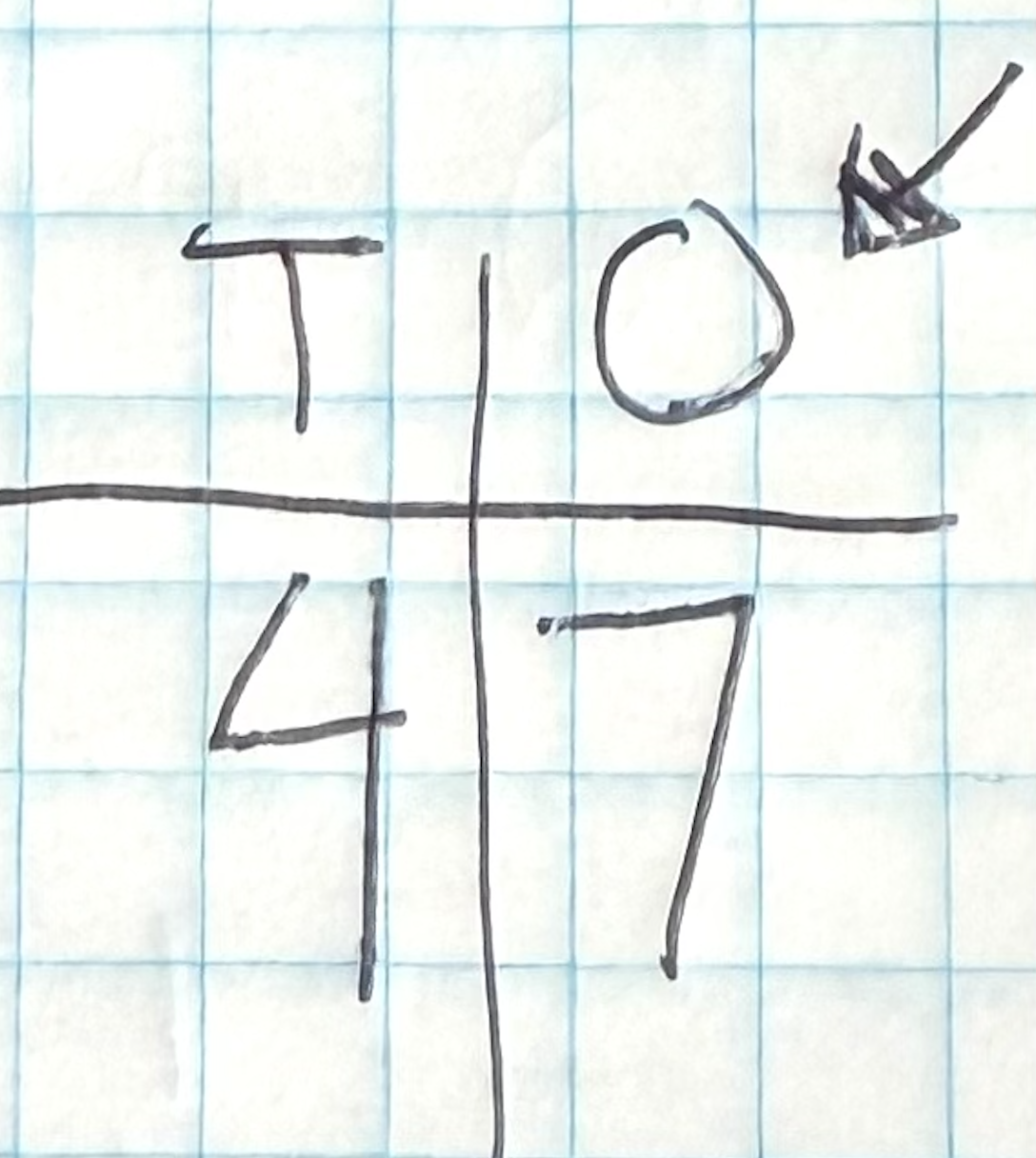
• Check the one's place.
7
If the ones are larger than 5, round up to the next 10.

50
Let's Try:

44
• The one's place is less than 5, and it goes down to zero.
40
We Do
• Try some examples:
62 31 26 84 17 23
• Check out our CarTalk Tennis Game
I DO
• Model how to estimate or round a number to the nearest 100, using:

247
• Now, you check the ten's place.
4
It's less than 5, so you would round down to

200
We Do
• Here are some examples to try:
532 470 256 608 928 761
• Check out our CarTalk Tennis Game
Challenge
• Have them estimate to solve this word problem:
"Luna and Charlie want to buy a $43 lamp and a table for $89. They have $100 to spend. Do they have enough money for both items?"
• You can change the numbers and try this word problem again and again.
• Try checking the exact answers using mental math and see how close your estimates are.
M4
Word Problems
I can answer word problems that use multiplication and division.
OA.3.1 · OA.3.2 · OA.3.3
Skill 1 — Multiplication
I DO:
• Model how to solve this word problem using circles and dots:
4 chaperones take a class to the aquarium. Each one supervises 5 students. How many students are in the class?
• Represent with 4 circles with 5 dots inside each. You can count out the dots to show and count the circles by 5 to show that this is represented by: 4 × 5 = 20


• You can use Math 1 Skip Counting for future problems and practice counting by 3s, 4s, 6s, 7s, 8s, and 9s.
We DO:
• Use this same problem frame and switch the numbers around a few times until they get used to it.
6 chaperones take a class to the aquarium. Each one supervises 7 students. How many students are in the class?
• Represent with 6 circles with 7 dots inside each.
• You can count out the dots to show and count the circles by 5 to show that this is represented by: 6 × 7 = 42
• You can use Math 1 Skip Counting for future problems and practice counting by 3s, 4s, 6s, 7s, 8s, and 9s.

Skill 2 — Division Problems
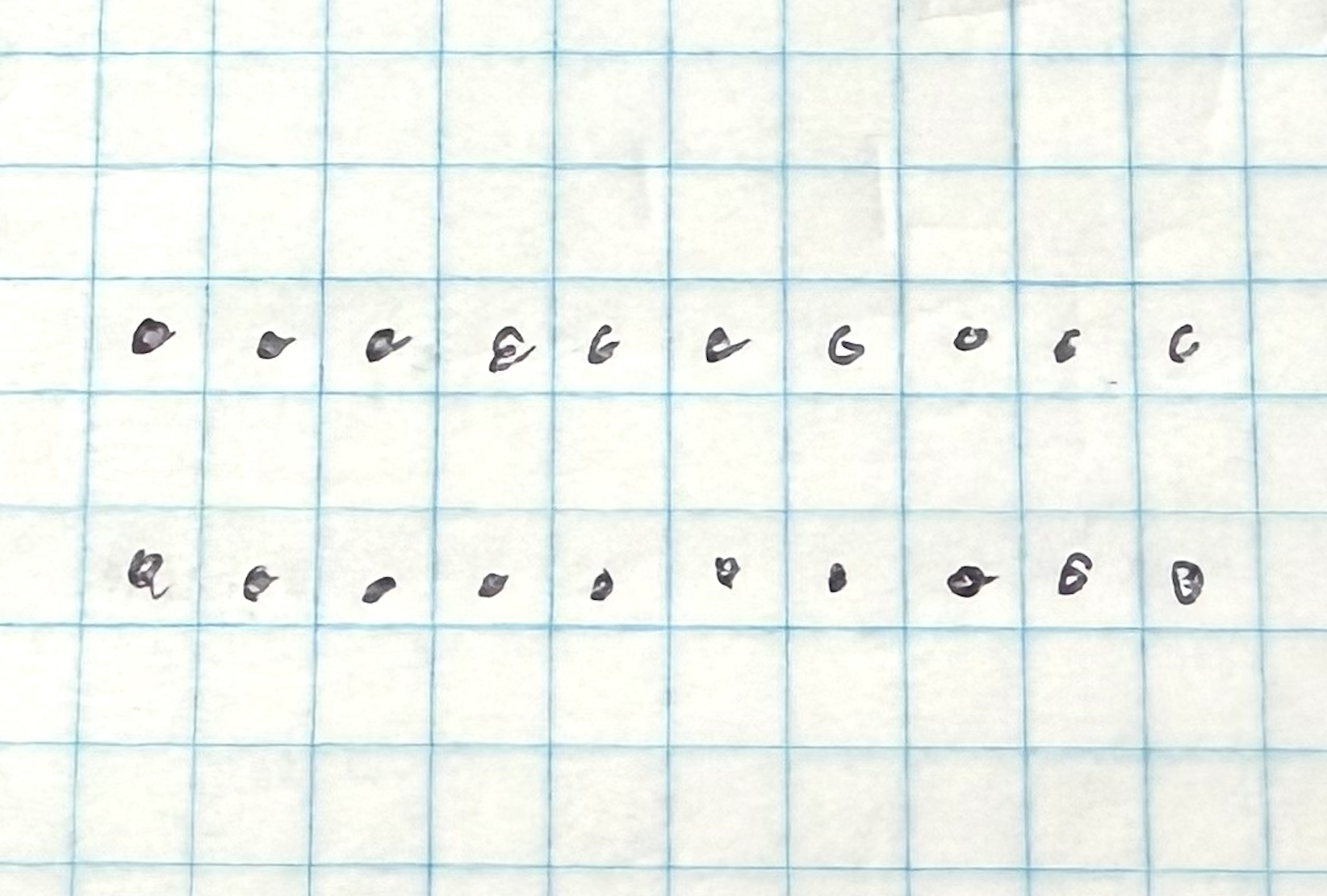
• Model how to solve this word problem using circles and dots in reverse:
A class of 20 students plans a field trip. They must provide a chaperone for every 5 students. How many chaperones are needed for the field trip?
• Draw 20 dots and circle groups of 5. Count how many circles you have.
• This is the same as counting by 5 on your fingers until you reach 20.
20 ÷ 5 = 4

We Do:
• Prompt them to try this one:
A class of 30 students plans a field trip. They must provide a chaperone for every 10 students. How many chaperones are needed for the field trip?
• Make more questions like these to practice. They can decide to use circles and dots or the skip counting on their fingers to answer.
M5
Properties of Multiplication and Division
I can use special rules to help me with multiplication and division problems.
OA.3.5 · NBT.3.2
Skill 1 — Number Bonds / Fact Families
• The Commutative Property, which they may have seen with adding and subtracting, applies to multiplication and division facts as well. If you know that 2×3=6, then you know 3×2=6 (picture on card).
• These three numbers (2, 3 and 6) have a number bond (or fact family).

• See if they can name the fact family for 4×2.
• Play tennis with these until they get comfortable and it's automatic.
Skill 2 — The Zero Trick
• Another trick we use when multiplying large number estimates is with zeroes.
• Model with the example:
4 × 5 = 20
• Add a 0 to each side of the equation:
4 × 50 = 200

• Check by adding: 50 + 50 + 50 + 50 = 200.
• Explain the rule: if you add a zero to a number on one side of the equation, you need to add one to the other.
• Try a few more up to the thousands place.
What's 4 × 5,000 = ?
We Do:
3×70= 8×60= 8×90= 5×200= 7×400= 100×200=
Skill 3 — Distributive Property

The Distributive Property lets us break apart numbers in new ways.
We know that A × (B + C) = (A × B) + (A × C)
• Model this with simple numbers first:
2 × (3+1) = 2×4 = 8
2×3 + 2×1 = 6+2 = 8
• This comes in handy as you try to multiply numbers like:
4 × 17 = 4 × (10 + 7)
(4×10)+(4×7) is not hard to figure out
40+28 = 68
• Play tennis with other problems that multiply a number in the teens using this method.
M6
More Complex Word Problems
I can identify what the word problem is asking of me and solve it.
OA.3.4 · OA.3.6 · OA.3.8
Skill 1 — Missing Number
• Model how to find the missing number in the problem below.
A family takes a trip to Grandma's. Their car travels 4 miles on one gallon of gas. The tank has G gallons at the start of the trip. It is empty after 28 miles. How many gallons did they have to start?

• Identify this as a missing number problem and that:
4 × G = 28
• Draw 28 dots for total miles traveled.
• Divide the dots into circles of 4 (miles traveled on one gallon).
• Count the groups to find G=7.
• Remind them that 4×G=28 is the same fact family as 28 ÷ 4 = G

We Do
• Try this same problem again with different numbers:
The car travels 8 miles on one gallon of gas. The tank has G gallons at the start of the trip. It is empty after 48 miles. How many gallons did they have to start?
• Make more problems like these using different situations and different letter variables.
Skill 2 — Two-Step Problems
• In 3rd grade, your student will begin state testing and face tricky two-step problems.
• Model how to slowly think aloud to identify what to do with this problem:
6 students share 3 boxes of crayons. There are 12 crayons in each box. The crayons are distributed equally among the 6 students. How many crayons will each student get?

• You must first find the total number of crayons:
12 × 3 = 36

• (You can use dots for each crayon and make three groups of 12 on card.)
• Then divide the total number into 6 groups:
36 ÷ 6 = 6

We Do:
• Try prompting them through this same problem again with different numbers:
4 groups of students share 2 boxes of crayons. There are 10 crayons in each box. The crayons are distributed equally among the 4 groups. How many crayons will each group get?
• This will take continued practice mixing adding, subtracting, multiplication and division.
• Check out our “Problem of the Month” on the website.
M7
Fractions
I understand how fractions work and can compare them.
NF.3.1 · NF.3.2 · NF.3.3
Skill 1 — Concept of a Fraction
3rd grade introduces your child to the strategy of representing fractions in simple pictures.
• Model the parts of a fraction using 1/4 (pointing to a picture on card).
• The bottom number in a fraction, the denominator, is the total number of parts.
• The top number in a fraction, the numerator, is the part of the whole (shaded).

• Model how to draw another fraction pizza with a circle.
• Divide it into 2 equal parts. Label each ½ inside.
• Color one part and say ½, then color the 2nd part and say 2/2.
• This is one whole.
We Do:
• Prompt your student to draw more circles and divide them equally into 2, 3, 4 and 6 parts.
• Color different numbers of parts to create as many fractions as possible.
• You can show them ⅔, 4/6, ¾.
• You can color them all in and show them 2/2=3/3=4/4=1 whole.
Skill 2 — Comparing Fractions
This skill uses number lines between 0 and 1 to compare fractions.

• Show on the red number line how it's divided into 5 parts.
• Point out how the numerator changes as you move toward 1 whole, while the denominator stays the same.
• Show this again on the green number line, which is divided into 3 parts.
• Note the difference: a smaller denominator equals a bigger part.
• Point to different fractions from each number line, like ⅖ and ⅓.
• Compare them with the symbols <, >, = in the notebook.
⅖ > 1/3 (The alligator eats the bigger number)
We Do:
• Guide them to create a number line using a ruler and a graph paper page in the notebook.
• Label the ends 0 and 1.
• Measure 4 equal parts either with the ruler or by counting the squares on the graph paper.
• Label the parts with the correct fraction.
• Create a 2nd number line with a different denominator and compare fractions with < and >.
Skill 3 — Equivalent Fractions

• Comparing fraction number lines will also provide the opportunity to introduce equivalent fractions.
• Create and compare number lines of 4/4 and 2/2.

• Point out that at the point 2/4 is the same place as ½.
• Show this comparison with these two pizzas as well.
We Do:
• Try to find more fraction equivalents of ½ using pizzas or rectangles if circles are too difficult:
1/2 = 2/4 = 3/6 = 4/8 = 5/10
• Next, work together to find equivalents either using the rectangles or number lines for 2/3:
4/6 = 6/9 = 8/12
• Point out as you write these equivalent fractions next to each other horizontally, they show skip counting patterns on both the top and bottom. This is a useful shortcut!
• Try this shortcut for:
3/4 = 6/8 = 9/12 = 12/16
One whole can be equivalent in many ways: 3/3 or 137/137.
M8
Area Modeling
I can count equal square units or use multiplication to find the area of a rectangle.
MD.3.5 · MD.3.6 · MD.3.7
Skill 1 — The Concept of Area
I Do:

• Confirm they understand that area is the space covered by the shape. It is useful when choosing the right carpet for a room. We measure this with square units like square feet or square meters.
• Model using the grid inside this rectangle to count 6 square cm long and 4 square cm wide.
• Remind them of how to skip count by 6 four times: 6, 12, 18, 24.
• Ask them to count the actual squares inside to make sure. 24 square cm.

We Do:
• Draw a square on the notebook and have them count the width and length in units of your choice.
• Have them skip count to find the area in "square" units.
• Repeat until this is automatic.
Skill 2 — Area = Length × Width
I Do:
• Model how this formula can make things easier using Length (6) × Width (4) = Area (24).
• Using the previous rectangles you drew, you can apply the formula and recalculate.
• Try making larger rectangles that they wouldn't want to count and see if they can multiply (like 9×8 or 10×7).
Challenge
• After covering Math 5 Properties of Multiplication and Division, show how they can apply the Distributive Property to problems of finding areas with two-digit lengths.
• They can find the area of a rectangle that is 4 × 12 by splitting this into 4 × (10 + 2).
• Multiply: 4 × 10 = 40 and 4 × 2 = 8.
• Add the results: 40 + 8 = 48.
• Try more: 5 × 18, 6 × 14, 5 × 28, 8 × 12.
M9
Elapsed Time Modeling
I can use time intervals on a number line to answer word problems about when something happened.
MD.3.1
Skill — Solving Elapsed Time Word Problems
In 3rd grade, your student will be challenged to solve word problems involving elapsed time and use a timeline.
I DO:
• Review units of time before you start. Point out that at 60 minutes it moves to the next hour.

• Model how to use the timeline to solve the following problem:

John leaves school at 3:15 pm and talks to friends for 15 minutes. He walks 10 minutes to a soccer practice that lasts 45 minutes. He then has to wait 5 minutes for his dad to come. What time will John's Dad arrive?
• Point to 3:15 on the timeline and move 15 minutes ahead for talking with friends (3:30).
• Then move 10 minutes to walk (3:40) and 45 minutes for practice (4:25).
• Last, move 5 more minutes to wait, and his dad comes at 4:30pm.

We Do:
• Use the graph paper notebook to draw a new timeline for this problem:
The trip from San Diego to Los Angeles takes 45 minutes. The train leaves the station at 12:45 pm. It will make a 10 minute stop in Irvine. When will the train arrive in LA?
• Prompt them through and make another timeline.
Challenge: You can create problems where you know the arrival time and ask when it must depart.
M10
Mass and Volume
I can use mass and volume measurements and understand what would be reasonable.
MD.3.2
Prompt — What Is the Difference Between a Balloon and a Bowling Ball?


• Mass is the amount of matter an object contains, which gets pulled down by gravity to make something "heavy."
• Practice remembering units from heaviest to lightest: tons, kilograms, pounds.
• Volume is how much space an object occupies.
• Practice units as liquid volume (liter, gallon) and as spatial (cubic meters, cubic inches).
• A balloon can take up lots of space but does not have much mass, while a bowling ball has a high mass.
• What are things that have a high mass and low volume?
• Ask questions like which has a higher volume, your car or your classroom?
• Talk about how many pounds they were when they were born and how they have grown.
Challenge
• Guess the mass or volume of something specific and then measure or look it up to see how close you can get.
M11
Perimeter
I can find the perimeter of any shape.
MD.3.8
Skill — Finding Perimeter
In 3rd grade, your child will explore how to find the perimeter of shapes.
I DO
• Model finding the perimeter of the triangle on the card by adding the lengths of its sides.
• Add the sides of this triangle: 9ft + 9ft + 9ft = 27ft.

We Do:
• Have them try to find the perimeter of the diamond on the card.
• Use the notebook to draw rectangles, hexagons, pentagons, and irregular shapes with more sides and continue practicing.
• This is a good opportunity to review shape names.
M12
Shapes
I can identify and classify quadrilaterals, and understand what makes a shape symmetrical.
G.3.1 · G.3.2
Prompt 1 — Quadrilaterals

• Use the image to discuss the differences among the following types of quadrilaterals: Trapezoid, Square, Rectangle, Rhombus, Quadrilateral.
• Discuss how to identify each of these shapes using obtuse (wide), acute (narrow) and right (90 degree) angles and side lengths.
All squares are rectangles. All rectangles are quadrilaterals.
What makes a Rhombus or diamond shape different?
Which shapes can only be named as quadrilaterals?
Prompt 2 — Symmetry

• Discuss how symmetry is when a shape is a perfect "mirror image" of itself on both sides.
• Point to the different shapes and how they have been divided on lines of symmetry in green lines.
• Have them explain why the red lines are not lines of symmetry.
• See if they can trace their own lines of symmetry with their fingers on the remaining shapes on the card.
Language Habits
Select a learning target below. Prepare before you hand the companion card to your student and give it a try.
 L1
L1
Longer Words
I can read longer words with 3 or more syllables.
RF.3.3
Skill 1 — Open and Closed Syllables
This standard focuses on your child's ability to read and write complex words by breaking them into parts called syllables.

• Start with
remember
• Have them clap each syllable and go slowly as they write it out.
The syllable re/ is called “open” as it ends in a vowel which makes it long, while /mem/ and /ber/ the vowels are closed off by consonants.
Often as we clap out a word we notice “open syllables” and know to read them as long vowels.
o/pen, A/pril

Skill 2 — Common Irregular Syllables
• Give them the card to practice spelling common syllables to know:

• Use words like:
reaction, hopefully, sensitive, imagination
• Clap as you say each syllable with your child and remind them to spell each syllable slowly.
• You can have them add a slash between each syllable as they write:
help/er ac/tion kind/ness
L2
Sightwords
My list of sightwords I can spell continues to grow.
RF.3.3
Skill — Growing the Sight Word List
Discuss how “sight words” don't follow the letter and sound rules and that you will need to memorize. These words will help you to move into writing full sentences.
• Find the first word on this list they misspell. If it's easy, medium or hard, then click here to find more words to practice.
• Introduce three words a week over time and always spiral back to practice previous ones.
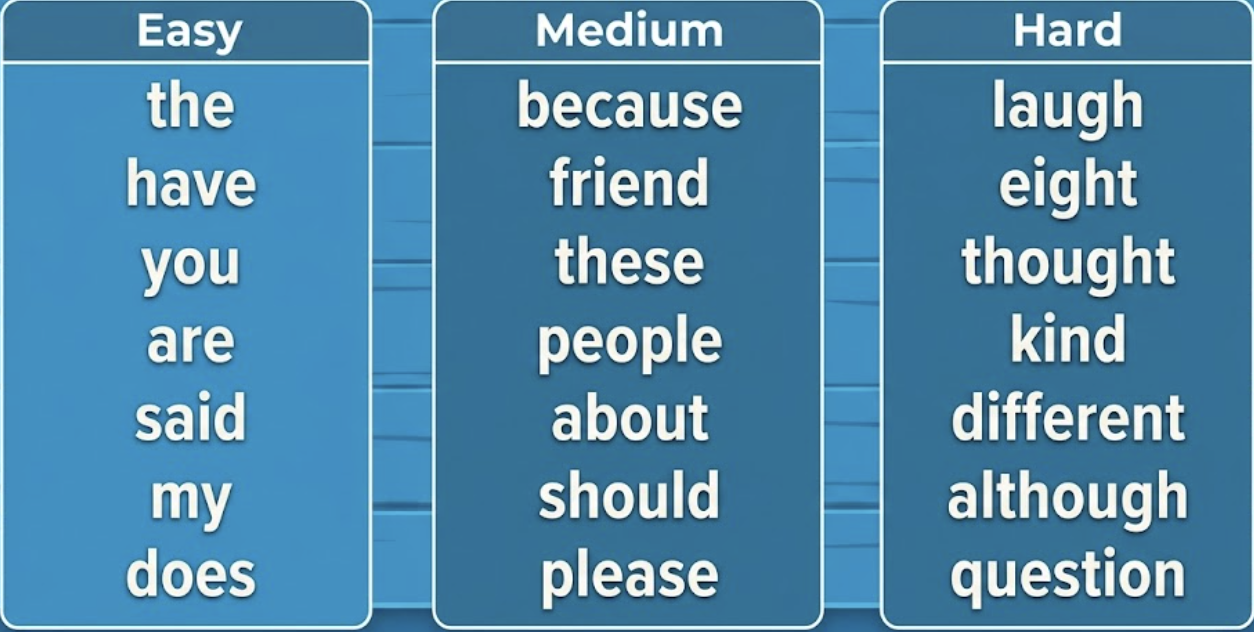
• If you think of more or you spot one while reading, add it to this rotation.
• Your teachers may call these “Red words” and already provide you with a weekly list.
 L3
L3
Fluency
I can read at least 130 words per minute and read inside my mind.
RF.3.4a · RF.3.4b
Skill 1 — Building Independent Reading
By 3rd grade, developing a Reading Time Routine is critical. It can be pretty independent, as they should be able to read on their own.
Fluency is your student’s ability to read words without pausing to decode the letters and sounds. This allows them to “listen” to the story as they read it. A big signal that they are reaching this level is their ability to read silently. Try our Fluency Coach.
• It's important to give the primary responsibility of reading during StoryTime to your student.
• You can put your finger on each word as you listen to them read.
• As the story develops, stop and think aloud about the story, the characters and the illustrations.
• Model how to make the characters' voices and personalities come alive as you read.
• Try some sessions where they read quietly, and you check in with them and ask the same questions periodically.
• Read to them when you see they are getting tired or for special occasions.
Skill 2 — Timing Words Per Minute
In 3rd grade, the goal is for your student to read a grade level book at 130 wpm.
• When your student seems ready, maybe in the winter or spring, try using a timer to have them read a story and count the words they read in one minute.
• You can also use the passage below. Cut and paste this into a document and print two copies. You can use one to mark off where they finished with a pencil and cross out any words they misread.
• Put this word count number in the box for the L3 card in your notebook to track your progress!
The Secret of the Lighthouse
Maya stood on the breezy cliff, watching the dark waves crash against the rocks below. Her grandfather had been the lighthouse keeper for thirty years, but today was the first time he had invited her inside. She followed him up the winding spiral staircase, her shoes clicking softly on the cold iron steps. (44 words)
When they reached the top room, Maya gasped. Bright sunlight streamed through the massive glass windows, reflecting off a huge, polished brass lens. "This is a Fresnel lens," her grandfather explained proudly. "It can send a beam of light miles out to sea, guiding ships safely through heavy fog and violent storms." (105 words)
Maya peered through the glass at a distant boat tossing on the blue water. She realized that keeping the light bright was an important job that saved many lives. (134 words)
L4
Clarify
I stop when I am confused in a story, and use the other words as clues or look for figurative language to follow what is happening.
RF.3.4
Skill 1 — Context Clues
As they read, hold your finger to each word and observe your child for any sign of confusion or stumble in pronunciation. In 3rd grade they will be introduced to many more new content-specific words and jargon in informational text and figurative language in narratives. When a confusion arises, ask them to stop reading and use one of the following strategies:

• Look for clues in other words in the sentence or any pictures.

Skill 2 — Figurative Language
If you spot figurative language, stop to point it out and gauge if your student understands the inferred meaning. Often in 3rd grade they are looking only for literal meaning. Try to help them identify if it's a simile or metaphor.
Similes compare two concepts with like or as:
My bed feels as soft as a cloud.
Metaphors use unrelated words together to bring out a new meaning:
The party went by in the blink of an eye.
Skill 3 — Root Words
You can use CarTalk to play tennis and brainstorm metaphors and similes in everyday interactions.
• Look for clues in the word, its root or any suffix, prefix.
astronomer = If I know the root astro means stars, then I can guess that an astronomer is someone who focuses on stars.
• If interested, your student can create a picture dictionary in their notebook to gather these new words and definitions.
L5
Retell
I am able to summarize a text in my own words and pull out the author's main idea or lesson.
RL.3.2 · RI.3.2 · RI.3.3
Skill 1 — Summarize
As part of the Reading routine, it's important to take an opportunity to stop and reflect after each chapter you read. In 3rd grade, you should mix history and science nonfiction books in with the fictional chapter books. There are some great book ideas here.
• After reading a chapter, model to your student how to retell the main points on who the characters were and what happened in your own words.
• Try having them summarize the next chapter and you can take turns as you complete the book.
• HINT: Have them use their notebook to draw a picture or series of pictures (comic) to summarize each chapter, and include a few sentences. This will help with Skills 2 and 3.

Skill 2 — Identifying Cause and Effect

Look through the story you are reading to find an event, scientific concept or plot development that shows cause and effect, stop and point it out. Here are some hypothetical examples:
Frost hits a village each year in November, so they have created traditions around harvesting and storing food to ensure they have food over the winter.
[The main character] in the story is feeling anxious, so they decide [not to act in a situation] in the story and [lose an opportunity to get their goal].
Skill 3 — Identifying the Main Idea or Moral
Fable Generator button
After completing the novel or nonfiction book, look back over the pages of the book (and possibly the comic strips they have drawn) to reflect on the main idea.
• If the book is nonfiction, look back at the subheadings and illustrations/charts, and reflect on any underlying message (i.e. humans should protect the environment).
• If you have finished a novel, reflect on how the problem was resolved.
Did the characters learn and grow?
Was there a lesson the author wanted us to learn?
L6
Ask and Answer Questions
I can use the text to find answers and develop opinions through Socratic Dialogue.
RL.3.1 · RI.3.1
Skill 1 — Questions That Find the Answer
As part of the Reading routine, mix history and science nonfiction books in with the chapter books.
• Model asking a question and finding the answer in the story.
What did Mr. Dursley say when the letters started coming in the fireplace?
• Point to the exact line.
He said, "No Post on Sundays!" on page 34.
• Practice with Who, What and Where questions that are easier to answer.
• Let them ask you a question and you show them how you find the answer in the book.
• Play Tennis
Skill 2 — Questions That Develop an Opinion
• Model and think aloud how to answer How and Why questions such as:
How did [the character] feel after [the event] happened?
How did they [solve the problem] in the story?
Why do you think [they] did [that]?
• You can focus on discussing one good why or how question.
• Have a Socratic Chat!
• After they finish a chapter book, they can develop a quiz in their notebook.
• Have them craft questions that go from easy (skill 1) to hard (skill 2).
• Over the course of the year, it is important to mix in nonfiction (science and history) texts. Click here for some resources to help you find good topics and questions.
Which invention do you feel was the most helpful to people of that time?
Do you agree with how the people solved the problem they faced?
Why did so many pioneers in America go west?
L7
Character Study
I can chart how characters grow and change, and make personal connections to their experiences.
RL.3.3 · RL.3.5 · RL.3.7 · RL.3.10
Skill 1 — Charting a Character's Development
As part of the Reading routine, take an opportunity for a deeper investigation of the characters and how they react and evolve to the events in the story. This is the time to pull out the book you remember, or a classic you have always wanted to read together. There are some great book ideas for this click here. Begin this card after you have completed a few chapters and have gotten into the flow.
I DO

• Model how to identify an important event early in the story that changes the character in some way. For example:
When Harry Potter got the first invitation to Hogwarts from Hagrid.
When Opal goes to the grocery store for her father and comes home with a messy, stray dog she names Winn-Dixie.
When Wilbur is sold to the Zuckerman farm and moved to a new barn away from his original owner, Fern.
WE DO
• In the notebook, work together to create a picture timeline for the character, with sentence captions, as they face the central problem and the events that develop them towards the solution.
• If you want extra practice, use these comic timelines to chart characters' journeys through scenes from a movie or acts of a play.
Skill 2 — Making Connections
I DO
• As you read the story, model how to identify moments when you connect how a character acts or feels in a story to your own experiences and feelings.
I remember my first day of school. I was nervous and didn't want to stand out. I could see why she did that…
We Do
• Prompt them to stop reading at any description that mirrors a similar moment in your child's life and ask them if they want to make a connection.
• Throughout the book, celebrate anytime your student can make a connection on their own with the characters.
Think back to all the books you have read together, which character do you most connect with?
• Have a Socratic Chat!
Skill 3 — The Narrator's Voice
In 3rd grade, they will begin to explore stories where the narrator shares a clearer perspective on the events.
• As you read some books, you may find the narrator jumps from chapter to chapter “inside” different characters' minds.
In others, like Tales of a Fourth Grade Nothing by Judy Blume, you find the narrator is a 9-year-old named Peter.
• It's important to point out the difference between 1st person (I did) and 3rd person (They did) and explore books written from both.
• A great exercise to try is to have your child try to retell an event in the story from another character's point of view.
• Don't forget to use the book quiz.
L8
Expanding Sentences
I can write sentences like I read in books, using descriptive language and combining sentences.
L.3.1 · L.3.1e · L.3.1h · L.3.1b
Skill 1 — Descriptive Language

Use the card with a chart of the difference between adjectives and adverbs.
• Generate a few more of each together to see if they are on the right track:
Adjectives describe nouns.
Small, shiny, sleepy, green…
Adverbs describe verbs.
Quickly, softly, loudly…
I DO
• Model how you can use adjectives and adverbs to enhance a boring sentence like:

The boy walked into the house.
The terrified boy slowly walked into the spooky old house.
WE DO
• Give them simple sentences and have them write them first, and circle the nouns and underline the verbs.
• Then ask them to rewrite them adding adjectives and adverbs to enhance.
I DO
• There is also a 3rd grade standard around using comparisons with adjectives and adverbs.
• Model for them how you can go from happy to happier to happiest.
We DO
• Have them try to turn Slow into slower and slowest.
• Use some other examples.
• Try challenging them to use these to enhance more simple sentences.
Skill 2 — Compound Sentences, Complex Sentences and Connecting Words
In third grade, they will be asked to combine and extend their sentences with commas. Start by modeling the difference between compound and complex sentences:
I DO
• A compound sentence combines two full sentences using and, but, or.
John was happy, but Joe was sad.
• A complex sentence combines a sentence with a “clause” which uses words like because, when, if, while.
While walking, the giant shook the ground.
We Do
• Use Listen and Write to mix practice with these two types of sentences and have them identify if it's a complex or compound sentence.
• Try giving them two separate sentences and have them combine using the correct connecting word.
• HINT: Keep an eye out for “run on” sentences in any of their writing activity, as they may try to combine more than two sentences or clauses while learning this.
L9
Writing Dialogue
I can use quotation marks to show when people are speaking in my story.
L.3.2c · W.3.3b
Skill — Punctuating Dialogue
3rd grade is when your student is asked to master writing dialogue. It's important to mix sentences with quotation marks into all your Listen and Write sessions.
• Here are some examples you can use:

"Discuss this with Carlos first," she said.
"So what?" he mumbled.
The boy shouted, "Look for the bouncing ball!"
"This is your stop," the conductor informed us.
"I'm coming," Ella added, "wait for me, please."
• As they are writing ELA projects and other assignments, challenge them to include dialogue when possible to help them build out their descriptions.
L10
Polishing Grammar
I can write at the 3rd grade level.
L.3.1c · L.3.1d · L.3.2
Skill 1 — Mastering Capitalization
3rd grade marks the final time the standards will touch on capitalization rules. It's important for you to use Listen and Write to practice all possible situations:
• First letter in a sentence
• Names of people, places (cities, countries, names of parks)
• Months, days of the week, holidays
• Product names (Coke, Nike)
• The first word inside the quotation in a dialogue sentence
• Titles of books, movies, plays, video games
You may try examples like:
Mary and Ryan watched Toy Story 5 on Tuesday at the Cinemark Theater in Boston.
In July, France celebrates Bastille Day in Paris with fireworks.
Skill 2 — Irregular Plurals and Past Tense Verbs
By the end of 3rd grade, it's expected that your child knows all the most common irregular word patterns. The two biggest are irregular plurals and irregular past tense verbs.

• Use Listen and Write as a way to test these by saying the sentence and asking either to make the noun plural or the sentence past tense.
• HINT: Listen to your child as they speak to spot any of these irregular words being mistaken verbally and correct. You can make a note to try them at the next Listen and Write.
Skill 3 — Plural Possessives
I DO
• Model the differences in the placement of the apostrophe for singular and plural when there is possession:
teacher's, dog's, teachers', dogs'

• Review possessive pronouns mine, yours, his, hers, ours, theirs.
• Mix sentences between singular and plural like:
Our school's calendar starts on Monday.
Is this book mine or theirs?
Their home is next to the library's entrance.
The 3rd grade students' pencils have all been ordered this year.
• Give them sentences with proper nouns and have them replace with pronouns:
Jane used Peter's notebook. She used his notebook.
L11
Vocabulary
I continue to expand my vocabulary both in speaking and in writing.
L.3.4 · L.3.2d · RI.3.4 · RF.3.3
Prompt 1 — Expanding a Toolbox of Prefixes and Suffixes
3rd graders are asked to recognize prefixes and suffixes in increasingly more complex texts.
• Use CarTalk to go over lists of prefixes and suffixes and have them guess their meaning:

• Have them try to list as many words they know for each:
• Interdistrict, interdepartment
• Dehydrate, defang, defy
• Creative, active, inquisitive
• Action, creation, inquisition
Prompt 2 — Word Choice
Discuss how to build strategies for making appropriate word choices to communicate different shades of meaning.
• Have them compare and discuss the difference between:

• running and sprinting
• looking and staring
• cozy and safe
• Have them give you pairs of similar words for you to distinguish.
• Play a game of tennis where each player must choose a new word to build on the previous person's sentence, for example:
There are many choices of desserts.
There are countless choices of desserts.
The choices of desserts are innumerable.
• You can also play where one person says a sentence and the other adds multiple words to fully enrich the sentence back.
I want some ice cream.
My tastebuds yearn for the sweet embrace of vanilla.
• Always celebrate when your child comes up with the perfect word in any conversation or writing activity!
Prompt 3 — Abstract Ideas
3rd graders are exposed to many more nouns that are not really a person, place or thing. They are abstract concepts that can't be touched, heard, smelled or tasted.
• Use CarTalk to list and discuss these types of abstract nouns:
• Friendship
• Knowledge
• Freedom
• Childhood
• Kindness
• Democracy
• Capitalism
• When you see them in a story or hear them in the world, call them out and add them to the next discussion.
Projects
Each project breaks into lettered cards (A, B, C...) instead of numbered skills — open a project, then work through its cards in order.
 P1
P1
My Biography
Write a life story that includes accounts of vivid description and dialogue of real memories and includes a creative, "fictional" future.
L.3.2c · L.3.4 · W.3.9 · W.3.3
Card A — The Timeline
Prompt 1: Looking back at your whole life, let's pick the top 5 most significant events.
• Guide them to think of their life in chapters (baby, toddler, school, past year) and choose one from each.
• Discuss why they chose the event and see if/how it changed them as a person.
Notebook follow up
• Model how to build a timeline using years as units and summarize each event with a brief description of who was involved, what happened, and important things that were said.
Prompt 2: What will happen to humanity by the time they are in their 80s.
• Guide them to think what they might do within this vision, from 6th grader to grandparent.
Will they live on Mars? Will they save the rainforest?
Notebook follow up
• Have them return to their timeline and extend it or draw one beneath.
• Add "future" bubbles for when they are in high school, college and stages of adulthood.
• Use the same format of who, what and important discussions in this future world.
Card B — Drafting & Dialogue
Lionel Messi: The Soccer Star
Lionel Messi was born on June 24, 1987, in a city called Rosario, Argentina. From the time he was a very little boy, he loved playing soccer more than anything else. He played with his brothers and cousins, and he was so good that people noticed his talent right away. Even as a child, he could dribble the ball better than kids much older than him.
When Lionel was eleven years old, he faced a very big challenge. Doctors found out that he had a growth problem, which meant he would have a hard time growing as tall as his friends. His family did not have enough money to pay for the special medicine he needed to help him grow. He almost had to stop playing the game he loved so much, but he did not lose hope that he could still become a great player.
Everything changed when a team in Spain called FC Barcelona heard about how talented he was. They offered to help pay for his medical treatments if he moved to Spain to play for their youth team. Lionel moved far away from home at a young age to follow his dream. He worked very hard every single day, showing everyone that he could be a star even if he was smaller than the other players.
Soon, Lionel Messi became one of the most famous soccer players in the entire world. He became known for his amazing speed, his smart passes, and his ability to score beautiful goals. He played for Barcelona for many years and won many trophies, including the Ballon d'Or, which is given to the best player in the world. He even led his home country, Argentina, to win the World Cup in 2022, which was a huge dream come true for him.
Today, Lionel Messi is a hero to millions of people. He teaches us that even when things are difficult, you should not give up on your dreams. Because he kept working hard and believed in himself, he was able to find something truly special in his life. He is remembered not just for being a great soccer player, but for showing the world that you can achieve big things if you keep trying.
I DO
• Using the biography exemplar on the website, point out how it's organized sequentially. The author begins with birth location and setting the scene and creates subtopics or chapters for each stage of their life.
We DO
• Return to the timeline bubbles, and guide them to turn these into sentences and paragraphs.
• They can decide if they want to write this in the 1st person (autobiography) or in the 3rd person (biography).
• Develop the future paragraphs with descriptions of fictional settings, people and events.
• Prompt them to find a larger theme to their life story. This can be really fun!
• In 3rd grade, there is a clear focus on using Dialogue.
Make sure to find points in the timeline that include important moments where key things were spoken. Maybe it was advice or even an argument.
It's ok if they don't remember word for word. What's important is using dialogue to help bring the reader to the experience.
Help them use these quotations with the proper grammatical marks to show exactly what people said during those big memories.
Here is how adding dialogue to Messi's medical challenge helps deepen the reader's understanding:
His family did not have enough money to pay for the special medicine he needed to help him grow. He sat on the edge of his bed one night and whispered to his mom, "What if I can't be a soccer player because I'm too small?" His mom hugged him and said, "Don't lose hope, Leo. You have a special gift, and we will find a way."

Card C — Editing for Publication
We Do:
• Read the draft out loud together, looking for areas of confusion.
"Run on sentences" use too many clauses and commas.
"Sentence fragments" are incomplete.
• Make sure each paragraph is sequenced and contains all the elements from the timeline.
How does the dialogue element fit?
Does the future paragraph match the style of the past?
• If your student is ready, see if they can vary sentences to make the flow more interesting. Celebrate the "juicy words" they used in their descriptions and point out areas where they could use more.
• Decide how they want to "publish" this story.
• Have them create a paper book with a table of contents listing subtopics and adding illustrations.
• Guide them to create a word document:
• Choose fonts and titles
• Upload photos and images
P2
Fractions and Survey Data
Use family surveys to understand elements of fractions and how to use data.
NF.3.1 · NF.3.2 · NF.3.3 · G.3.2 · MD.3.3
Card A — Brainstorming
• Introduce the idea of a survey using an example.
• Discuss how the blue and orange show which are the most popular (roller coaster) and which are the least (broccoli).
• Come up with a list of 8 simple "Yes/No" questions like these.
• Decide on 10 people to survey.
Notebook follow up:
• Write the list of questions and potential survey participants down.
Card B — Gathering Data
Tech Tools: Model how to use a Google Forms
• Open and title the file
• Create new questions as "multiple choice"
• Write the questions and add answer options as yes and no
• Send out the survey by text or email to participants
Non Tech Tools: Model how to use their notebook as a tally chart
• Divide the pages up into 10 boxes and write each question
• Divide the boxes in half and write Yes and No in each
• Interview participants and capture their responses in their notebook
• HINT: Have your child try a hybrid of both strategies and discuss which they prefer:
Talking to participants?
The ease of emailing and getting back responses already organized?
Card C — Analyzing the Results
WE DO
• Review the Math 7 Fractions card and:
• Model how to review responses of yes and no and turn them into fractions. For example, 6 out of 10 saying yes would be 6/10.
• Guide them to draw "pizza" pictures or number lines for each of these fractional amounts and find fractions that are equivalent (6/10 = ⅗).
• If there are any questions that are 10/10, remind them that this is the same as 1 whole or 100%.
I DO
• Model for your child how to use the graph paper to outline horizontal bars 2 squares tall and 10 squares long.
• Shade the number of yes responses in columns horizontally across the bar. For example, 6/10 would have 6 columns shaded and 4 empty in the bar.
WE DO:
• Have them complete bars for each question, they can use colors if desired.
• Rank the questions in order from greatest to least amount of yes responses.
• Ask more questions that compare fractions using <,>,=
• TECH TOOLS : If using Google Forms, model how to check your data charting against the "response summaries" it gives.
P3
Research Report (inferred title — see note)
Research a topic, organize facts into body paragraphs with cited sources, and present findings to an audience.
—
Missing from Source
Heads up: This project's title, goal, standards, and Cards A & B are missing entirely from the live page — the section jumps straight from Project 2 into what is clearly the middle of a research-report project (an outline structure and a presentation card). The title and goal above are my best inference from the content that is present, not text found on the page. Card B is referenced ("images gathered on card B") but its actual content isn't on the page anywhere. You'll want to check whether this content simply didn't render, or whether Cards A and B need to be written.
Card C — Organizing & Drafting the Outline
Part 1: The Introduction (The Hook & The Plan)
• The Hook
• The Subtopics Summary
Part 2: The Body Paragraphs (The Evidence)
Use this chart to check each of your three body paragraphs.
Paragraph — My Own Words (3–4 sentences) — Sources to Cite
Body 1
Body 2
Body 3
Part 3: The Conclusion (The Wrap-Up)
• The Big Summary
• Final Thought: (Write one sentence that leaves the reader thinking about why your event was important)
We DO
• Work together to create an outline like this in their notebook, organizing their essay using their notes.
• Compare your sources and notes and choose the best facts to include.
• Allow them to draft the paragraphs on their own this time.
• Remind them to say the sentence to themselves before writing it.
• Remind them to look back at the exemplar to see how they build out the subtopic paragraphs and use quotations to cite the important facts.
• When ready, have them read their draft to you and stop them to rethink any places of confusion, where a citation is missing, or where more description could be added.
Card D — The Presentation
Non Tech Tools:
• Create a presentation poster, sketching sections first in pencil
• Have them draw their own charts/diagrams and summaries for each subtopic and attach them to the board
TechTools:
• Using Google Slides or PowerPoint, model for them how to create slides, using different fonts, inserting images, themes, and backgrounds
• Model how to use bullet points and reduce the wording to get across the main ideas on each slide
• Model how to cut and paste images gathered on card B to engage the audience and reinforce their presentation
We DO:
• Guide them to create flashcards to help them present this information to an audience.
• Practice presenting this with them. See if they can present without flashcards.
• Try scheduling a presentation for other family members or friends.
P4
Character Study in Book Series
Form and support an opinion piece to compare how characters grow and change in different books in a series.
W.3.1 · RL.3.5 · RL.3.2 · RL.3.7 · RL.3.3
Card A — Forming an Opinion (CarTalk)
IMPORTANT: This project requires your child to have read at least two editions of a book series during StoryTime.
Identify the recurring character (Harry Potter, Ramona Quimby, Jack and Annie, or Ms. Frizzle) that will be the focus of the study. Here are some prompt options you can use for the comparison:
Prompt A: Which book do you feel like Harry was the bravest?
Prompt B: Which book do you feel like Harry changed the most?
• Using Socratic dialogue (Listener/Advocate) develop their opinion.
• Use "clarify, consider, restate" to question.
• Use specific scenes in each story as evidence.
Notebook follow up:
• Have them draw a picture comparing the character engaged in an important event in each story.
• Have them write down their final opinion.
• Have them find supporting scenes in the story and record using this simple 3-paragraph outline format:
• Introduction — stating the argument
• Body — using scenes from the story to expand and support
• Conclusion — restating the argument and making connections to the world
Card B — Drafting with Details (Modeling)
I DO:
• Review the exemplar narrative "Harry's Bravest Moment" on the website and point out how they took their notes from each section of the graphic organizer and expanded it with description in complete sentences.
• Point out how the account slows down and describes the key moments in the story with Chapter citations.
We DO:
• Review their graphic organizer on their character and speak with them about how they want to expand these with description.
• Have them say the sentence to you first and then, when it sounds ready, let them write it down.
• Encourage your student to practice the "inventive" sound spelling and take risks in choosing new, more "scholarly" words in their writing.
• After a few sentences, have them practice saying it out loud to themselves before writing it down, and eventually fade into "You Do."
Card C — Revising & Publishing (Modeling)
We DO:
Reading over the two versions of the example essay, guide them by thinking out loud on how Essay 2 improved on Essay 1. Point out how it:
• Identifies and fixes mistakes and confusing parts
• Makes better word choices to express things more sharply
• Expands description of supporting scenes to better convince the reader
• Challenge: It clearly defines what the concept "brave" means in this context.
Essay 1
Harry Potter was very brave in the first book, but I think he was even braver in the second book, Harry Potter and the Chamber of Secrets. In the first book, he was trying to stop a bad guy from getting a magic stone. But in the second book, he had to face a giant snake called a Basilisk! He had to go deep into a dark, scary room all by himself to save his friend, Ginny. That is very scary, but Harry did not give up.
Another reason he was braver in the second book is because people were being mean to him. Some kids thought Harry was the one hurting people at the school. It is hard to be a hero when others do not trust you, but Harry kept trying to do the right thing anyway. He was sad and lonely, but he still chose to be kind and helpful. He proved that being a hero means doing what is right, even when it is hard.
In the end, Harry had to be very strong to face the giant snake. He used a special sword to win the fight and save the day. He showed that he could face his fears, even when he was scared. Because he was willing to go into the dark and save his friend while people doubted him, Harry was much braver in his second year at school.
Essay 2
While Harry Potter displayed great courage in the first book, it is in Harry Potter and the Chamber of Secrets that he truly cements his status as the bravest hero in the series. In the first book, Harry's actions were largely motivated by the immediate need to stop an external threat and protect the Sorcerer's Stone. However, in the second book, his bravery is tested by a deeper, more personal terror. He faces a monster he cannot see or fully understand, all while his own reputation is under attack as students whisper that he is the Heir of Slytherin. To continue fighting to save his friends when the entire school suspects him of being the villain is a profound, mature type of bravery that surpasses his actions in the first year.
Furthermore, Harry's decision to enter the Chamber of Secrets is a far more active and perilous act of heroism than his journey to the Stone. In the first book, he was guided by a set of trials that were prepared as a final barrier; in the second book, he chooses to descend into a dark, unknown underworld with no guarantee of safety, specifically to rescue Ginny Weasley from certain death. Confronting a thousand-year-old Basilisk—a creature that kills with a single glance—requires a level of resolve that goes beyond the quick reflexes needed to stop Quirrell. It is this willingness to plunge into the heart of darkness for the sake of another, even when he feels completely alone, that makes his bravery in the second year truly unparalleled.
Ultimately, Harry's courage in the second book is defined by his choice to embrace his identity as a Gryffindor when he was tempted by doubt about his own nature. When Harry wonders if he belongs in Slytherin, it is his active choice to act with selflessness and integrity that summons the Sword of Gryffindor. This moment proves that Harry's bravery is not just about physical reflexes or stopping a villain, but about the strength of his character in the face of internal and external pressure. By choosing to stand up for the innocent despite the fear and isolation surrounding him, Harry demonstrates that he was, without a doubt, much braver in the second book.
We DO:
• With this same lens, review their draft.
• Let them spot mistakes and find areas where they can enhance the word choice and add dialogue.
Publish: Create a final version with their best handwriting and a detailed illustration.
P5
Park Planner (Area & Perimeter)
Map out a local playground to understand scale, perimeter, and area by designing a space for people and animals.
MD.3.7a/c · MD.3.8 · MD.3.4 · MD.3.5/3.6
Card A — Mapping the Park (Modeling)
We DO:
• Go to a local park, playground or use your backyard and sketch out the different areas and features. This works well if you each draw your own.
• Select 3 sections, no more than about 30x30 feet large, to focus on.
• While some sections might be rectangles, others may be more complicated. Gauge the detail you want to include; the more irregular the shape, the more challenging it will be.
For example: the playground, the picnic area, or the grassy field.
I DO:
Ask "If we wanted to put a fence around this, how much fencing would we need?"
• To find the answer we need to find the Perimeter.
• NON TECH TOOLS: Use a measuring tape to find the length and width of each section. If desired, you can estimate by counting your own paces.
• TechTools : Model how to use the measurement app on a phone. Click on one point and glide to the other side of the item and click.
• Label each side on the section.
• Model for your child how to add up every side of a section to find the total distance around the edge, or the Perimeter.
We DO:
• Guide your child to measure the lengths and widths of the two other sections.
• Watch that they correctly label their sketch and correctly add to find the other two perimeters.
Card B — Drawing to Scale (Modeling)
I DO
• Talk about how city planners use "blueprints" to design safe parks for the whole community.
• Model how you can use graph paper to create a "scale." 1 foot = 1 square.
• Using a ruler, carefully redraw one of the lengths of the areas by counting the number of graph paper squares to match the number of feet.
• If a measurement isn't a whole number, encourage them to estimate it as a fraction (about ½ or about ¾).
We Do:
• Guide them to complete the scaled drawing of the outer boundaries of all the areas.
• Watch that they are counting the squares and using their ruler to keep things neat.
• Add in the features like benches, trees and playground equipment as they want.
Card C — Calculating Area (Modeling)
We DO:
• Review Math 8 Area together.
• Take the "complex shapes" (like an L-shaped playground), and show your child how to divide it into smaller, simple rectangles.
• Use the formula Area = Length × Width for each smaller rectangle.
• Then add them all together to find the total area of that section.
Challenge: Follow up with the notebook and ask, "Can two garden plots have the exact same area but different perimeters?"
• Draw a 2x8 garden and a 4x4 garden and see if they can figure out which one needs more "fence" (perimeter) even though they both take up the same amount of space.
P6
Letter of Gratitude
Form and support an opinion on who in the world should be appreciated for their efforts, and write a formal letter to thank them.
W.3.1 · L.3.2b · RI.3.5 · RI.3.8 · RI.3.1 · RI.3.3 · RI.3.2 · RI.3.9
Card A — The Discussion (CarTalk)
Prompt 1: Can you think of someone or something they have noticed has made a recent positive change in the world?
Who recycles all of our plastic?
Who makes sure our beaches stay clean?
Who helps make sure everyone in the world can eat food?
• Using Socratic dialogue (Listener/Advocate) guide them to develop their opinion on which act they feel had the most impact.
• Use "clarify, consider, restate" to question.
Notebook Follow up:
• Help them research any information you need to find out about the person or organization credited with this positive change.
• Find out any specific facts about how they accomplished this.
Card B — Drafting the Letter
I DO:
• Use the image on the card to show how to format a formal letter with Address, Date, Greeting, Body, Closing, and Signature.
• Point out how the letter is organized by introduction, reasons why it's important, and closing.
July 12, 2026
Mr. Tom Fletcher, Under-Secretary-General for Humanitarian Affairs and Emergency Relief Coordinator
United Nations Office for the Coordination of Humanitarian Affairs (OCHA)
United Nations Secretariat Building
New York, NY 10017
Dear Mr. Fletcher,
I am writing to you today to express my deepest gratitude for the incredible work you and the United Nations Office for the Coordination of Humanitarian Affairs do to feed children all around the world. Knowing that your organization works so hard to ensure that kids have the nourishment they need to grow and thrive is truly inspiring.
Access to healthy food is so important for every child's future. Because of your dedication, many children are able to stay strong, stay in school, and have the energy they need to play, learn, and dream. Your efforts provide a vital foundation of health and hope for families everywhere.
I understand that managing such a massive, global mission involves many complex challenges and limited resources. However, I want you to know that your work is a life-changing investment in our world's greatest treasure: its children. By providing consistent and nutritious meals, you are not only saving lives today but also helping to build a safer, healthier, and more peaceful world for tomorrow.
Please continue your noble work. You are making a profound difference, and you have the heartfelt thanks of young people everywhere who are inspired by your kindness and mission.
Sincerely,
[Your Name]
We Do:
• Allow them to draft their letter, asking them to start with date and address, and pay close attention to their formatting.
• Have them say their sentences for the introduction to you before writing them down.
• Allow them to complete their draft letter independently, reminding them to keep their paragraphs to 3-4 sentences and to stay on topic with the reasons they discussed in the car.
• Once they complete their 1st draft, have them try to rewrite and improve a 2nd draft and sign the bottom.
(The goal is for each project to get more independent.)
Card C — Mailing the Letter (Modeling)
In the past, students were taught to address envelopes, often as part of sending penpals, as part of 3rd grade. When your student is ready, use the image below to help them format the envelope to send their letter.
Recipient's Address (The Delivery Address):
• This should be placed in the center of the envelope.
• It must include the recipient's name, the street address, the city, the state, and the ZIP Code.
• All lines should be left-aligned and written in clear, capital letters to ensure readability by scanning machines.
Your Address (The Return Address):
• This should be placed in the top left corner of the envelope.
• It must include your name, street address, city, state, and ZIP Code.
• This ensures the mail can be returned to you if it cannot be delivered.
Stamp Placement:
• The stamp should be placed in the top right corner of the envelope.
• Have them practice in their notebook until they are ready, and then give them an envelope and a stamp!
P7
Page vs. Screen Comparison
Write a brief opinion piece to compare a story told in a book to its movie version.
W.3.1 · RL.3.5 · RL.3.2 · RL.3.7 · RL.3.3
Card A — The Comparison (CarTalk)
IMPORTANT: This project requires your child to have read a book with a movie version during StoryTime.
Examples are Charlotte's Web, Harry Potter, Matilda, Charlie and the Chocolate Factory
When you are done reading, you can use a prompt like this:
Prompt 1: Which did you like best, the movie or book version of Charlie and the Chocolate Factory?
Creating Socratic Dialogues to strengthen logic — State, Clarify, Probe, Consider, Restate
• Clarify: By best — do we mean most exciting or most satisfying?
• Probe: The book had more characters in it, but did that make it "better" by our definition?
• Consider: Practice switching roles and take the opposite position through this cycle with them challenging you.
• Restate: See if they can restate their initial opinion with reasons more strongly.
Notebook follow up:
• Have them write down their opinion in their notebook with their supporting logic.
Card B — Charting the Scenes and Chapters (StoryTime)
Session 1
• Review the book version, scrolling through the chapters and recalling how the event unfolded.
• Use the notebook to make a timeline, divided by chapters, summarizing and sequencing the events of the story.
Session 2
• Watch the movie together with their notebook, creating the same timeline to compare how the events unfolded.
• Instead of chapters, have them divide the timeline into "scenes."
Card C — Venn Diagram Comparison (Modeling)
I DO:
• Use the sample Venn Diagram to point out how to use this to compare. The outsides show differences while the overlap shows similarities.
• Look over the two timelines and model writing one difference on each side and one similarity in the center.
We Do:
• Guide them in spotting more similarities and differences between the two stories.
• Discuss the differences to see which approach to an event or character they preferred.
• Return back to their initial opinion to see if they have anything to add or change.
• If desired, have them complete a draft paragraph independently to explain their reasoning in their notebook.
• Repeat for other Movie/Book pairings throughout the year!!
Social Emotional Learning
Each card is a single discussion — look at the image together, then talk through the reflection questions.
SEL 1
Choices
I know my choices have consequences.
Look at the image. Shane and Oliver are throwing a ball inside Oliver's house during the football game on TV.
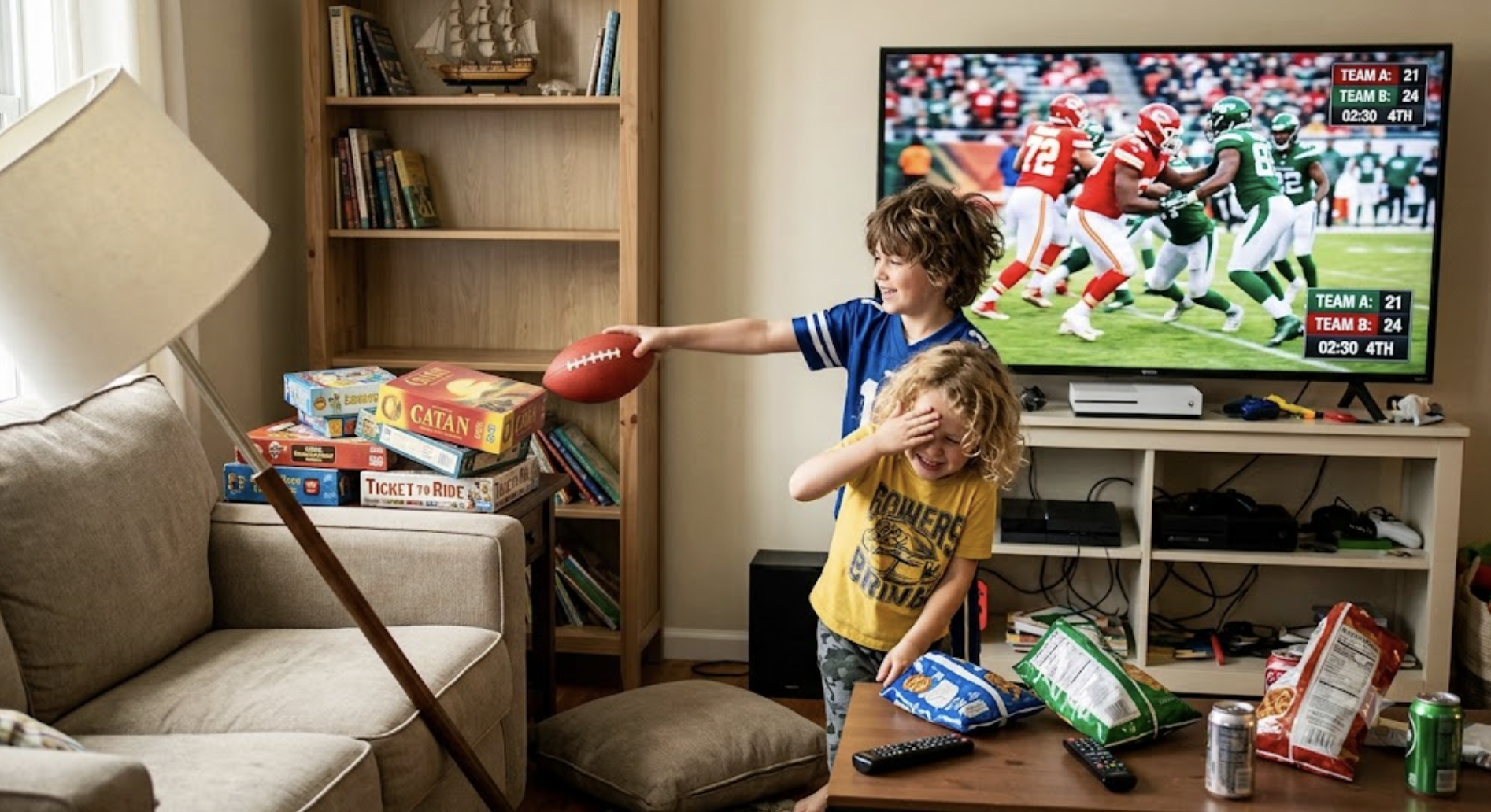
Why would they make this choice?
What might be a consequence of this choice?
What would be a better place to throw the ball?
Can you think of a choice you made that you regret?
How do we make good choices for ourselves?
SEL 2
Inclusive
I know how to be inclusive.
Look at the image. Miguel is playing handball with his friends at recess, when Jake asks to join. The group says there are too many people in the game, but Miguel knows they are being mean.
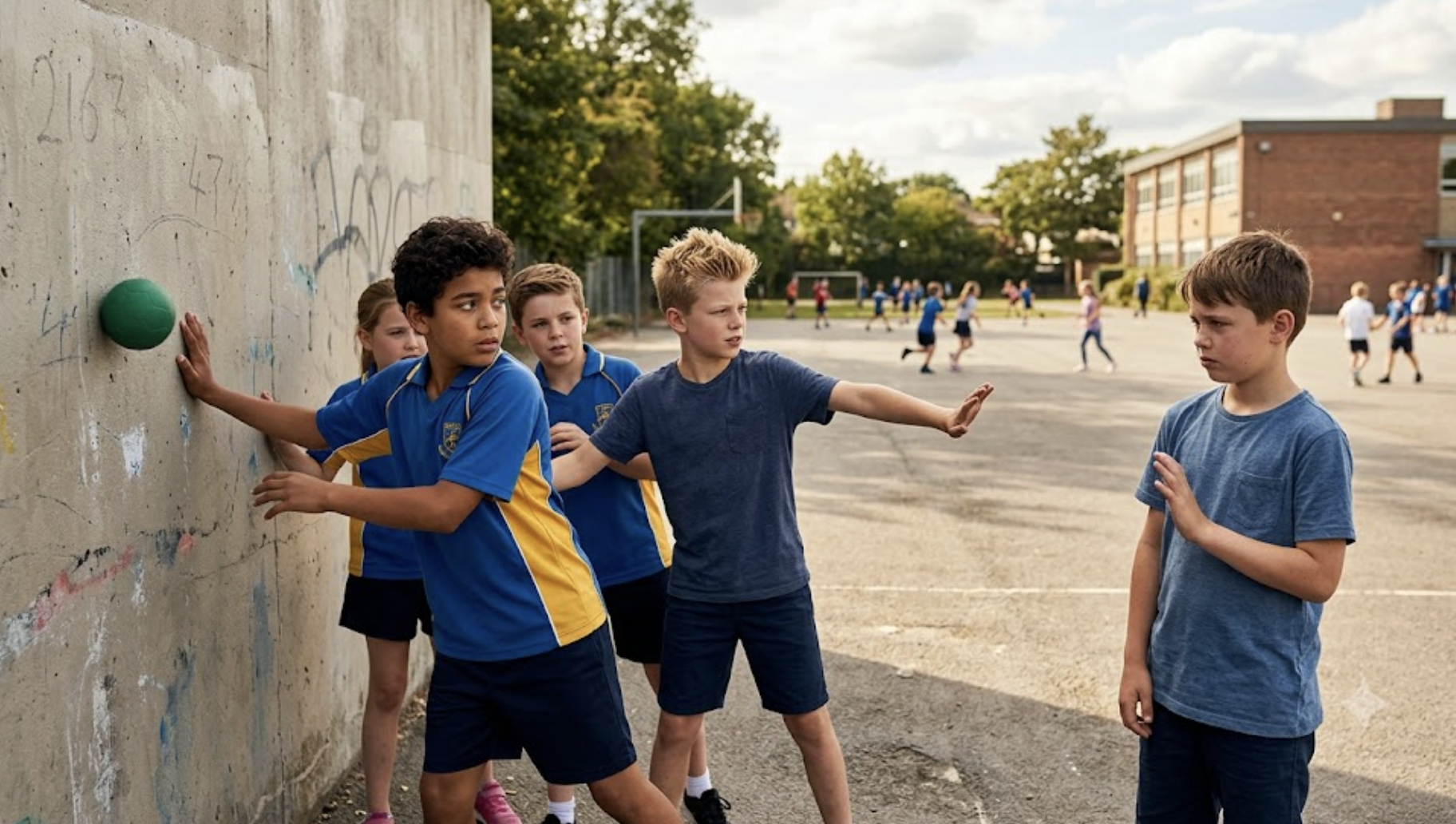
How do you think Jake feels?
How do you think Miguel feels?
What can Miguel do to solve this problem?
Why is it important to be inclusive at school?
SEL 3
Fairness
I know how to play fair.
Look at the image of Lisa and her friends playing Go Fish. She is able to see her friend Abe's cards, but the rules say she is not supposed to.
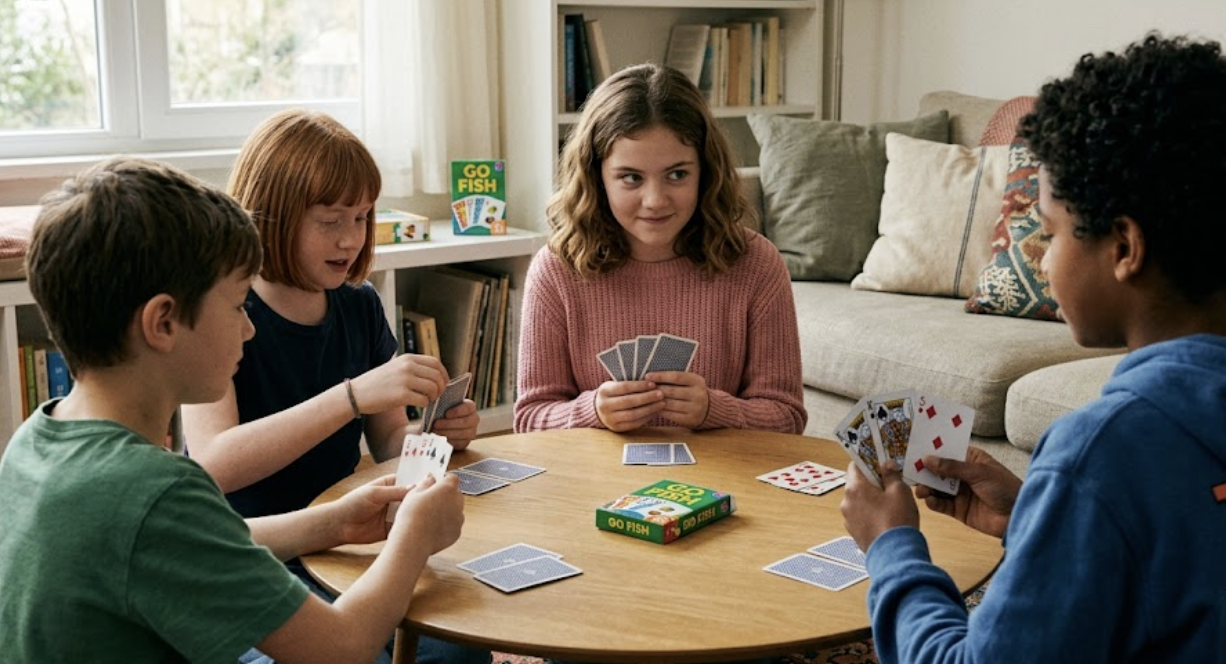
What can she do to keep the game fair?
How would Lisa feel if she saw a match in Abe's cards and won the game?
Is it more important for the game to be fair or to win?
What Lisa Can Do to Keep the Game Fair
To play with integrity and respect her friends, Lisa can take several direct actions:
• Look Away: The simplest solution is to immediately and deliberately look away from Abe's cards and focus only on her own.
• Tell Her Friend: She can privately or quietly say, "Hey Abe, your cards are tilting, and I can see them. You might want to hold them up." This helps him while maintaining the integrity of the game.
• Suggest a Re-deal: If she has already seen significant information that makes playing on unfair, she can suggest a fresh start by re-shuffling and re-dealing the hands.
How Lisa Would Feel if She Won Unfairly
Even if she won, Lisa would likely experience negative feelings because she would know she didn't win through strategy or luck, but by an unfair advantage:
• Guilt: Knowing that she peeked would make the victory feel hollow and undeserved.
• Awkwardness: If her friends suspected she saw the cards, it could lead to uncomfortable questions and tension in the group.
• Loss of Pride: She wouldn't feel the same sense of accomplishment as a fair win.
Fair Play vs. Winning
For long-term enjoyment and maintaining friendships, fair play is much more important than winning.
While winning a single game of Go Fish feels good temporarily, a history of fair play builds trust, respect, and ensures that everyone continues to have fun. If games are consistently unfair, friends may not want to play together in the future.
SEL 4
To Be a Scholar
I am a scholar when I am in the classroom.
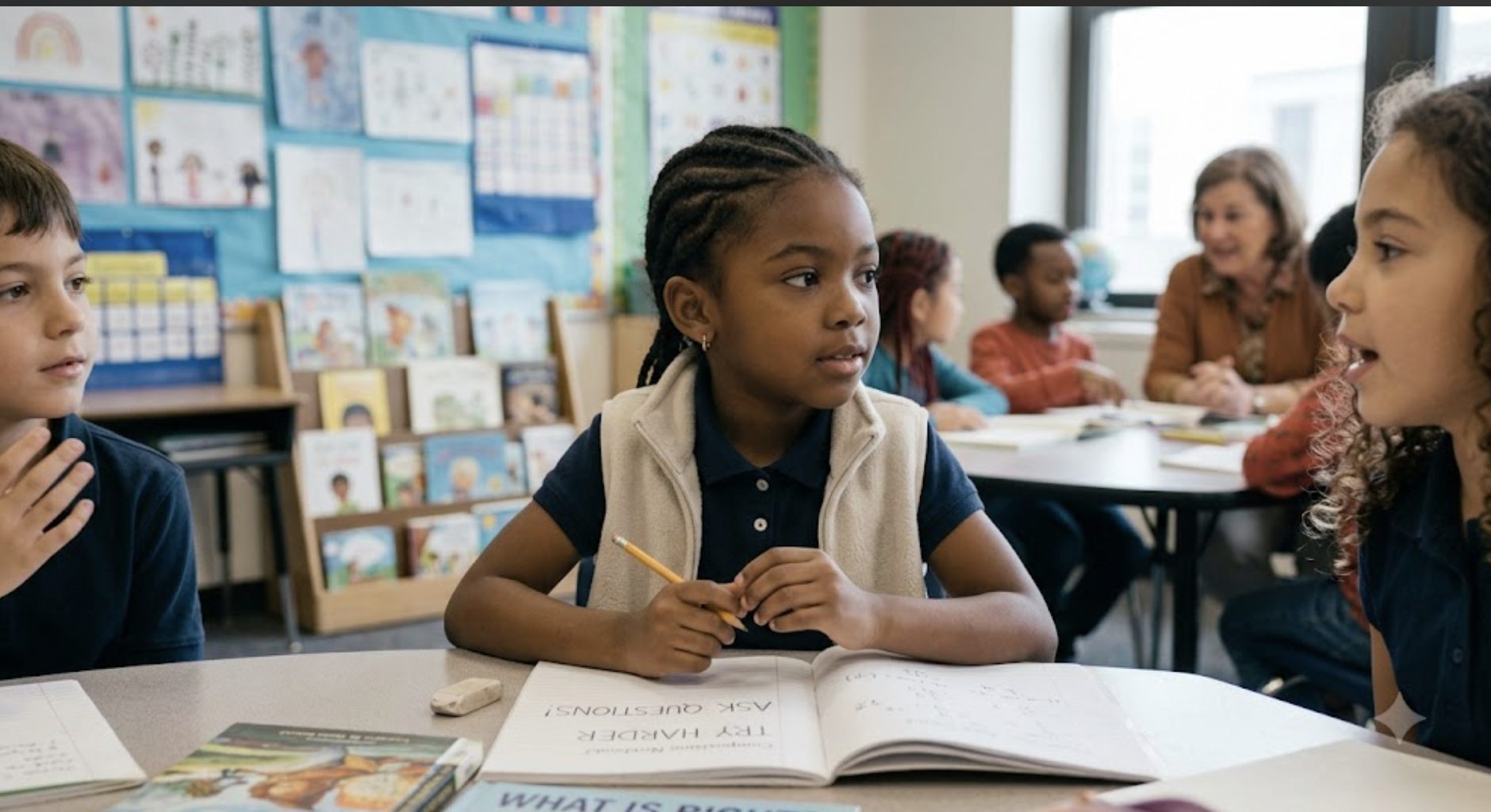
Look at the image of this scholar. A scholar is someone whose job is to learn. They are ready to accomplish any task the teacher asks of them. They treat their classmates with respect and listen to their thoughts in a discussion. A scholar tries their best on their work, even when it gets hard, and asks questions when they are confused.
What parts of being a scholar are the easiest? What parts are the hardest?
Here are the key attributes of a true scholar illustrated on the card:
• Active Engagement: They are not just present but are actively listening and prepared to participate, with a hand raised to share thoughts or ask a question.
• Respectful Collaboration: They show deep respect for their peers, looking attentively at a classmate who is speaking, fostering a positive group dynamic.
• A Love of Learning: They are surrounded by resources—books, notebooks, and a digital device—which shows they are prepared for any task and commit fully to their work.
• Curiosity and Inquiry: By having their hand raised, they demonstrate the courage to ask questions when they are confused, which is essential for deep learning.
SEL 5
Perspectives
I see how others might see situations differently.
Look at the image of the three students. During recess, the teacher announced that everyone had to line up early and go inside.
Alex felt upset because he was in the middle of a soccer game and thought it wasn't fair.
Maya felt relieved because the playground was loud and she had a headache.
Jordan thought the announcement was helpful because dark clouds were rolling in and he didn't want anyone to get wet in the rain.
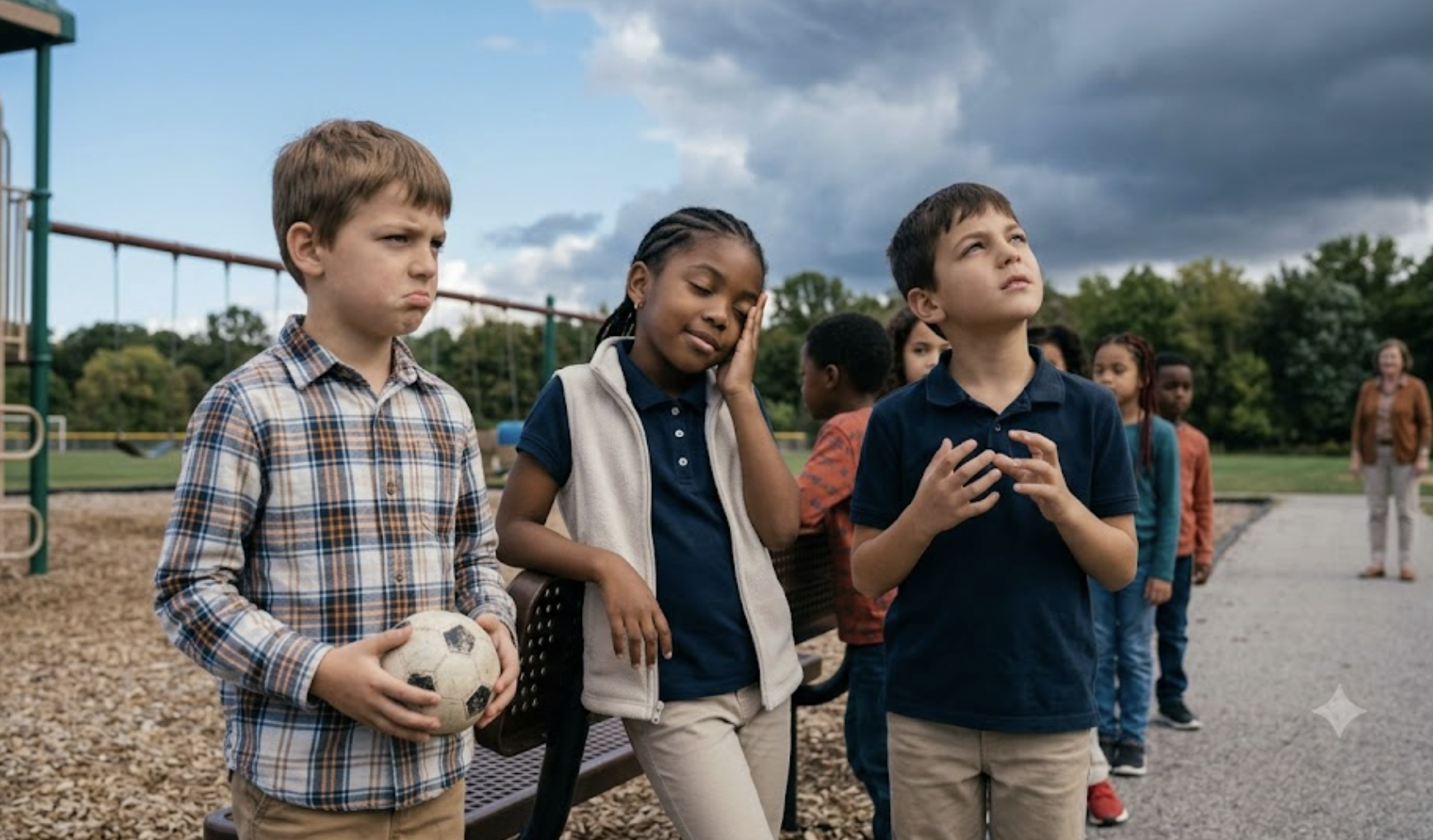
What details in the story help explain why each character felt that way?
Was anyone wrong for how they felt? Why or why not?
How could understanding each other's perspectives help the students get along better?
"Have you ever felt differently from someone else about the same situation? What helped you understand each other?"
SEL 6
Celebrating Difference
I celebrate the differences I see in my friends.
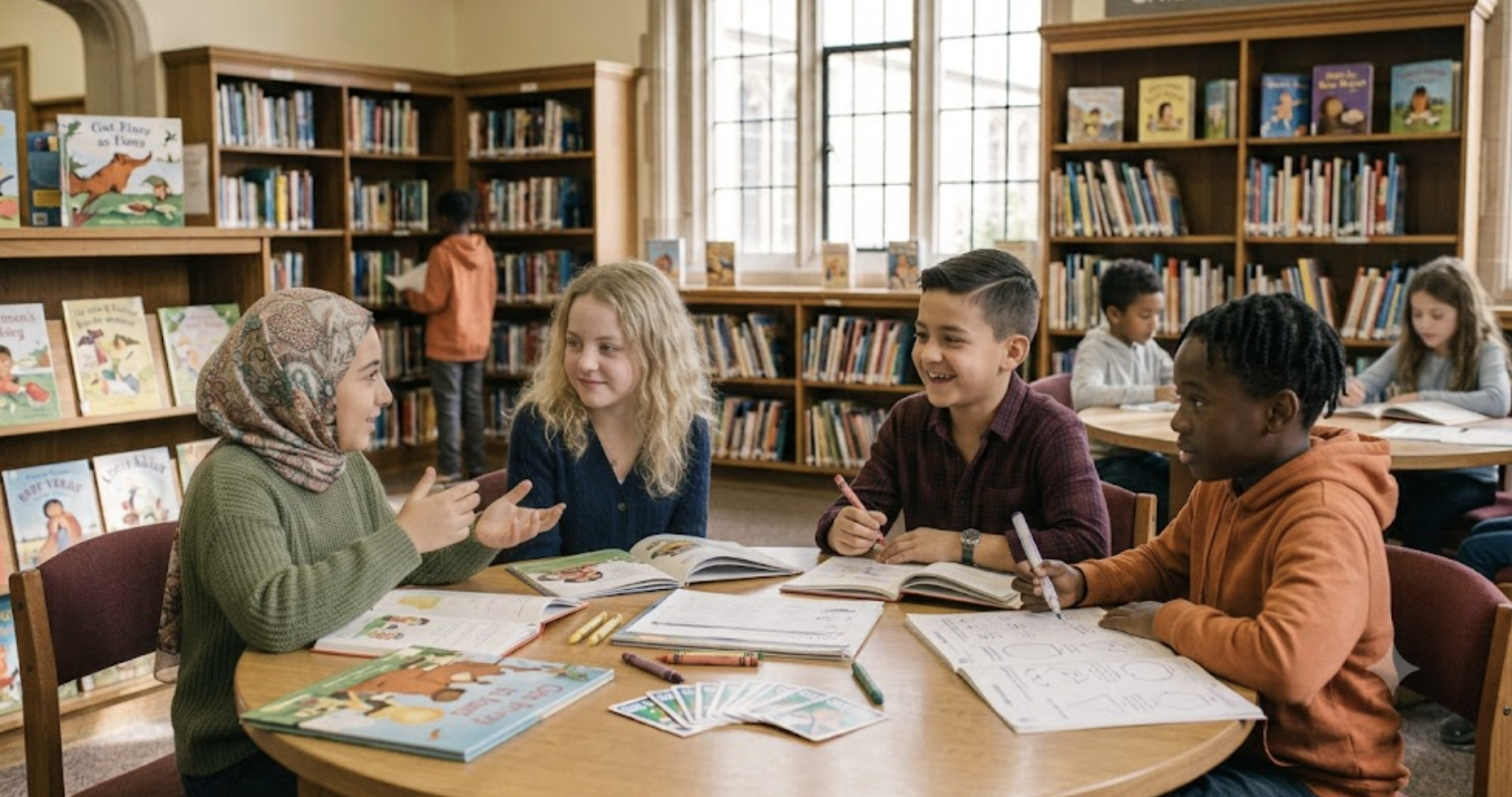
Look at the image. Do you notice any differences between Yazmin, Sarah, Juan, and Ryan?
They are wearing different clothes. Juan and Yazmin speak a 2nd language in addition to English.
Have you ever noticed students teasing someone about their differences? Sometimes when people are nervous or don't understand someone else, they try to tease them to feel better about this.
Have you ever laughed? Have you ever had someone laugh at your difference? It's important to know that the hurt you feel is the reason you need to stand up. If you can use your agency and ask questions, you can learn something new about their culture and family. The more we learn about the world, the wiser we become.
Tell us about a time when you met someone who was different and what you learned about them.