

4th Grade: Explore the World
You came to this page looking for advice on how to help your 4th grader.
If you do nothing else but get familiar with what they are being asked to do, you will quickly see your connection around their learning deepen.
You can start with our free checklist of learning targets for the year. This is a great reference when checking homework or as a topic of conversation in the car.
Paying attention to their learning is the most critical thing you can do.

The 4 Habits
Our Approach for Parents to dive in.
These practices allow you to dive right into any of the math and language standards in your grade level with effortless, bite-sized practice that builds skill fluency and confidence.

Modeling
Our most powerful habit. Grab a blank page, use our prompts, and show your child how to approach a new skill. This direct, stress-free connection is the fastest way to ensure grade-level mastery.

CarTalk
Turn your daily drive into a classroom. Use quick practice games to solidify math facts and phonics, prompt socratic reasoning, or use our SEL cards to help your child navigate friendships and emotions.

Listen and Write
Use these cards to supercharge reading skills. You say the sounds, words, or sentences, and your child writes them down—building the exact phonetic foundation they need to read with ease.

StoryTime
Whether at bedtime or on the weekend, elevate your reading routine. Our cards give you the exact questions to ask to build deep comprehension, ensuring your student is ready to lead classroom discussions.
Using the Habits in 4th grade
We have put together a program to help you tackle all these many learning targets using just our 4 habits. Imagine using a car ride or two a week to develop higher level thinking with Socratic Dialogues.
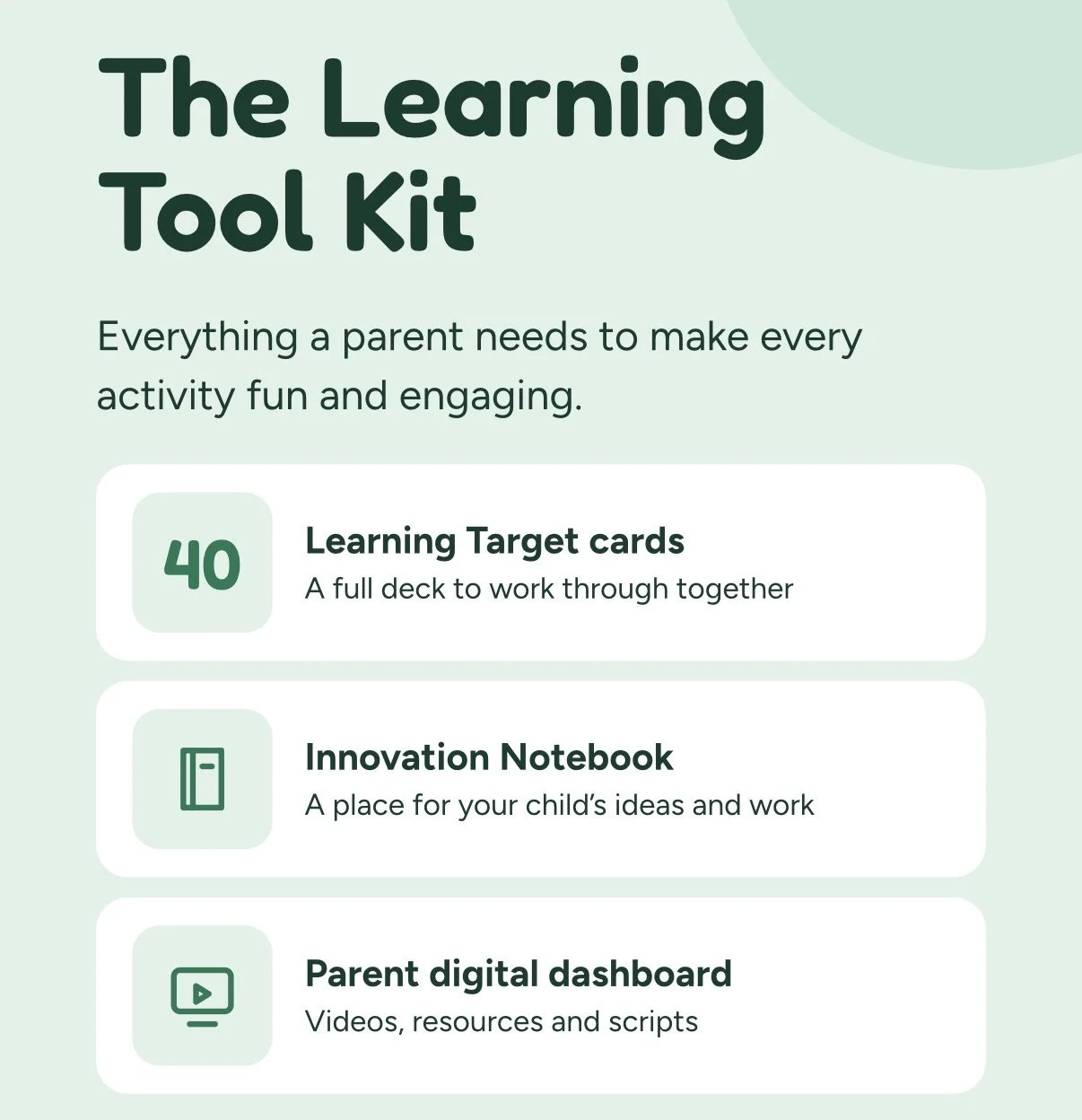
Here is a look at the scope of the program in 4th grade.
Math Habits
 M1Factors and Multiples
 M2Addition and Subtraction with Large NumbersM3Place ValueM4Multiplication of Large NumbersM5Division with RemaindersM6Word Problems with VariablesM7Comparing FractionsM8Adding FractionsM9DecimalsM10Elapsed Time and Unit ConversionsM11Area & PerimeterM12Geometry
Language Habits
 L1Attacking Unknown WordsL2Sight Words
 L3FluencyL4Figurative LanguageL5Summarizing using Text StructureL6Text-Based EvidenceL7Character DevelopmentL8SentencesL9QuotationsL104th Grade GrammarL11Vocabulary
Projects
P1Publish a Reference Book P2Your Superpower Narrative FictionP3Persuasive LetterP4Comparing AuthorsP5Measurement Data AnalysisP6Architectural Floor Plan (Area & Perimeter)P7The Stock Market Challenge
SEL
 SEL 1Choices Affect OthersSEL 3Respectful & SupportiveSEL 4Everyone Learns DifferentlySEL 5Standing Up OnlineSEL 6Being InclusiveSEL 7Listening to FeedbackSEL 8Looking DeeperSEL 9Celebrating Difference
A sample of what our activities look like.
We have included a mixed sampler of the different activities we have in 4th grade. Give one a try!

Mixed Sampler
A custom sampler pulling one card or skill from each subject — Math, Language, Projects, and SEL — each keeping its own subject color.
M1Math
Factors and Multiples — Factoring
I can find all factor pairs for a whole number.
4.OA.B.4

Prompt 1 — Factoring
Let's try factoring numbers! Factoring is when we find all the pairs of numbers that multiply to make our target number. We can start with 24.
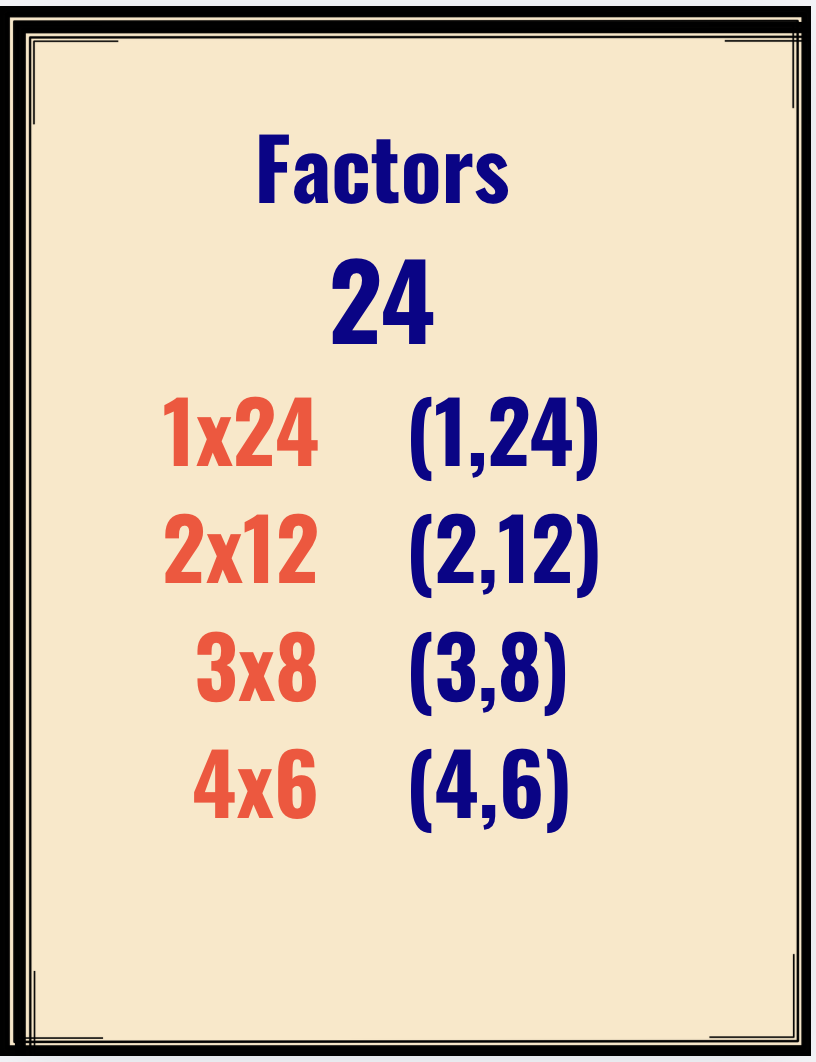
• As you review all the ways to make 24. Pause and let them try to find the last few.
• Play “Tennis” with 36. You name one factor, your child names its pair:
(1,36) (2,18) (3,12) (6,6)
• Try other target numbers:
20, 48, 50, 72.
M4Math
Multiplication of Large Numbers — Area Model
I can use the area model to multiply two 2-digit numbers.
4.NBT.B.5
Skill 1 — Area Model (Box Method) for 2×2 Multiplication


• Model 34 × 26 using an Area Box drawn on graph paper:
Break numbers into expanded form: (30 + 4) and (20 + 6).
Draw a 2 × 2 box grid:
Top-left: 30 × 20 = 600
Top-right: 4 × 20 = 80
Bottom-left: 30 × 6 = 180
Bottom-right: 4 × 6 = 24

Add all 4 partial products: 600 + 180 + 80 + 24 = 884

 Draw boxes and solve together:
43 × 18 =
52 × 37 =
 Math Generator
Click to generate more problems like this.
L5Language
Summarizing using Text Structure — Narrative Summary
I can summarize a narrative using its key story elements.
RL.4.2 · RI.4.2 · RI.4.5
Skill 1 — Narrative Summary
Summarize the latest chapter book you have read by using:
• Somebody: Who is the main character?
• Wanted: What was their goal?
• But: What problem/conflict did they face?
• So: What action did they take to solve it?
• Then: How did the story or chapter end?
 Book Quiz
Our Book Quiz will allow your student to quiz after they have read their book. We have included over 150 of the most popular books at their grade level.
L9Language
Quotations — Advanced Dialogue Conventions
I can correctly punctuate dialogue with commas, quotation marks, and capitalization.
L.4.2b · L.4.2c · L.4.2d
Skill 1 — Advanced Dialogue Conventions
Practice placing commas, quotation marks, and capital letters correctly:
"If we leave now," whispered Maya, "we can beat the traffic."
The teacher asked, "Has everyone submitted their project?"
Use Listen and Write to give them more practice sentences like these:
"I love playing soccer," said Tyler, "because it is my favorite sport."
The coach shouted, "Run to the finish line!"
"Don't forget your lunch box," Mom reminded us, "or you will be hungry at school."
"Where are my keys?" asked Mr. Davis.
Lily smiled and said, "We are going to the zoo tomorrow."
Use our Listen & Write Generator for grade-level dictation words, sentences, and paragraphs read aloud.
P2Projects
Your Superpower Narrative Fiction
Expand a personal memory into a detailed narrative using dialogue, sensory description, and pacing, conveying a clear thematic lesson.
W.4.3 · RL.4.2 · L.4.1e · L.4.2b
Card A — Story Mapping

Look over the example brainstorm on the back of the card, and tell me how they organized their ideas.
Have your child divide a notebook page into 4 quadrants. Brainstorm a focused 20-minute memory, outline the arc, and articulate the lesson learned (e.g., "Patience and teamwork can turn a disaster into an adventure").
Card B — Drafting with Sensory Detail
Demonstrate expanding story points into descriptive sentences using sensory imagery (sight, sound, touch) and prepositions to show spatial relationships.
• Have your child state sentences aloud before writing
• Focus on pacing — slow down the most critical moment with internal thoughts and physical reactions, beat by beat
• Encourage advanced word choices (e.g., "scared" → "apprehensive" or "trembling")
• Discuss how the superpower would change how they feel about themselves and others.
• Decide how they will use their super power to solve a problem and create and ending to the story.
Card C — Revising, Editing & Publishing
The art of revising is to take your writing from GOOD to GREAT. Before we get started, let's compare these two student essays. What is the difference?
Good — The Day I Saved the Class Pet
One sunny Tuesday, I was at school sitting at my desk. My secret superpower is that I can turn invisible whenever I hold my breath. Nobody at school knows about it except my best friend Maya.
During quiet reading time, our class hamster, Barnaby, escaped from his cage! Mr. Davis noticed the cage door was open and gasped. Barnaby was running super fast under the tables. Everyone started yelling and looking for him, which made Barnaby get scared and hide under a giant bookshelf in the back of the room. The gap under the bookshelf was really small, and if we moved it, it might crush him.
I knew I had to act fast. I took a big deep breath and turned totally invisible. Since no one could see me, I didn't have to worry about anyone stepping on my hands or asking what I was doing. I crawled quietly over to the bookshelf. I reached my arm far underneath the dark space.
Because I was invisible, Barnaby wasn't scared of a big human coming at him. I gently scooped him up into my hands. Then I walked back over to the cage, let my breath out, and became visible again right in front of the cage!
"I found Barnaby!" I shouted. Everyone cheered and Mr. Davis gave me two prize tickets. Being invisible helped me save our class pet without scaring him away.
Great — A Breeze of Fresh Air
It was a sweltering ninety-degree afternoon, and the air conditioning in Room 14 had completely died. Ms. Gable was trying to teach long division, but everyone was slouched over their desks like melting popsicles. Sweat was dripping down my face, and my friend Sophia was fanning herself with a notebook, looking like she might pass out.
That was when I decided to use my secret power: Aerokinesis, which means I can control and generate wind currents with my hands. I have to keep it a secret so scientists don't test me in a lab, but this was a real emergency.
Carefully hiding my hands under my desk so no one would notice, I snapped my fingers three times to activate my power. I pointed my fingers toward the open classroom windows and gently swept my arms upward.
Instantly, a crisp, cool breeze swept in through the blinds. I focused hard, making the air swirl around the classroom like a gentle vortex. It rustled our worksheets, cooled down our sweaty foreheads, and blew away the stuffy heat. I kept the breeze focused right near the ceiling so it felt just like a giant ceiling fan was running overhead.
"Oh, thank goodness for that refreshing breeze!" Ms. Gable exclaimed, wiping her forehead and smiling. Everyone sat up straight, instantly refreshed and energized. Sophia turned to me and whispered, "Where did that cool wind come from?" I just smiled and pretended to adjust my papers.
Thanks to my wind powers, Room 14 survived the hottest day of the year, and we even finished our math lesson on time!
Guide revising for sentence variety, dialogue punctuation, and precise vocabulary. Publish a final handwritten or typed copy with an illustration of the climax.
SEL 3SEL
Respectful & Supportive
I am respectful and supportive of others.
Look at the image. Amara gets a math problem wrong on the board in front of the class. Some kids snicker. She has two choices: laugh it off and stop raising her hand for the rest of the year, or ask the teacher to explain what she got wrong.

What makes the second choice harder in the moment?
Why might a scholar choose the harder option anyway?
What's the difference between being wrong and being a bad student?
Have you ever had a moment like Amara's? What did you do?
How the Learning Targets Connect Long Term
As you get more comfortable with where your student sits in their grade level’s learning targets, you may want to explore the grade above or below. It’s good to see what they have learned so far, and where they are going. Try our Learning Target Maps below:
Coherence map, kindergarten through 6th grade
Math: how skills connect
Pick a domain and a grade to see the year before, this year, and next year side by side. Tap one or more standards to light up how they connect.
Domain
Grade
Standards are the Common Core State Standards, K–6 (© 2010 National Governors Association Center for Best Practices and Council of Chief State School Officers). Plain-language wording is a family-friendly summary; the code with each one points to the official text.
Coherence map, kindergarten through 6th grade
Reading & Language: how skills connect
Pick a domain and a grade to see the year before, this year, and next year side by side. Tap one or more standards to light up how they connect.
Domain
Grade
Standards are the Common Core State Standards, K–6 (© 2010 National Governors Association Center for Best Practices and Council of Chief State School Officers). Plain-language wording is a family-friendly summary; the code with each one points to the official text.
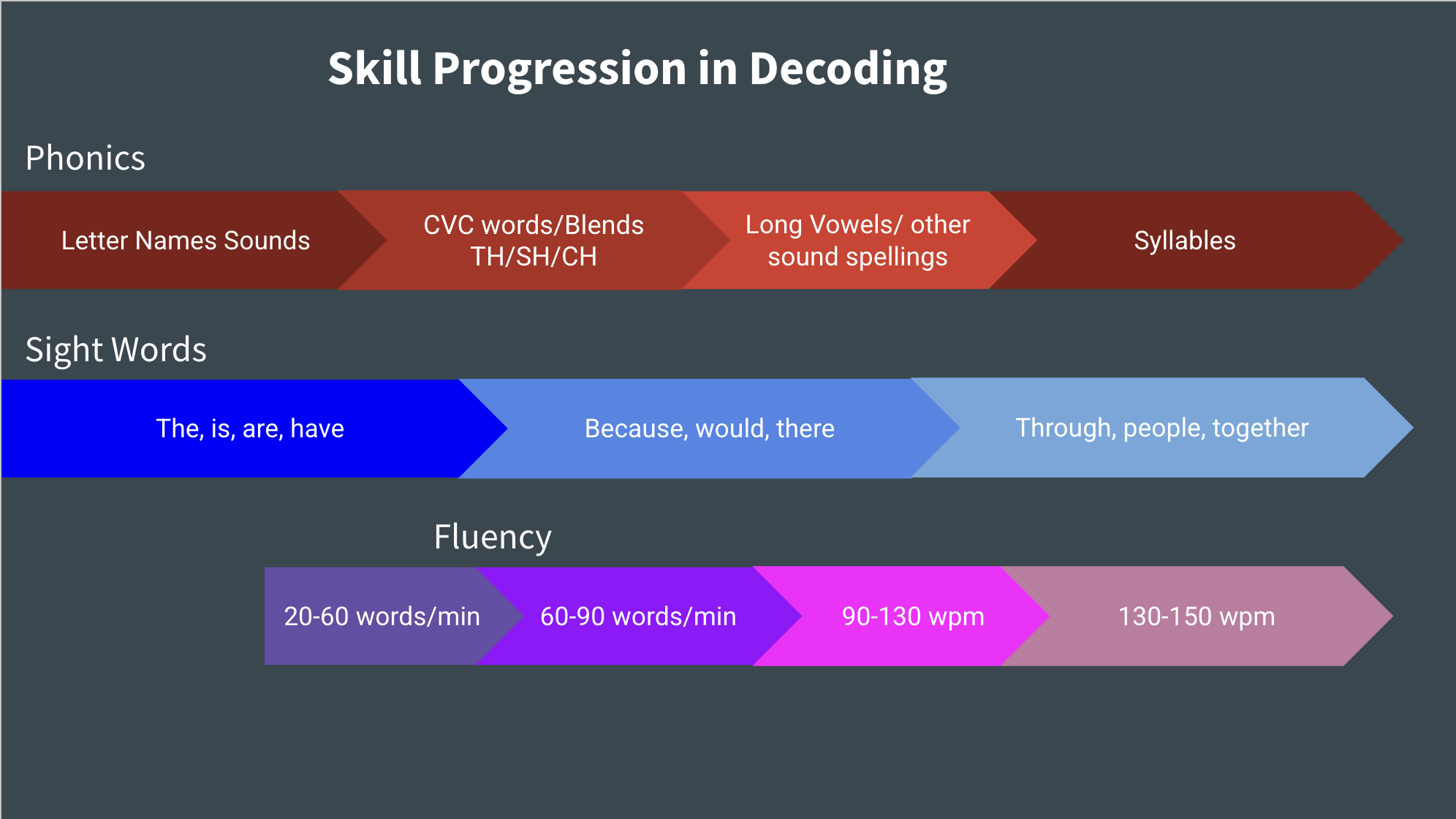
Reading progresses at different levels for every kid. If you try our Literacy Screener using our Listen and Write Habit, you can place where they are along this journey and start having a real impact!