
3rd Grade: The transition into upper elementary
You came to this page looking for advice on how to help your 3rd grader.
If you do nothing else but get familiar with what they are being asked to do, you will quickly see your connection around their learning deepen.
You can start with our free checklist of learning targets for the year. This is a great reference when checking homework or as a topic of conversation in the car.
Paying attention to their learning is the most critical thing you can do.

The 4 Habits
Our way for you to dive in.
These practices allow you to dive right into any of the math and language standards in your grade level with effortless, bite-sized practice that builds skill fluency and confidence.

Modeling
Our most powerful habit. Grab a blank page, use our prompts, and show your child how to approach a new skill. This direct, stress-free connection is the fastest way to ensure grade-level mastery.

CarTalk
Turn your daily drive into a classroom. Use quick practice games to solidify math facts and phonics, prompt socratic reasoning, or use our SEL cards to help your child navigate friendships and emotions.

Listen and Write
Use these cards to supercharge reading skills. You say the sounds, words, or sentences, and your child writes them down—building the exact phonetic foundation they need to read with ease.

StoryTime
Whether at bedtime or on the weekend, elevate your reading routine. Our cards give you the exact questions to ask to build deep comprehension, ensuring your student is ready to lead classroom discussions.
Using the Habits in 3rd grade
We have put together a program to help you tackle all these many learning targets using just our 4 habits. Imagine using a car ride or two a week to develop higher level thinking with Socratic Dialogues.
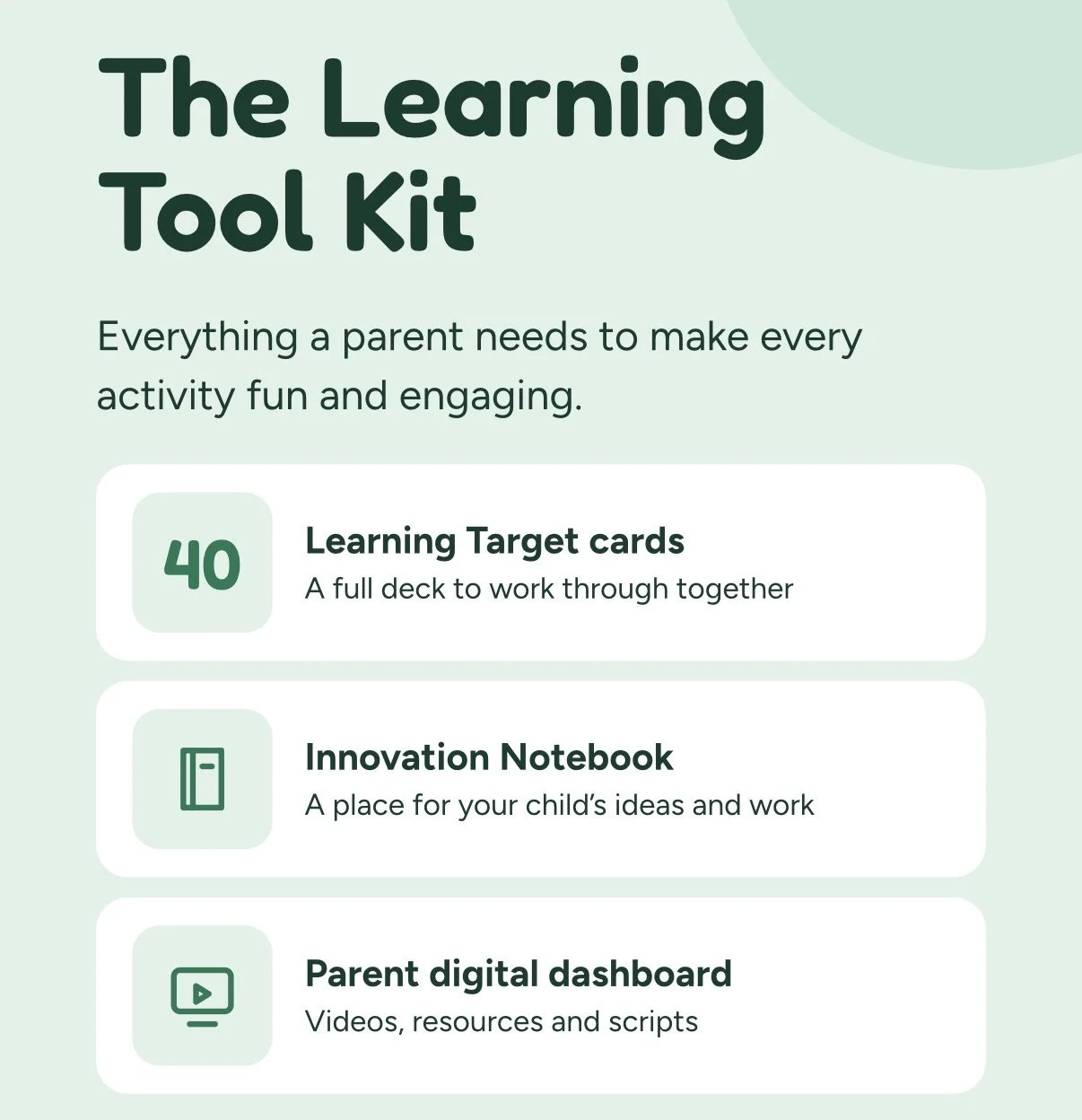
Here is a look at the scope of the program in 3rd grade.
Math Habits
 M1Skip Counting
 M2RegroupingM3EstimationM4Word ProblemsM5Properties of Multiplication and DivisionM6More Complex Word ProblemsM7FractionsM8Area ModelingM9Elapsed Time ModelingM10Mass and VolumeM11PerimeterM12Shapes
Language Habits
 L1Longer WordsL2Sightwords
 L3FluencyL4ClarifyL5RetellL6Ask and Answer QuestionsL7Character StudyL8Expanding SentencesL9Writing DialogueL10Polishing GrammarL11Vocabulary
Projects
 P1My BiographyP2Fractions and Survey DataP3Historical Event InvestigationP4Character Study in Book SeriesP5Park Planner (Area & Perimeter)P6Letter of GratitudeP7Page vs. Screen Comparison
SEL
SEL 1ChoicesSEL 2InclusiveSEL 3FairnessSEL 4To Be a ScholarSEL 5PerspectivesSEL 6Celebrating DifferenceA sample of what our activities look like.
We have included a mixed sampler of the different activities we have in 3rd grade. Give one a try!

Mixed Sampler
A custom sampler pulling one card or skill from each subject — Math, Language, Projects, and SEL — each keeping its own subject color.
 M1Math
Skip Counting — Count by 3s
I can skip count using multiplication patterns.
3.OA.A.1
Prompt 1 — Count by 3s

• Model how to count by 3.
"Now you try to count by 3. Repeat these numbers after me"
You should start slowly as you teach the sequences.
Repeat small groups of numbers until they are solid and move on.
"3, 6, 9"
"12, 15, 18"
Can you do the whole thing?
"18, 21, 24"
"24, 27, 30"
• Once they are solid, you can try to make a song or rhyme out of it as you repeat.
Try to have them serve using either number.
Have them use their fingers as they count by three.
Move into asking questions like:
How many is 3×7?
Hold seven fingers up and let's count.
3, 6, 9, 12, 15, 18, 21
• Play tennis with these questions until solid, then move to skill 2.
 Play Tennis
M8Math
Area Modeling — The Concept of Area
I can understand area as the space covered by a shape, measured in square units.
3.MD.C.5
Skill 1 — The Concept of Area

• Confirm they understand that area is the space covered by the shape.
It is useful when choosing the right carpet for a room. We measure this with square units like square feet or square meters.
• Model using the grid inside this rectangle to count 6 square cm long and 4 square cm wide.

• Remind them of how to skip count by 6 four times: 6, 12, 18, 24.
• Ask them to count the actual squares inside to make sure. 24 square cm.


• Draw a square on the notebook and have them count the width and length in units of your choice.
• Have them skip count to find the area in "square" units.
• Repeat until this is automatic.
L1Language
Longer Words — Common Irregular Syllables
I can read and spell longer words by breaking them into syllables.
RF.3.3
Skill 2 — Common Irregular Syllables
• Give them the card to practice spelling common syllables to know:

• Use the Listen and Write Habit on words like:
reaction, hopefully, sensitive, imagination
• Clap as you say each syllable with your child and remind them to spell each syllable slowly.
• You can have them add a slash between each syllable as they write:
help/er ac/tion kind/ness
 Listen & Write Generator
Use our Listen & Write Generator for grade-level dictation words, sentences, and paragraphs read aloud.
 L6Language
Ask and Answer Questions — Finding the Answer
I can ask and answer questions to demonstrate understanding of a text.
RL.3.1
Skill 1 — Questions That Find the Answer
 Book Quiz
• Use Book Quiz at the top of this card for ready made quizzes on all the most popular books.
As part of the Reading routine, mix history and science nonfiction books in with the chapter books.
• Model asking a question and finding the answer in the story.
What did Mr. Dursley say when the letters started coming in the fireplace?
• Point to the exact line.
He said, "No Post on Sundays!" on page 34.
• Practice with Who, What and Where questions that are easier to answer.
• Let them ask you a question and you show them how you find the answer in the book.
• Play Tennis
P1Projects
My Biography
Write a life story that includes accounts of vivid description and dialogue of real memories and includes a creative, "fictional" future.
L.3.2c · L.3.4 · W.3.9 · W.3.3
Card A — The Timeline
Prompt 1:
Looking back at your whole life, let's pick the top 5 most significant events.
• Guide them to think of their life in chapters (baby, toddler, school, past year) and choose one from each.
• Discuss why they chose the event and see if/how it changed them as a person.
Notebook follow up
• Model how to build a timeline using years as units and summarize each event with a brief description of who was involved, what happened, and important things that were said.
Prompt 2: What will happen to humanity by the time they are in their 80s.
• Guide them to think what they might do within this vision, from 6th grader to grandparent.
Will they live on Mars? Will they save the rainforest?
Notebook follow up
• Have them return to their timeline and extend it or draw one beneath.
• Add "future" bubbles for when they are in high school, college and stages of adulthood.
• Use the same format of who, what and important discussions in this future world.
Card B — Drafting & Dialogue
• Using the biography exemplar on the website, point out how it's organized sequentially. The author begins with birth location and setting the scene and creates subtopics or chapters for each stage of their life.
Lionel Messi: The Soccer Star
Lionel Messi was born on June 24, 1987, in a city called Rosario, Argentina. From the time he was a very little boy, he loved playing soccer more than anything else. He played with his brothers and cousins, and he was so good that people noticed his talent right away. Even as a child, he could dribble the ball better than kids much older than him.
When Lionel was eleven years old, he faced a very big challenge. Doctors found out that he had a growth problem, which meant he would have a hard time growing as tall as his friends. His family did not have enough money to pay for the special medicine he needed to help him grow. He almost had to stop playing the game he loved so much, but he did not lose hope that he could still become a great player.
Everything changed when a team in Spain called FC Barcelona heard about how talented he was. They offered to help pay for his medical treatments if he moved to Spain to play for their youth team. Lionel moved far away from home at a young age to follow his dream. He worked very hard every single day, showing everyone that he could be a star even if he was smaller than the other players.
Soon, Lionel Messi became one of the most famous soccer players in the entire world. He became known for his amazing speed, his smart passes, and his ability to score beautiful goals. He played for Barcelona for many years and won many trophies, including the Ballon d'Or, which is given to the best player in the world. He even led his home country, Argentina, to win the World Cup in 2022, which was a huge dream come true for him.
Today, Lionel Messi is a hero to millions of people. He teaches us that even when things are difficult, you should not give up on your dreams. Because he kept working hard and believed in himself, he was able to find something truly special in his life. He is remembered not just for being a great soccer player, but for showing the world that you can achieve big things if you keep trying.
• Return to the timeline bubbles, and guide them to turn these into sentences and paragraphs.
• They can decide if they want to write this in the 1st person (autobiography) or in the 3rd person (biography).
• Develop the future paragraphs with descriptions of fictional settings, people and events.
• Prompt them to find a larger theme to their life story. This can be really fun!
• In 3rd grade, there is a clear focus on using Dialogue.
Make sure to find points in the timeline that include important moments where key things were spoken. Maybe it was advice or even an argument.
It's ok if they don't remember word for word. What's important is using dialogue to help bring the reader to the experience.
Help them use these quotations with the proper grammatical marks to show exactly what people said during those big memories.
Here is how adding dialogue to Messi's medical challenge helps deepen the reader's understanding:
His family did not have enough money to pay for the special medicine he needed to help him grow. He sat on the edge of his bed one night and whispered to his mom, "What if I can't be a soccer player because I'm too small?" His mom hugged him and said, "Don't lose hope, Leo. You have a special gift, and we will find a way."

Card C — Editing for Publication
• Read the draft out loud together, looking for areas of confusion.
"Run on sentences" use too many clauses and commas.
"Sentence fragments" are incomplete.
• Make sure each paragraph is sequenced and contains all the elements from the timeline.
How does the dialogue element fit?
Does the future paragraph match the style of the past?
• If your student is ready, see if they can vary sentences to make the flow more interesting.
• Celebrate the "juicy words" they used in their descriptions and point out areas where they could use more.
• Decide how they want to "publish" this story.
• Have them create a paper book with a table of contents listing subtopics and adding illustrations.
• Guide them to create a word document:
• Choose fonts and titles
• Upload photos and images
SEL 5SEL
Perspectives
I see how others might see situations differently.
Look at the image of the three students. During recess, the teacher announced that everyone had to line up early and go inside.
Alex felt upset because he was in the middle of a soccer game and thought it wasn't fair.
Maya felt relieved because the playground was loud and she had a headache.
Jordan thought the announcement was helpful because dark clouds were rolling in and he didn't want anyone to get wet in the rain.

What details in the story help explain why each character felt that way?
Was anyone wrong for how they felt? Why or why not?
How could understanding each other's perspectives help the students get along better?
"Have you ever felt differently from someone else about the same situation? What helped you understand each other?"
How the Learning Targets Connect Long Term
As you get more comfortable with where your student sits in their grade level’s learning targets, you may want to explore the grade above or below. It’s good to see what they have learned so far, and where they are going. Try our Learning Target Maps below:
Coherence map, kindergarten through 6th grade
Math: how skills connect
Pick a domain and a grade to see the year before, this year, and next year side by side. Tap one or more standards to light up how they connect.
Domain
Grade
Standards are the Common Core State Standards, K–6 (© 2010 National Governors Association Center for Best Practices and Council of Chief State School Officers). Plain-language wording is a family-friendly summary; the code with each one points to the official text.
Coherence map, kindergarten through 6th grade
Reading & Language: how skills connect
Pick a domain and a grade to see the year before, this year, and next year side by side. Tap one or more standards to light up how they connect.
Domain
Grade
Standards are the Common Core State Standards, K–6 (© 2010 National Governors Association Center for Best Practices and Council of Chief State School Officers). Plain-language wording is a family-friendly summary; the code with each one points to the official text.
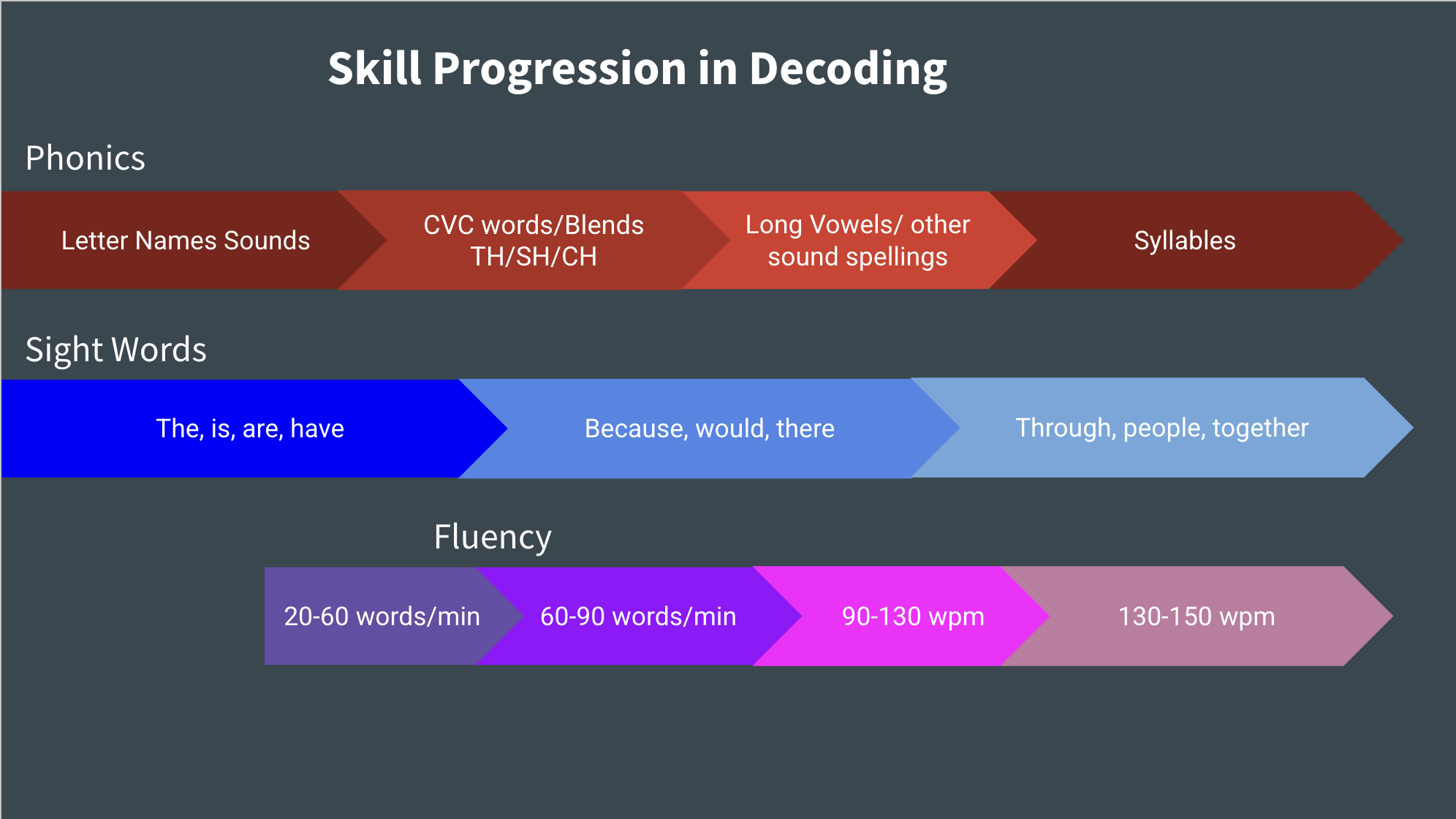
Reading progresses at different levels for every kid. If you try our Literacy Screener using our Listen and Write Habit, you can place where they are along this journey and start having a real impact!