

4th Grade:
-
The 1st grade classroom is designed to apply all the letter sounds and spellings they learned in Kindergarten to begin to read “real” books:
Reading: Students move from simple books with pictures and a few sentences per page, to books with a much expanded range of words written in paragraphs. They will now be reading for a purpose and will start to see the author at work. Are they trying to be funny? Are they trying to convince me?
Writing: Students are now asked to write multiple sentences and will begin to understand how to organize and express their ideas clearly.
Math: The curriculum pushes your student to work with numbers up to 120, and begin to have their addition and subtraction facts down. By year's end, students begin to add two-digit numbers and “carry” the ones column into the tens.
-
Help them develop a love of reading:
You will see your student being challenged to read and write much more frequently. They will begin to shift their brain’s energy to word meanings as decoding the letters and sounds gets easier.
They will be given tools to read all the vowel sound spellings, which will take practice. English is a quirky language!
Your student will be learning the fundamentals of a grammatically correct sentence. They most likely will have a research report or longer writing assignment that will involve your support. Focus on having them say their sentence out loud before writing and reread it afterward.
By now, you should start engaging your student in reading chapter books without pictures together. Click here. It is important for them to create the “movie in their mind” as you read the words. There are so many great ones to choose from!
Math will be focused on working with larger numbers by understanding how the hundreds, tens, and ones place work.
Here you will find parent resources for all the habits, lessons, projects, and social emotional learning cards in your set.
This includes:
prompts for you to say
examples of what your modeling
links to generate texts, problems and other resources you might need.
If you are looking for more support, please try our online courses or our personal learning audit.

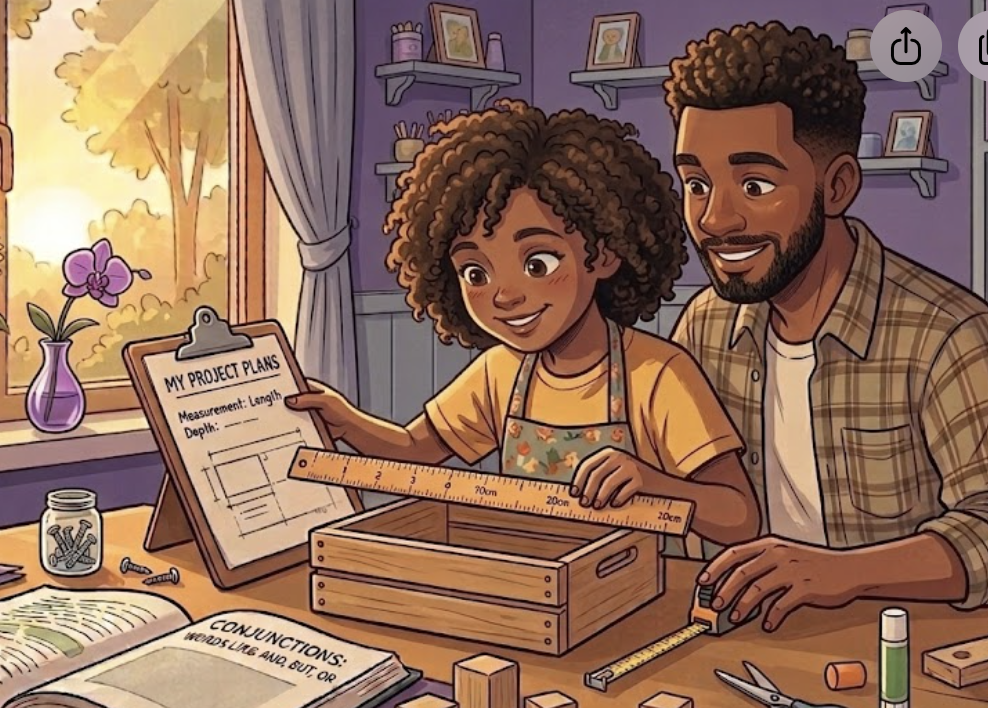
Let’s Do This Together
Every event we host is designed with intention, from the atmosphere we create to the way each session flows.

Language Habits
Select a learning target below. Prepare before you hand the companion card to your student and give it a try.
 L1
L1
Attacking Unknown Words
I can use all I have learned about phonics, word roots, and syllables to accurately read and spell unfamiliar words.
RF.4.3a
Skill 1 — VCCV, VCV, and Consonant+le Syllable Division

Dictate these 4th-grade words for Listen and Write. Have your child clap syllables and write them with slashes between syllables:
sub / ma / rine
dis / a / gree / ment
un / com / fort / a / ble
Skill 2 — Roots and Affixes
Practice spelling words built from Latin/Greek roots:
• struct (to build): structure, construct, destruction, instructor.
• tract (to pull/drag): tractor, attract, subtract, extract.
• phon (sound): symphony, microphone, phonics, megaphone.
• geo (earth): geology, geography
• vis/vid (see): invisible, evidence, video
• port (carry): portable, transportation, export
L2
Sight Words
I can accurately read and spell 4th-grade academic vocabulary across subject areas.
RF.4.3a · L.4.6
Skill — Academic Vocabulary Across Subjects
Practice high-frequency 4th-grade academic words weekly. Focus on irregular spelling patterns and silent letters.
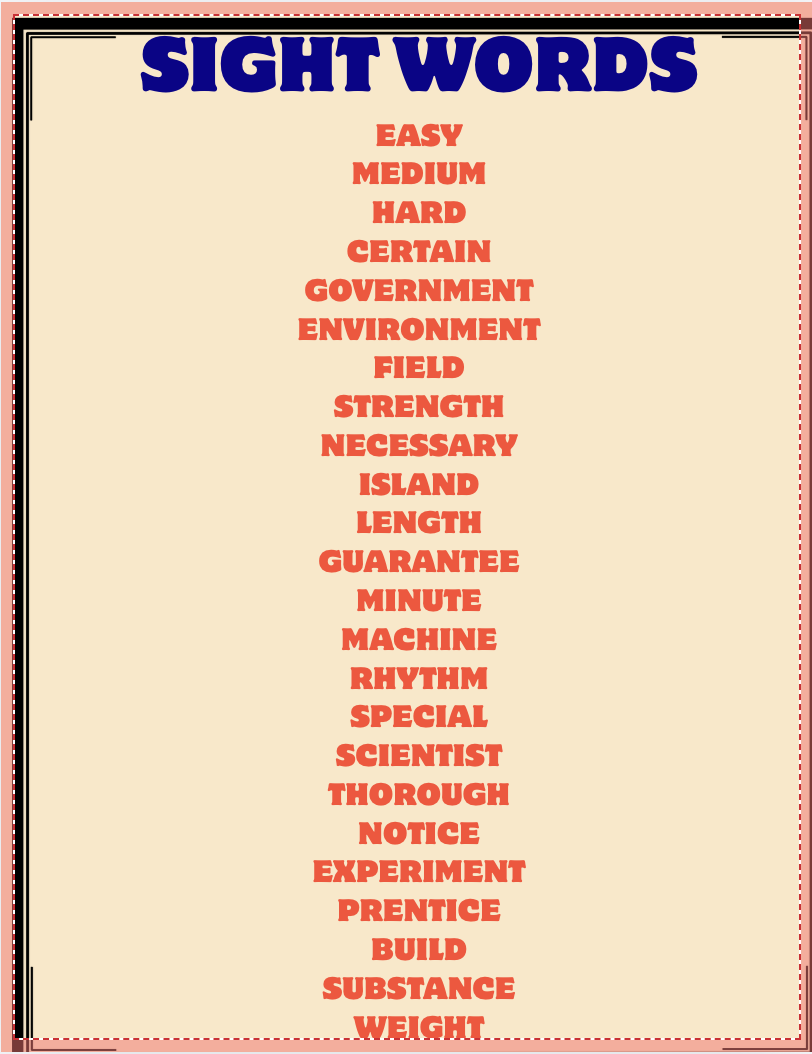
Dictate sentences using these words:
"The scientist conducted a thorough experiment on the island."
"It is necessary to protect our natural environment."
 L3
L3
Fluency
I can read grade-level prose and poetry orally with accuracy, appropriate rate (140 WPM).
RF.4.4a · RF.4.4b · RF.4.4c
Skill — 4th Grade Fluency Benchmarks
Target Rate: 115–140+ Correct Words Per Minute (CWPM) by end-of-year on grade-level text.
Key Components: Accuracy, Pacing, and reading in natural phrases, honoring punctuation.
Try our Fluency Coach.
Tips to look for during StoryTime:
• Guide them to read in 3-to-5 word meaningful chunks rather than word-by-word.
Punctuation Markers:
• Pause at commas.
• Lower voice pitch at periods.
• Raise voice pitch at question marks.
• Adapt voice expression for dialogue inside quotation marks.
L4
Figurative Language
I can determine the meaning of unknown words using context clues and interpret idioms, adages, similes, and metaphors.
RL.4.4 · L.4.4a · L.4.5a · L.4.5b
Skill 1 — Context Clues Strategies
When encountering an unfamiliar word in reading, use neighboring words/sentences to find:
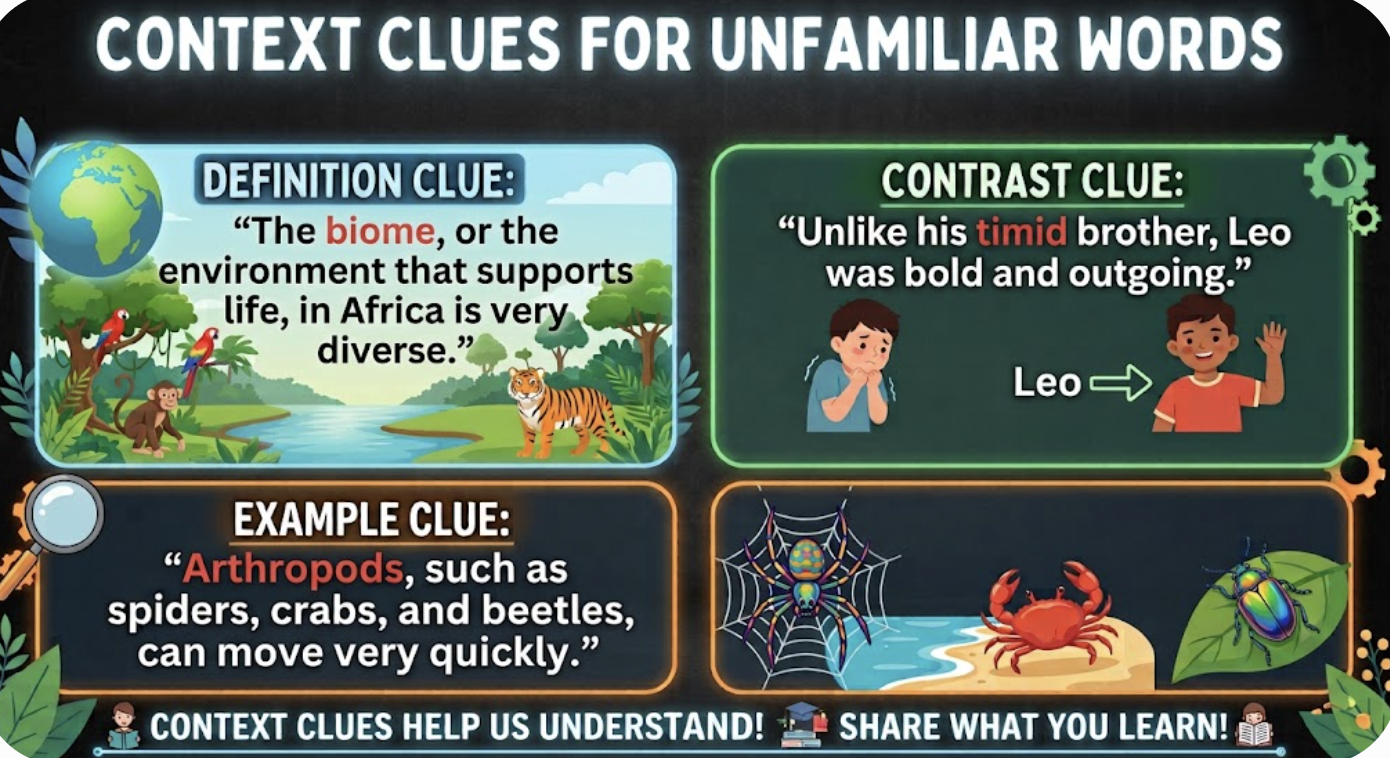
Definition Clue: "The biome, or natural habitat, was home to many species."
Antonym Clue: "Unlike his timid brother, Leo was extremely boisterous."

Skill 2 — Idioms and Proverbs
Discuss non-literal meanings during CarTalk :
Idioms: "Bite the bullet", "On the fence", "Spill the beans".
Proverbs: "A penny saved is a penny earned", "Look before you leap".
• Use the button below and click on Idioms to play a game where you give an idiom and ask your child to explain the real meaning.
Link to Figurative Language generator
Skill 3 — Figurative Language
In 4th grade, they are being taught to identify different forms of figurative language in their reading. Stop and name which type when this comes up.
Simile: "Her smile was as bright as the morning sun."
Metaphor: "The thunder was a booming kettle drum in the sky."
Personification: "The wind whispered secrets through the trees."
• Use the button below and click on Idioms to play a game where you give an idiom and ask your child to explain the real meaning.
Link to Figurative Language generator
L5
Summarizing using Text Structure
I can summarize literary or informational texts by analyzing their text structures.
RL.4.2 · RI.4.2 · RI.4.5
Skill 1 — Narrative Summary
Summarize the latest chapter book you have read by using:
• Somebody: Who is the main character?
• Wanted: What was their goal?
• But: What problem/conflict did they face?
• So: What action did they take to solve it?
• Then: How did the story or chapter end?
Skill 2 — Informational Text Main Idea & Text Structure
Identify your last informational text's structural pattern:
• Chronological/Sequential: first, next, finally, dates
• Cause & Effect: because, as a result, due to, therefore
• Compare & Contrast: similarly, however, on the other hand
• Problem & Solution: the issue is, to resolve this
If you need a text, use our Info Text Generator.
L6
Text-Based Evidence
I can refer to details and examples in a text when explaining what the text says explicitly and when drawing inferences.
RL.4.1 · RI.4.1
Skill 1 — Quoting and Citing Evidence
After reading your next chapter, prompt your child with questions where they must point directly to a sentence:
"How do you know the main character was scared? Read the sentence that proves it."
"What exact evidence does the author give to show that solar power is renewable?"
Skill 2 — Making Inferences (Text + Schema = Inference)
I DO Use the image to model combining text facts with what you already know:

We DO "He wiped sweat from his forehead and grabbed his canteen." What can you infer about the weather?

Skill 3 — Socratic CarTalk
Discuss open-ended questions about books or news, using Socratic Dialogue :
"Do you think the character's choice was justified? Why or why not?"
Practice the cycle:
• State opinion
• Cite evidence
• Consider counter-argument
• Re-state.
L7
Character Development
I can describe in depth a character, setting, or event in a story, drawing on specific details in the text.
RL.4.3 · RL.4.6 · RL.4.7
Skill 1 — Traits vs. Feelings
Your child is likely reading more and more complex chapter books, and may have found a favorite series which include the same characters. In 4th grade, we offer several projects covering these standards, but for this habit, we focus on two specific skills.
An emphasis in 4th grade is on emotional understanding and empathy for characters during the plot. A big place to distinguish is between their core traits and temporary feelings.
We do:
• Using your notebook, chart how each main character changes from the beginning to the end of a novel.
• Identify a few traits for each character.
• Identify different emotions each character had and in which scenes in the book these occurred.
Skill 2 — Identifying the Point of View
Take a moment to identify the narrator's perspective in the story you are reading:
1st Person: The narrator is a character inside the story (I, me, my, we). You can use Socratic Chat to engage your student in questions like:
Do you identify with them?
How does the author use their thinking as a technique to drive the story?
3rd Person Limited/Omniscient: Usually a narrator observing one or all characters (he, she, they).
Some authors travel from one character's mind to another based on chapters, others write from a completely objective view.
How do you think the narrator feels about this event?
We Do: Have your child rewrite a short paragraph in both 1st person and 3rd person point of view.
L8
Sentences
I can produce complete sentences using prepositions, relative pronouns, and can spot a mistake in my writing.
L.4.1a · L.4.1b · L.4.1e · L.4.1f
Skill 1 — Relative Pronouns & Adverbs
I DO Demonstrate how to use the following words in a sentence: who, whose, whom, which, that, where, when, why:
"This is the dog that barked all night."
"The scientist who discovered the fossil received an award."
WE DO Ask your student to try to write their own sentence with each.
Skill 2 — Prepositional Phrases
Combine simple sentences with prepositional phrases (under, through, across, during, beyond):
Basic: "The cat ran. It went under the fence."
Enhanced: "During the storm, the startled cat ran swiftly under the wooden fence."
Skill 3 — Fixing Fragments and Run-Ons
Dictate run-on sentences and fragments for your child to edit in the notebook:
Run-on: "We went to the park it was fun we ate ice cream."
Corrected: "We went to the park and had a wonderful time. Afterwards, we ate ice cream."
WE DO Give them more run-ons and fragment sentences and let them correct and rewrite.
The sun was shining bright outside we played soccer all afternoon.
My puppy loves to chase his ball he gets tired and falls asleep on the rug.
We went to the library to get new books I chose a story about dinosaurs.
Maya likes strawberry ice cream best her brother prefers chocolate fudge.
The rain started pouring down hard we had to move our picnic inside.
L9
Quotations
I can use correct punctuation for dialogue, direct addresses, and formatting titles.
L.4.2b · L.4.2c · L.4.2d
Skill 1 — Advanced Dialogue Conventions
Practice placing commas, quotation marks, and capital letters correctly:
"If we leave now," whispered Maya, "we can beat the traffic."
The teacher asked, "Has everyone submitted their project?"
Use Listen and Write to give them more practice sentences like these:
"I love playing soccer," said Tyler, "because it is my favorite sport."
The coach shouted, "Run to the finish line!"
"Don't forget your lunch box," Mom reminded us, "or you will be hungry at school."
"Where are my keys?" asked Mr. Davis.
Lily smiled and said, "We are going to the zoo tomorrow."
Skill 2 — Direct Address Commas
Model writing sentences which set off names with commas when speaking directly to someone:
"Are you ready, Alex, to start the game?"
"Dad, can we go to the park?"
Use Listen and Write to give them more practice sentences like these:
Skill 3 — Formatting Titles
• Underline (or Italicize) major works: Books, Movies, TV Shows, Plays (Tales of a Fourth Grade Nothing, Inside Out).
• Use Quotation Marks for short works: Poems, Songs, Articles, Chapter titles ("The Raven").
• Use titles of things in your Listen and Write Practice.
L10
4th Grade Grammar
I can correctly use modal auxiliaries, order adjectives, and spell commonly confused homophones.
L.4.1c · L.4.1d · L.4.1g · L.4.2a
Skill 1 — Order of Adjectives

Adjectives follow a natural order: 1 Opinion 2 Size 3 Age 4 Color 5 Origin 6 Material.
"A wonderful big old red French wooden box."
Doesn't "A wooden French red old big wonderful box" sound funny?
Correct some more out-of-order sentences. You say this the wrong way and they rewrite:
She wore a cotton silk black lovely long dress.
He drove an Italian red sports sleek new car.
They found a metal rusty small ancient round coin.
We sat on a leather brown cozy massive square sofa.
Skill 2 — Master Homophones
Dictate sentences to practice these tricky pairs/trios:
Their / There / They're ("They're going over there to get their backpacks.")
Its / It's ("It's clear that the dog lost its collar.")
To / Too / Two ("The two kids went to the store too.")
Your / You're ("You're going to love your new bike.")
L11
Vocabulary
I can choose precise words, domain-specific vocabulary, and analyze word roots to convey ideas clearly.
L.4.6 · L.4.4b · L.4.4c

Prompt 1 — Domain-Specific Vocabulary
Build domain vocabulary lists for each subject area as you find them in your reading, listening to the radio, and in discussion. Here are some to see if they know already:
• Science: ecosystem, photosynthesis, evaporation, conductor, adaptation
• History/Social Studies: constitution, migration, economy, geography, executive
• Mathematics: numerator, quotient, hypotenuse, symmetry, variable
• Literature: alliteration, protagonist, metaphor, stanza, foreshadowing
• Visual & Performing Arts: tempo, staccato, perspective, palette, choreography, timbre
• Physical Education: cardiovascular, agility, metabolism, endurance, nutrition
• Technology: algorithm, binary, encryption, hardware, database
• Economics & Finance: inflation, deficit, liquidity, revenue, dividend
This works great for Tennis!
Challenge: Build lists in your notebook of these with picture definitions when you get home.
Prompt 2 — Shades of Meaning

Play Tennis. When I say a word you try to upgrade!
Said = proclaimed, whispered, insisted, demanded
Nice = hospitable, compassionate, courteous, gracious
Big = colossal, substantial, immense, expansive
Prompt 3 — Greek & Latin Roots
Explore commonly used Greek and Latin elements in the language. Define what it means and play tennis to generate as many words as you can for each:
• struct (to build): structure, construct, destruction, instructor.
• tract (to pull/drag): tractor, attract, subtract, extract.
• phon (sound): symphony, microphone, phonics, megaphone.
• geo (earth): geology, geography
• vis/vid (see): invisible, evidence, video
• port (carry): portable, transportation, export
Math Habits
Select a learning target below. Prepare before you hand the companion card to your student and give it a try.
M1
Factors and Multiples
I can find factor pairs and identify multiples for numbers up to 100.
4.OA.B.4
Prompt 1 — Let's Try Factoring Numbers!
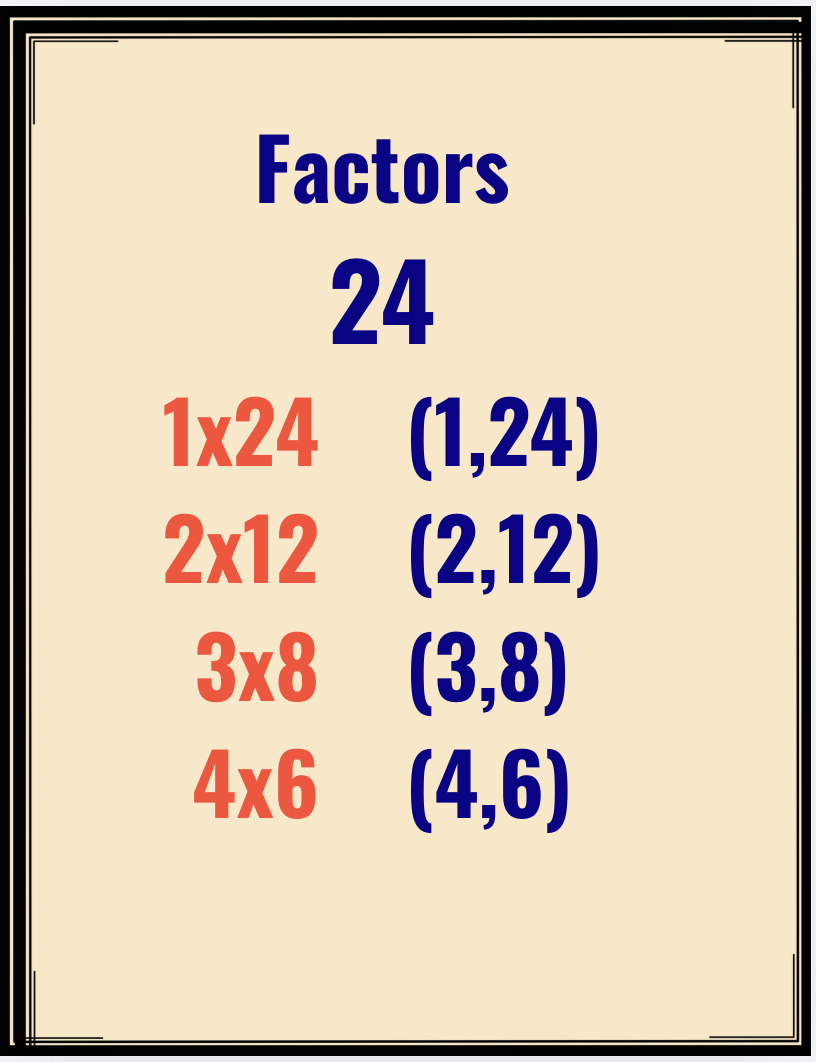
• Play “Tennis” with 36. You name one factor, your child names its pair:
(1,36) (2,18) (3,12) (6,6)
• Try other target numbers:
20, 48, 50, 72.
Prompt 2 — What's a Prime Number?
• Discuss how a prime number has only 1 and itself as factors (i.e. 7)
• A composite number has more than two factors (i.e. 9)
Play Tennis
• Call out numbers between 1 and 50 and ask:
"Prime or Composite?"
13 (Prime), 15 (Composite), 29 (Prime), 33 (Composite), 41 (Prime).
Prompt 3 — Multiples

Play Tennis:
• Call out numbers and ask:
"Is 56 a multiple of 7? Is 45 a multiple of 7?"
• Switch targets until they are comfortable with numbers 1 to 12.
 M2
M2
Multi-Digit Addition & Subtraction
I can fluently add and subtract multi-digit whole numbers up to 1,000,000 using the standard algorithm.
4.NBT.B.4
Skill 1 — Multi-Digit Addition with Regrouping Across Multiple Places
I Do:
• Model setting up 34,857 + 27,465 in vertical place value columns of Ones, Tens, Hundreds, Thousands, Ten Thousands
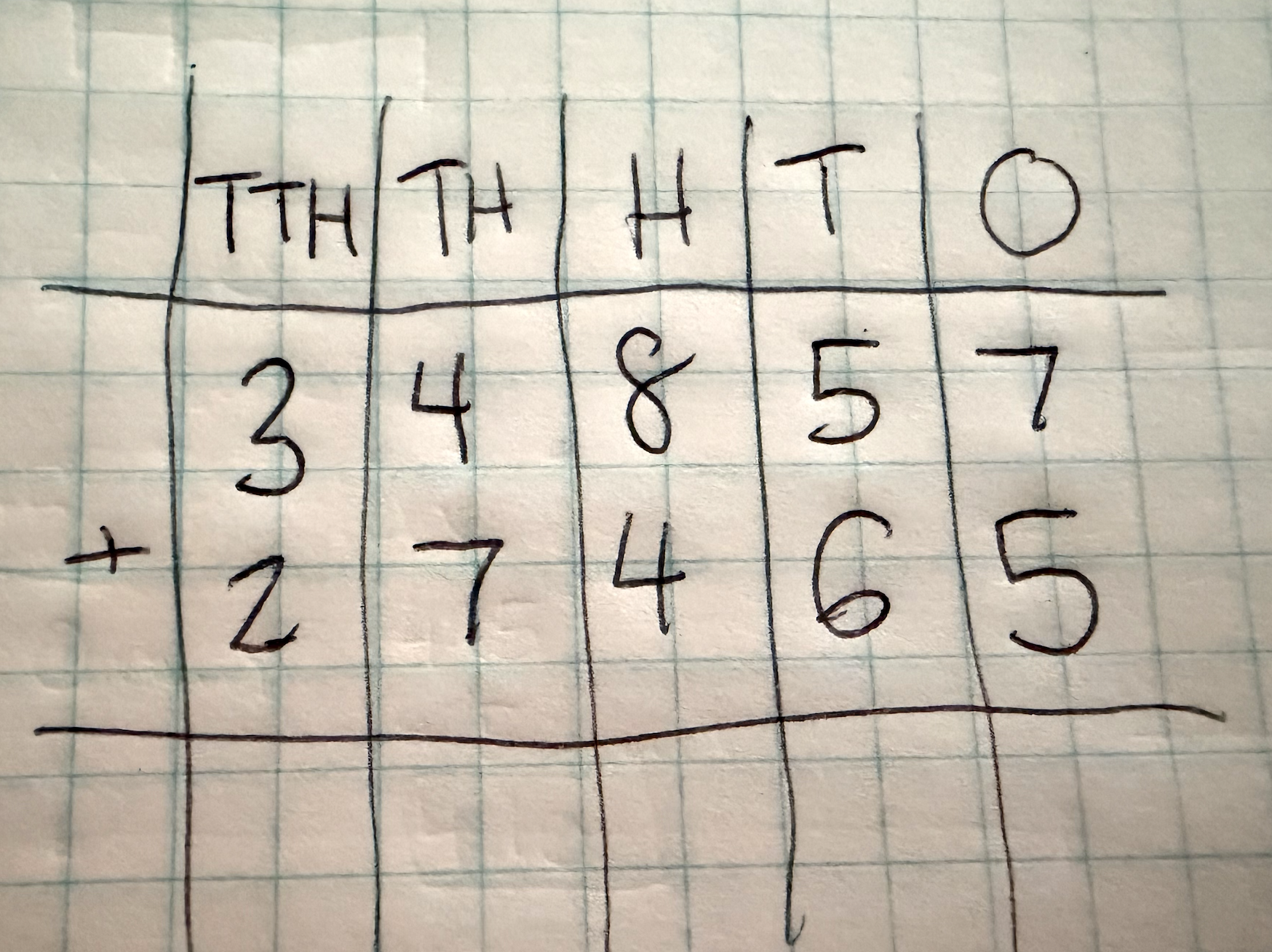
• Add ones: 7+5 = 12 (write 2, carry 1 to tens).
• Add tens: 1+5+6 = 12 (write 2, carry 1 to hundreds).
• Add hundreds: 1+8+4 = 13 (write 3, carry 1 to thousands).
• Add thousands: 1+4+7 = 12 (write 2, carry 1 to ten-thousands).
• Add ten-thousands: 1+3+2 = 6. Answer: 62,322.

We Do: Practice together with regrouping across multiple places:
45,678 + 38,495 =
128,450 + 87,911 =
Skill 2 — Subtraction Across Zeros
I Do:
• Model 50,004 - 23,617.

• Show how to "knock to your neighbor" all the way to the ten-thousands place to borrow 1, changing each column so it's 50,000 to 49,99_ and the ones place has 14.

• Subtract column by column: 14-7=7, 9-1=8, 9-6=3, 9-3=6, 4-2=2. Answer: 26,387.
We Do: Work through regrouping across zeros in the notebook:
70,000 − 34,258 =
40,302 − 18,546 =
M3
Place Value
I can read, write, and round numbers up to 1,000,000 using place value understanding.
4.NBT.A.1 · 4.NBT.A.2 · 4.NBT.A.3
Skill 1 — It's All About 10

• Show how in large numbers, a digit in one place represents 10 times what it represents in the place to its right.
How much bigger is the 5 in 50,000 than the 5 in 500? (100 times bigger).
• Play tennis identifying place values of random numbers up to the Millions place.
What is the value of 5 in 365,978?
What is the value of 2 in 356,528?
Skill 2 — Rounding to Any Place
I DO:

• Round 347,821 to the nearest Ten-Thousand.
• Find the digit in the target place (4 in ten-thousands).
• Look right at the neighbor (7 in thousands).
• 5 or higher? Round up! Change 34 to 35, zero out the rest: 350,000.
We Do Examples:
Round 682,419 to the nearest Hundred-Thousand (700,000).
Round 53,962 to the nearest Thousand (54,000).
Round 128,473 to the nearest Ten (128,470).
Challenge Word Problem:
"A stadium sold 64,812 tickets on Saturday and 28,390 tickets on Sunday. Estimate the total tickets by rounding to the nearest ten-thousand first. Is the estimate larger or smaller than the exact answer?"
M4
Multiplication of Large Numbers
I can now multiply a 4-digit number by a 1-digit number and a 2-digit number by a 2-digit number.
4.NBT.B.5
Skill 1 — Area Model (Box Method) for 2×2 Multiplication
I Do:

• Model 34 × 26 using an Area Box drawn on graph paper:
• Break numbers into expanded form: (30 + 4) and (20 + 6).
• Draw a 2 × 2 box grid:
• Top-left: 30 × 20 = 600
• Top-right: 4 × 20 = 80
• Bottom-left: 30 × 6 = 180
• Bottom-right: 4 × 6 = 24

• Add all 4 partial products: 600 + 180 + 80 + 24 = 884

We Do: Draw boxes and solve together:
43 × 18 =
52 × 37 =
Skill 2 — Multiplication the Traditional Way

This is the way we learned in school. Using the same 34 × 26 example:
• Start with the ones


• Next add the zero beneath and multiply the tens

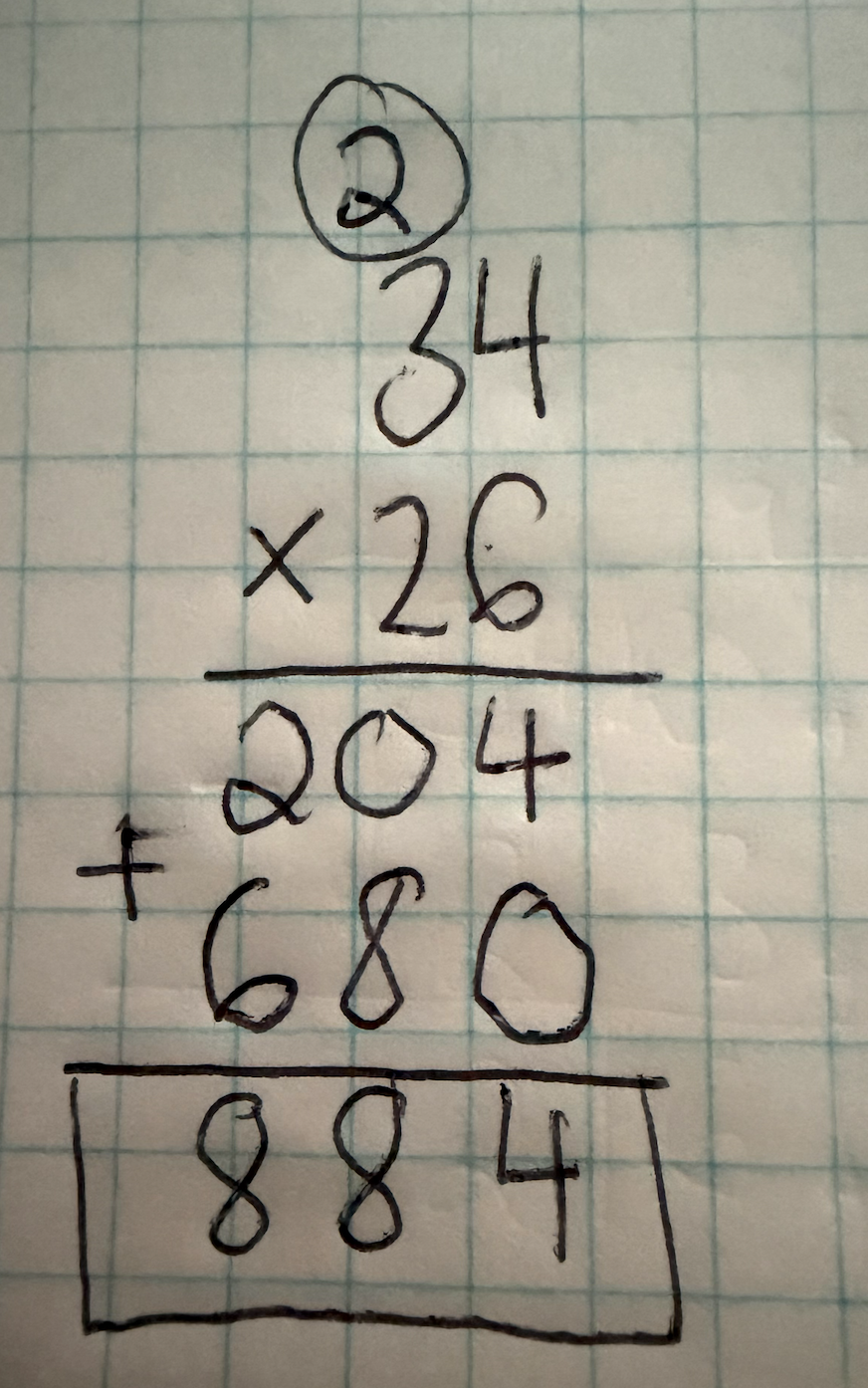
Your total is 884.
Skill 3 — 4-Digit by 1-Digit Partial Products
I Do:

(2,000 × 6) + (400 × 6) + (10 × 6) + (3 × 6)
12,000 + 2,400 + 60 + 18 = 14,478.
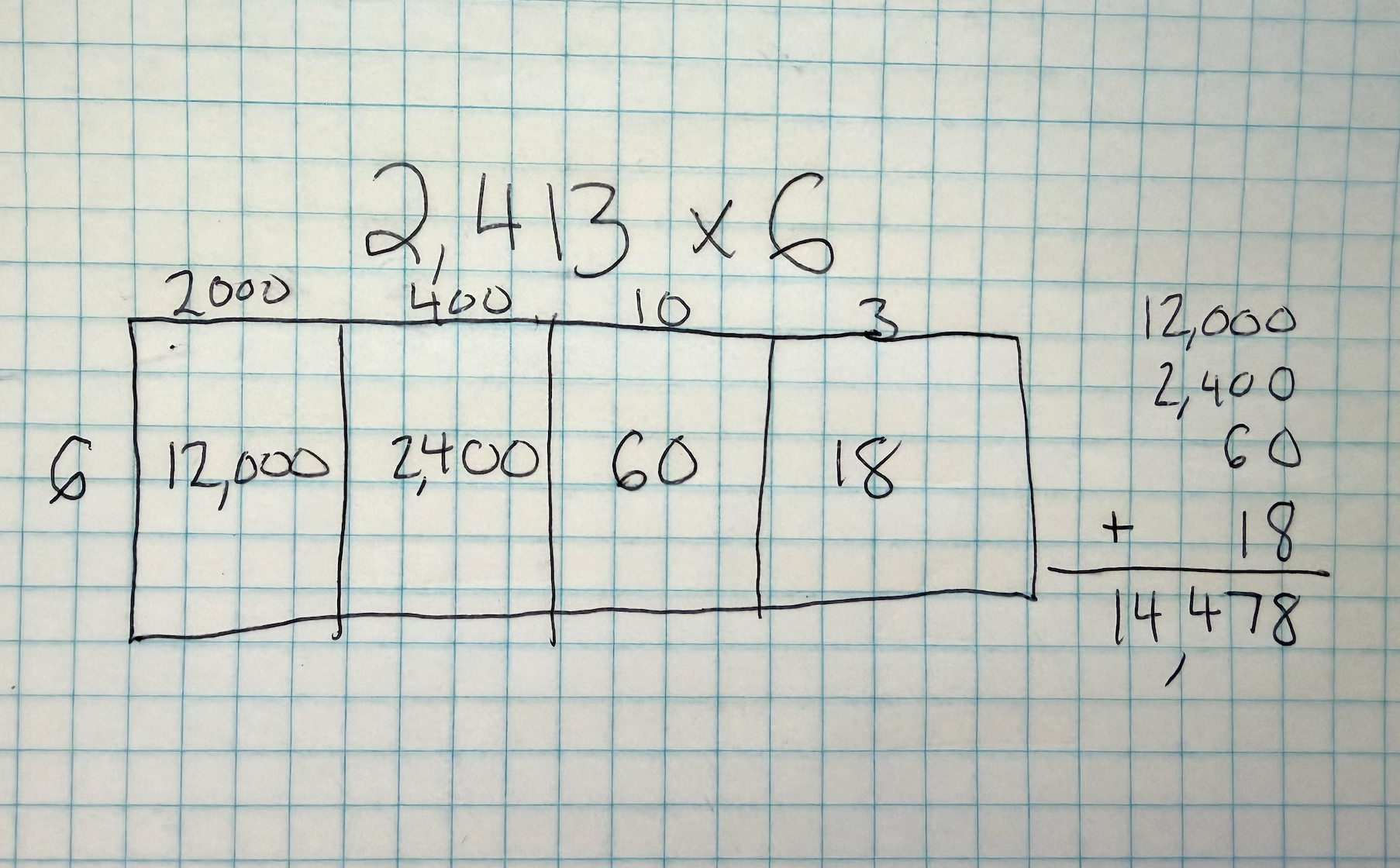
We Do: Try 3,152 × 4 and 5,084 × 7.
M5
Division with Remainders
I can divide up to a 4-digit number by a 1-digit divisor and interpret remainders.
4.NBT.B.6 · 4.OA.A.3
Skill 1 — Area Model for Division
I Do:

• Solve 156 ÷ 4
• Draw two or three boxes to give room to break the larger number up.
• Look for a big multiple of 4 to take your first slice: 4 × 30 = 120. Remaining: 156 - 120 = 36.

• Take out the remaining slice with 4 × 9 = 36.
• Add chunks: 30 + 9 = 39.

We Do: Try:
185 ÷ 5 =
216 ÷ 6 =

Skill 2 — Long Division the Traditional Way with Remainders

• Solving 345 ÷ 7: start with the first number you can do. Not 3, but yes 34.
7, 14, 21, 28 so 4 times. 7×4=28, below 34.

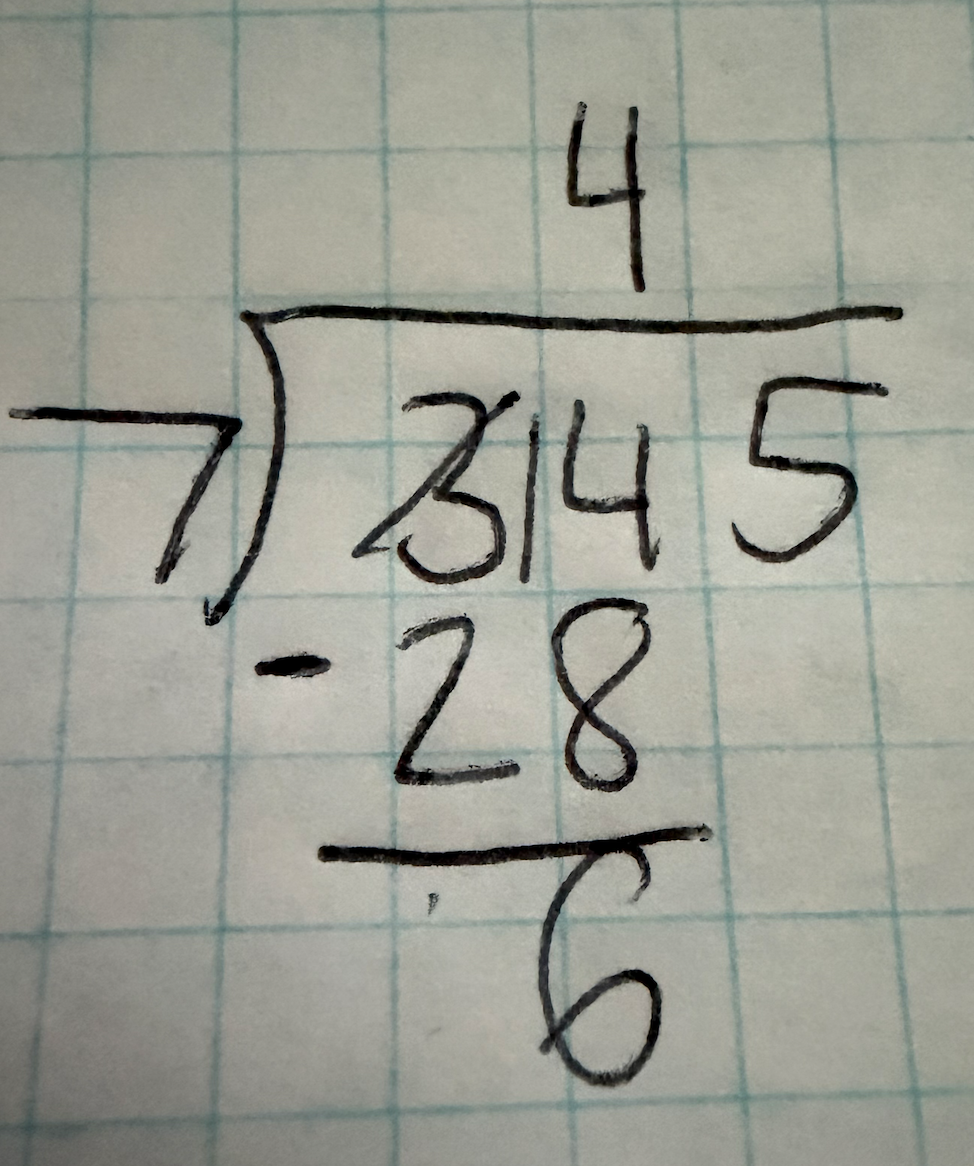
• Then subtract 34-28= 6

• Bring down the 5 to get 65
7, 14, 21, 28, 35, 42, 49, 56, 63 so 9
• So now we are subtracting 65-63=2
• There is nowhere else to go so it's 49 R2

Skill 3 — Division with Remainders
I Do: Solve 43 ÷ 5 = 8 R3. Model what to do with the remainder based on the question:
"If 43 students travel in vans holding 5 kids, how many full vans are there?"
8 vans. 3 would be left behind.
"How many vans are needed to take all students?"
9 vans.

We Do: Practice interpreting remainders:
"135 apples packed into boxes of 8. How many boxes are completely filled? How many apples are left over?"
M6
Word Problems with Variables
I can solve multi-step word problems using letters for unknown quantities.
4.OA.A.3
Skill 1 — Writing Equations with Variables
I Do: Model breaking down a multi-step problem into an equation:
"A farmer harvested 450 apples. She threw away 30 bruised apples and packed the rest equally into 6 crates. How many apples A are in each crate?"
• Step 1: Subtract bad apples.
• Step 2: Divide remaining apples by crates
(450 - 30) ÷ 6 = A
Solve: 450 - 30 = 420
420 ÷ 6 = 70. A = 70 apples.
We DO
"You saved $678. You spent $85 on a new guitar and then spent $10 a week for guitar lessons. How many lessons can you afford?"
Skill 2 — Complex Multi-Step Scenarios
I Do: Model how to set up and solve the following:
"An amusement park sold 3 adult tickets for $25 each and 4 child tickets for $15 each. The group paid with a $200 bill. How much change C did they receive?"
• Adult tickets: 3 × $25 = $75
• Child tickets: 4 × $15 = $60
• Total Cost: 75 + 60 = 135
• Change: $200 - $135 = $65. C = $65
WE DO: Try more like these:
"The school needed to buy 5 math books for $25 each and 6 science books for $30. They have a budget of $300. Can they afford this?"
M7
Comparing Fractions
I can explain and generate equivalent fractions and compare two fractions by finding common denominators.
4.NF.A.1 · 4.NF.A.2
Skill 1 — Generating Equivalent Fractions Mathematically
I Do: Show how multiplying or dividing numerator and denominator by the same number keeps the value equal:
1/2 = 6/12 = 9/18


We Do: Find 3 equivalent fractions in the notebook for:
2/5 5/7 7/8
Skill 2 — Comparing Fractions with Different Denominators

I Do: Compare 3/4 and 5/6
• Run multiples of numerator and denominator for both fractions.
• Identify 3/4 = 9/12 and 5/6 = 10/12 and the “common denominator” 12
So 5/6 > 3/4
We Do: Compare 3/4 and 2/3
M8
Operations with Fractions & Mixed Numbers
I can add and subtract fractions and mixed numbers with the same denominators.
4.NF.B.3a · 4.NF.B.3b · 4.NF.B.3c
Skill 1 — Decomposing Fractions
I Do:

We Do: Try to decompose 7/10 in 3 different ways:
Skill 2 — Addition and Subtraction of Mixed Numbers with Same Denominator
I Do:

• Model adding Mixed Numbers by solving 3 1/4 + 2 3/4
1/4 + 3/4 = 4/4. That's one whole.
3+2=5, plus the extra whole makes 6

We Do: Practice with more:
4 2/3 + 3 2/3
6 1/2 + 4 1/2
I Do

• Model subtracting mixed numbers by solving 5 1/3 - 2 2/3
You can't do 1/3 - 2/3 so we have to regroup
Take one from 5 and add another 3/3 to 1/3

Now we can solve!
We Do: Practice:
4 1/4 - 2 3/4
5 1/6 - 2 4/6
M9
Decimals
I can express decimals as fractions, add tenths and hundredths, and compare decimals to hundredths.
4.NF.C.5 · 4.NF.C.6 · 4.NF.C.7
Skill 1 — Tenths, Hundredths, and Decimal Equivalents
I Do:

Model saying “47 hundredths” and write:
47/100 = 0.47
We DO: Practice some more
0.32 0.07 .4
Skill 2 — Adding and Subtracting Decimals
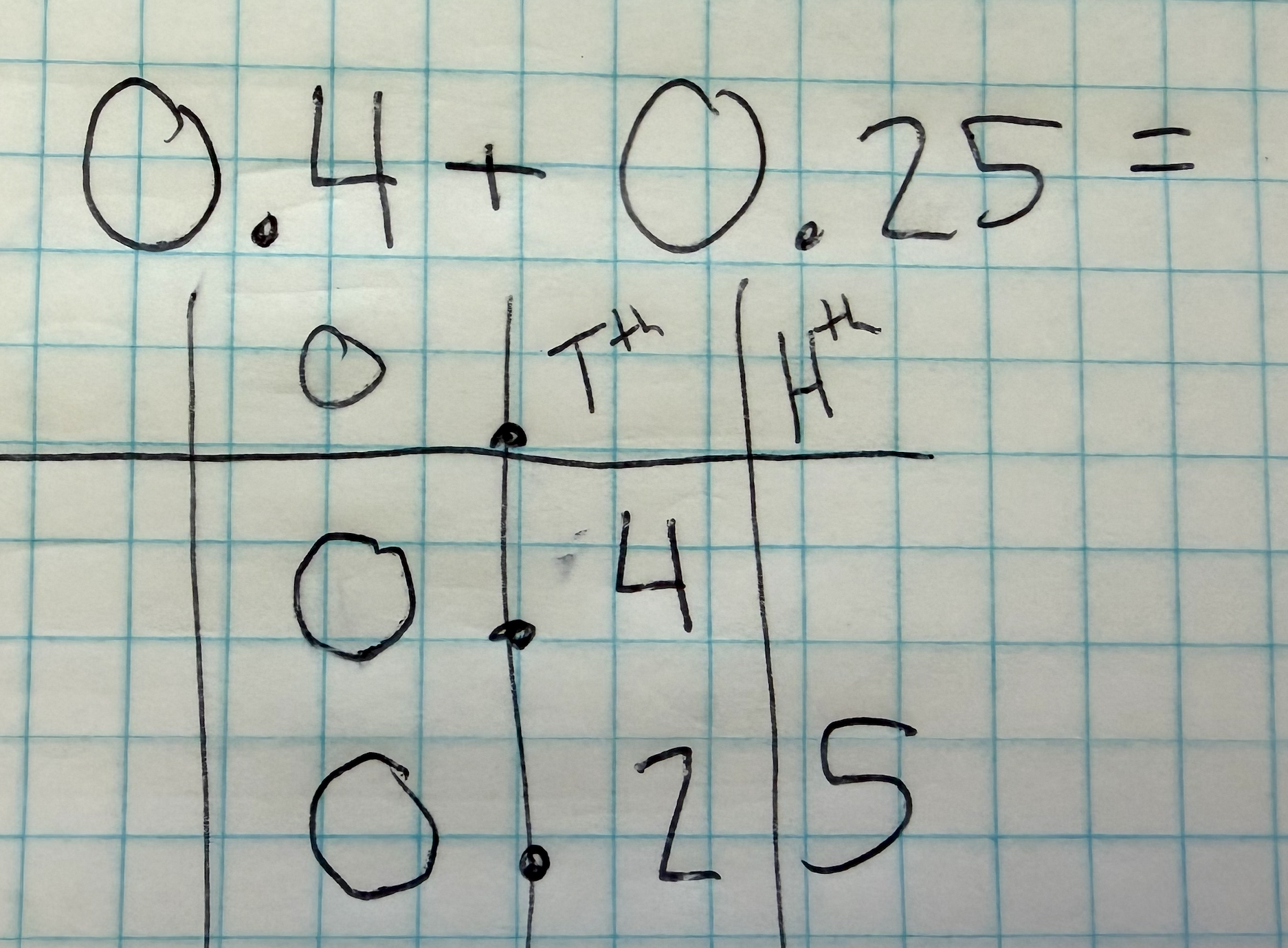
I DO: Set up your Place Value guide with a Ones, Tenths, and Hundredths column.

Point out how .4 = .40
• Add and carry down the decimal.
WE DO:
0.5 + 0.67
0.3 - 0.17
Skill 3 — Comparing Decimals to Hundredths
I Do: Compare 0.7 and 0.68.

We know 0.7 = 0.70 (70 hundredths), while 0.68 = 68 hundredths.
Since 70 > 68 then 0.7 > 0.68
We Do: Compare using <, >, =:
0.4 vs. 0.42
0.09 vs. 0.1
0.85 vs. 0.9
M10
Elapsed Time and Unit Conversions
I can solve measurement word problems involving elapsed time and convert between larger and smaller units.
4.MD.A.1 · 4.MD.A.2
Skill 1 — Unit Conversion Tables
I Do: Model conversion tables (1 unit = n smaller units):

We Do: Try to Convert:
7 hours to min
6 feet to inches
568 g to kg (decimals)
Skill 2 — Elapsed Time Problems Using Number Lines
I Do:

• Create a timeline with each square on the graph paper marking 10 minutes.
• Read the problem and either use a timeline or addition to solve.
"John leaves home at 2:35 PM. He walks 10 min to the library, stays 45 min, and waits 15 min for his ride. What time does his ride arrive?"
stop 1: 2:35 + 10 = 2:45
stop 2: 2:45 + 45 goes past 3pm by 30 min = 3:30
stop 3: 3:30 + 15 = 3:45
We Do:
"A movie begins at 4:15 PM and lasts 1 hour and 40 minutes. What time does it end?"
"It takes 5 min to walk to your car and 25 min to get home. What time do you arrive?"
M11
Area & Perimeter
I can apply the area and perimeter formulas for rectangles in real-world context.
4.MD.A.3
Skill 1 — Area and Perimeter Formulas
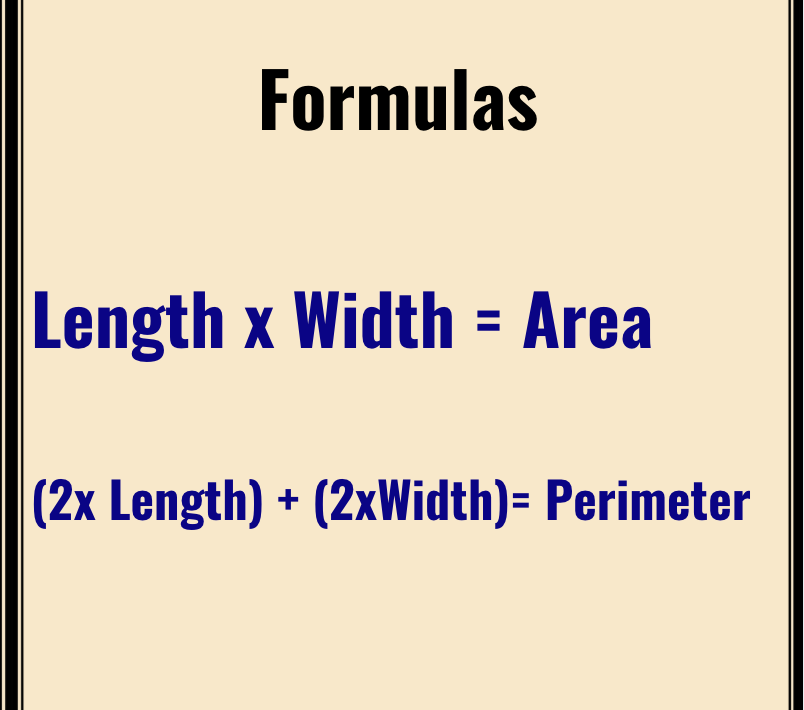
Review Formulas: P = (L+W) × 2 and A = L×W
I Do: A backyard garden is 12 feet long and 8 feet wide.
P = (12 + 8) × 2 = 20 × 2 = 40 feet.
A = 12 × 8 = 96 sq feet

Skill 2 — Finding Missing Dimensions
I Do: "A rectangle has an Area of 48 square inches. Its length is 8 inches. What is its width and perimeter?"
Step 1: 8 × W = 48. W = 6 inches
Step 2: (8 + 6) × 2 = 28 inches
We Do: Practice missing dimension problems:
"A rectangular rug has a perimeter of 30 feet. The width is 5 feet. What is the length and area?"
M12
Angles & Geometric Measurement
I can identify lines, angles, symmetry, and measure/draw angles using a protractor.
4.G.A.1 · 4.G.A.2 · 4.G.A.3 · 4.MD.C.5 · 4.MD.C.6
Prompt 1 — Geometric Vocabulary
Define and point out examples in the room/car:

• Parallel Lines: Lines that never cross (e.g., opposite sides of a window).
• Perpendicular Lines: Lines that intersect at a 90 degree (right angle) (e.g., door corner).
• Angles: Acute (<90 degrees), Right (90 degrees), Obtuse (>90 degrees), Flat line (180 degrees)
PLAY TENNIS
Prompt 2 — Lines of Symmetry

Discuss 2D figures (triangles, parallelograms, trapezoids, hexagons).
Ask: "How many lines of symmetry does a..."
The square have?
The rectangle have?
The hexagon have?
The triangle have?
Prompt 1 — Selecting a focused topic: Narrow down a high-interest research topic that allows for subtopic categorization. Present 2–3 options:
- The science of earthquake fault lines and plate tectonics
- How solar panels convert sunlight into electrical energy
- The life cycle and navigation systems of monarch butterflies
Guide your student to select one topic and formulate a primary research goal.
Prompt 2 — Developing subtopic inquiries: Model formulating 3–4 specific inquiry questions that will serve as chapter subheadings — e.g. "What geological forces cause fault lines to slip?" or "How do seismographs measure earthquake magnitude?"
Notebook follow-up: Allocate a dedicated page in the graph paper notebook for each subtopic question to organize incoming research notes.
Model searching trusted kid-friendly digital encyclopedias (e.g., Kiddle, Britannica Kids). Show how to evaluate results and cross-reference details across two distinct sources.
I Do (non-tech option)Visit the library. Model using the Index and Table of Contents in non-fiction books to find relevant pages, cross-referencing between two texts.
I Do — note-takingModel taking bulleted notes using key phrases rather than copying whole sentences. Demonstrate paraphrasing to prevent plagiarism.
We DoHave your child select their second inquiry question, locate answers across two sources, and record paraphrased notes. Verify they cite source names/URLs alongside their notes.
Review an exemplar 4-paragraph informational report, highlighting:
- Introduction: an engaging hook, domain vocabulary, and a thesis introducing the subtopics
- Body paragraphs: organized under bold subheadings; facts, definitions, and precise vocabulary
- Conclusion: synthesizes key findings and a lasting thought on real-world impact
Guide your child in converting bulleted notes into structured paragraphs, using transitional phrases (Furthermore, As a result, In contrast).
PublishStaple drafted pages into a formal reference booklet. Include hand-drawn labeled diagrams, a glossary of domain terms, and a table of contents.
Open Google Slides or PowerPoint. Model creating a professional 4-slide deck: a clean theme and readable font hierarchy, narrative paragraphs converted into concise bullet points, and high-resolution diagrams/images that reinforce text claims.
We DoAssist your child in building their draft into slides, creating custom visual layouts, and practicing oral delivery.
ChallengeHave your child present the slideshow to family or peers without reading directly off the slides, using the visuals as oral cues.
Review a narrative graphic organizer. Show how a broad event ("Family Camping Trip") narrows into a specific small moment ("Setting Up the Tent in a Downpour"). Point out four elements: Exposition & Hook, Rising Action & Conflict, Climax & Pacing, Resolution & Reflection.
We DoHave your child divide a notebook page into 4 quadrants. Brainstorm a focused 20-minute memory, outline the arc, and articulate the lesson learned (e.g., "Patience and teamwork can turn a disaster into an adventure").
Demonstrate expanding story points into descriptive sentences using sensory imagery (sight, sound, touch) and prepositions to show spatial relationships.
We Do- Have your child state sentences aloud before writing
- Focus on pacing — slow down the most critical moment with internal thoughts and physical reactions, beat by beat
- Encourage advanced word choices (e.g., "scared" → "apprehensive" or "trembling")
- End with a reflective paragraph on how the experience shaped their perspective
Compare a draft with an edited exemplar. Think aloud through editing: correcting dialogue punctuation, and replacing weak verbs/nouns with vivid alternatives ("ran" → "sprinted across the muddy clearing").
Guide revising for sentence variety, dialogue punctuation, and precise vocabulary. Publish a final handwritten or typed copy with an illustration of the climax.
Prompt 1: "What is one policy, facility, or program at our school or in our city that needs improvement?" Examples: solar shading over the blacktop, expanding bike lanes, a cafeteria composting system.
Prompt 2 — Stakeholders & counterarguments: Identify the decision-maker (Principal, City Council Member, Parks Director). Brainstorm supporting reasons. Anticipate objections: "Why might someone disagree?" (e.g., installation cost, maintenance labor).
Model using search engines or news databases to locate numerical data, scientific facts, or budget statistics.
We DoGuide your child in finding 3 compelling facts and 1 counterargument response, organized into a 4-box planner:

Display a formal business letter template: sender address, date, recipient address, salutation, indented body paragraphs, closing, and signature. Example:
Have your child draft their letter using their research planner. Practice typing in a word processor — tab indents, block formatting, formal tone, spell-check. Mail or email the completed letter to the actual recipient!
Select and read at least two classic myths, legends, or fables sharing similar themes across different cultural origins:
- Trickster tales: Anansi the Spider (West Africa) vs. Iktomi the Spider (Lakota Nation)
- Origin myths: How the Bear Lost His Tail (Iroquois) vs. How the Kangaroo Got Her Pouch (Aboriginal Australian)
- Overcoming odds: The Tortoise and the Hare (Greek Aesop) vs. The Turtle and the Monkey (Filipino folk tale)
Notebook follow-up: Draft a 3-sentence summary for each narrative, identifying the central conflict and moral/explanation.
Identify narrator perspective (1st person vs. 3rd person omniscient). Examine character motivations: what did the protagonist want? Was the antagonist acting from malice, survival, or foolishness? Pinpoint the climax in both tales.
Alternative perspective writing: Have your child select one fable and rewrite the climax scene from the antagonist's or trickster's point of view.
Model an analytical Venn diagram comparing both texts across four dimensions: moral/cultural theme, character motivations & traits, flaws or trickery employed, and narrator perspective & tone.
We DoGuide transferring points into a 3-paragraph comparative essay: (1) intro to both tales, cultural origins, and shared theme; (2) key structural differences in choices and plot twists; (3) concluding analysis of which fable communicated its message more effectively, and why.
Model using a physical ruler on small items (pencils, markers, keys, utensils). Show how to locate fractional tick marks: ⅛, ¼, ⅜, ½, ⅝, ¾, ⅞.
I Do (TechTools option)Demonstrate a digital caliper or smartphone measurement tool set to imperial fractional units.
We DoGuide your child to select 12 small objects, estimate each length, then measure to the nearest ⅛ inch. Record results in a 2-column T-chart (Object Name | Actual Length in Inches).
Show how to convert measurements into a frequency data table and construct a line plot: draw a horizontal number line from the shortest to longest length, divide each whole-inch interval into 8 equal subdivisions, and plot an X above each measured value.
Assist your child in plotting all 12 measured data points, verifying tick marks are evenly spaced and labeled.
Difference question: "What is the difference between the longest object (6⅝ in.) and shortest (2⅛ in.)?" → 6⅝ − 2⅛ = 4⁴⁄₈ = 4½ inches.
Combined length question: "If you laid all items measuring 3⅛ inches end-to-end, what's the total combined length?" → 3⅛ + 3⅛ + 3⅛ = 9⅜ inches.
We DoHave your child write and solve 3 custom analysis questions based on their own completed line plot.
Select a multi-room floor area (e.g., bedroom plus adjacent hallway or closet). Sketch the outer wall boundary in the notebook.
TechTools optionModel using a laser distance measure or smartphone room-scanning app, rounding wall lengths to the nearest whole foot.
Non-tech optionModel using a long tape measure or a 1-foot pacing scale along baseboards.
We DoGuide your child in measuring all outer wall lengths, writing every dimension clearly on the rough sketch.
Model establishing a scale on graph paper (1 square = 1 square foot). Use a straightedge to draw the outer perimeter, counting grid squares to match measured footage.
 We Do
We Do
Have your child construct the scaled blueprint, adding internal walls, door swings, and major furniture (bed, desk, rug) drawn to scale.
Show how to decompose an L-shaped or multi-room plan into non-overlapping rectangles, applying A = L × W to each:
Have your child decompose their own floor plan, write multiplication equations for each rectangle, and sum the results to find total area and perimeter.
Gather loose coins, allowance records, or gift funds. Demonstrate an accounting ledger in the graph notebook:
Model counting coins systematically — group into piles, write a multiplication expression for each denomination, and sum to find the total balance.


Browse an online storefront (e.g., target.com, scholastic.com).
Non-tech optionUse print store catalogs or store circulars.
Have your child select 4–5 desired purchase items across different price points ($10 to $100), recording an itemized Wish List table with item name, unit price, and estimated sales tax.
Model evaluating purchase options against the current balance using multi-digit subtraction with regrouping. Example: balance $78.45, purchase $34.50 + $28.99 = $63.49, remaining balance = $14.96.
We DoHave your child run 3 purchasing scenarios against their balance:
- Scenario A: Purchase the single most expensive item — what's the remaining balance?
- Scenario B: Purchase the maximum number of lower-cost items.
- Scenario C (deficit saving plan): If the desired total is $125.00, the deficit is $125.00 − $78.45 = $46.55. At $8.00/week allowance, $46.55 ÷ 8 ≈ 6 weeks of saving required.
 Scenario
Look at the image. Diego and his group are finishing a science project. Diego didn't do his part of the research, so the night before it's due, others help finish his work.
- Why might Diego have made this choice?
- What do his classmates feel?
- Is there a consequence even if the teacher doesn't notice?
- What could Diego have done instead, even starting the night before?
Scenario
Look at the image. A group of four students works on a poster together. Three of them do most of the drawing and writing. The fourth, Jordan, mostly talks and doesn't do much — but all four names go on the poster and get the same grade.
- Is this fair to the three students who did more work?
- Is it possible Jordan has a reason for not contributing that the others don't know about?
- What could the group do to make the work — and the credit — feel more fair?
- Is fairness always about everyone doing the exact same amount?
 Scenario
Look at the image. Amara gets a math problem wrong on the board in front of the class. Some kids snicker. She has two choices: laugh it off and stop raising her hand for the rest of the year, or ask the teacher to explain what she got wrong.
- What makes the second choice harder in the moment?
- Why might a scholar choose the harder option anyway?
- What's the difference between being wrong and being a bad student?
- Have you ever had a moment like Amara's? What did you do?
 Scenario
Look at the image. Sam uses a different way of learning — he listens to audiobooks instead of reading print books, and uses a calculator for math the other kids do by hand. A classmate says, "That's cheating, that's not fair."
- Is Sam getting an unfair advantage, or getting what he needs to learn well?
- Why might someone assume a different way of doing something is "cheating"?
- How would you explain the difference between "fair" and "identical" to that classmate?
- What's a way you learn or do things differently from your friends?
 Scenario
Look at the image. A group chat is going around making fun of a classmate's photo from the school dance. Elena hasn't sent anything, but she "liked" a few of the messages.
- Is liking a message the same thing as sending it? Why or why not?
- What consequence might Elena face that she isn't thinking about in the moment?
- What could Elena do instead of liking the messages — and would that feel hard?
- How is a choice online different from a choice made in person? How is it the same?
 Scenario
Look at the image. At lunch, a group of students is quietly excluding Jordan — not saying anything mean, just making sure there's never a seat open for him. Elena notices but isn't part of the group.
- Is this a form of unkindness, even though no one says anything unkind out loud?
- What makes it harder to speak up about something like this than about an obvious insult?
- What's the difference between a bystander and an upstander?
- What's one small thing Elena could do that wouldn't feel too big or scary?
 Scenario
Look at the image. Marcus gets an essay back with more red pen marks than he expected. His first instinct is to feel like the teacher doesn't like his writing.
- Is that the only possible reason for the marks?
- What's the difference between feedback on your work and feedback on you as a person?
- Why is it sometimes harder to hear feedback from someone you respect?
- What would a scholar do with the essay next?
 Scenario
Look at the image. Priya has been quiet and distracted in class all week. A classmate assumes she's being rude when she doesn't respond to a joke. What the classmate doesn't know: Priya's grandmother has been sick, and she's been worried.
- Why is it easy to misread someone's behavior without knowing the full story?
- Does knowing the reason change how you'd react to Priya?
- Is it fair to expect people to explain what's going on with them before you judge their behavior?
- What's a respectful way to check in with someone who seems "off," without prying?
 Scenario
Look at the image. Jordan's family celebrates a holiday none of his classmates have heard of. When he brings it up, one student says, "That's weird, why don't you just do it like everyone else?"
- Why might someone say something like that without meaning to be hurtful?
- How would you feel if something important to your family was called "weird"?
- What's a better response Jordan's classmate could have given?
- What's a tradition or belief in your own family that might be unfamiliar to others — and how would you want someone to react to it?

Words Per Minute
0