
Mastering your role as parent not by doing more, but by being intentional with the moments you have every day.
Christopher MedingerJan 31, 2026

If parenting were a river, 2026 is the year the whitewater knocks the paddle out of your hands and turns the map to mush.
Between Zoom meetings, the rapid rise of AI, and the logistical gymnastics required to get children to school, practices, tutoring, and the occasional dentist appointment, families are running on fumes. This isn’t the kind of tired a good cup of coffee can fix. It’s deeper than that.
After 22 years in education, 13 now as a school principal, I have watched modern parenthood up close. Each morning at drop-off, I see parents juggling water bottles, phones, backpacks, and a thousand invisible worries. Children are handed off to teachers with a mixed look in their eyes of love, guilt and hope.
Earlier in my career, when I was a classroom teacher, I didn’t fully understand this. I believed most students would thrive if families simply had more time to support learning at home.
Now, as a parent of two myself, I see the full picture.
Before we go any further, let me say this clearly:
You are doing far more than you think.
This article isn’t meant to add pressure. It’s meant to ease it.
Let’s find those small, ordinary moments you already have and make them matter.
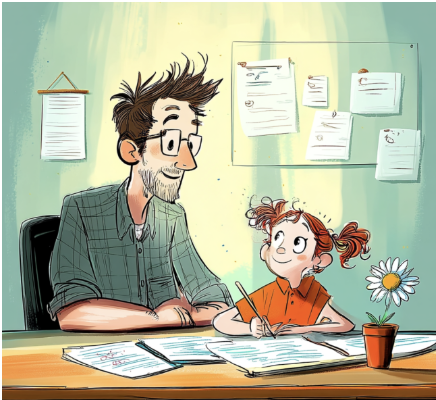
When Parents Listen, Children Thrive
Over the years, I’ve watched many educational theories cycle through schools. New curricula. New technologies. New programs. Each promises to be the solution for student success.
And yet, nationally, student achievement and student well-being continue to struggle.
Why?
I believe part of the answer lies in how far we’ve drifted from what children need most. Education has gradually shifted from a shared responsibility to something increasingly outsourced. Teaching has been reframed as technical expertise rather than a natural role families and communities play together.
As a result, many parents hesitate to step in. Education feels complicated and jargon-heavy. There’s a fear of doing something wrong.
So we hire tutors. We download apps. We even turn to AI.
However, there is an ageless truth in education, one that research continues to confirm:
Children grow best when they feel truly seen, heard, and supported by adults who love them.
Whether you are aware of it or not, you model for them with your thinking, speaking, and empathy in each interaction. When you direct your full attention to them, it is like providing sunshine for a flower. It is the fundamental source for a young and growing brain’s craving for new information.
This is grounded in decades of research on child development, attachment, and learning. It’s not about being perfect, it’s about being present.
When parents lead with listening—rather than correction or “I know best”—they build a deep line of trust. That trust becomes critical as children move into adolescence and beyond.
In a landmark study published in 2019—“Parental Warmth and Flourishing in Mid-Life”—followed participants from childhood into adulthood. The results were striking:
Adults who experienced higher parental warmth were 21% more likely to be flourishing in midlife
They had an 18% lower risk of depression
And a 17% lower risk of illicit drug use
Let that sink in.
The attention you give your child today doesn’t just help them survive third grade or even middle school; it echoes into their 40s and 50s. It might be your next bedtime conversation or car-ride check-in. It’s that moment when you put the phone down and really listen.
We can rebuild the Bridge between School and Home
With this mindset, parents can begin listening more closely to what their children are working on at school—and how they feel about it.
This may sound unpopular, but homework once played an important role here.
Historically, homework served as a bridge between school and home. Families reinforced skills and habits, and learning became visible. Over time, however, homework became associated with stress rather than connection.
A 2021 study found:
40% of parents reported frustration
37% said homework caused stress or anxiety
Over 75% communicated with teachers less than once a month
More than 25% said homework regularly interfered with family time
In response, many schools, including mine, scaled back traditional homework.

To be clear, this is not a call for more homework.
It is a call to rethink its purpose.
Homework was never meant to be about completion. It was meant to offer insight. When a child struggles, that moment is not failure—it’s information. Those few minutes spent listening and problem-solving together are where learning actually happens.
In response, many schools scaled back traditional homework, including mine. This, however, was not in the student’s best interest. I speak for almost all teachers when I say that homework is not about completion.
Your child’s assignment is about your student practicing a skill with you. If they have trouble and don’t finish. That’s ok. It’s much more important that you use these assignments as an intentional connection point to listen and learn what they did in school that day.
A Simple Guide to Providing Sunshine
Photo by Aaron Burden on Unsplash
During the first year of remote learning, I watched parents step into the learning process in powerful ways. When families were given clear, manageable routines, confidence grew—and so did student learning.
At our school, we saw academic growth not because parents became teachers, but because they became partners.
What remained clear then—and remains true now—is this: small, consistent habits make a meaningful difference.
Even twenty minutes of screen-free time a few times a week can reinforce learning, uncover confusion, and build confidence.
I’ve seen this not only as a principal, but as a parent to my own daughters.
Here are three routines that consistently support children—academically and emotionally.
1. Household Routines That Build Responsibility
Children don’t automatically know how to contribute to a group. That skill must be taught and practiced.
When children are given real responsibilities, they begin to see themselves as capable and trusted members of the family.
These routines teach children:
Their contribution matters
How small tasks support the larger group
What it feels like to be trusted
Pride in doing a job well
Simple roles like setting the table, organizing shoes, or managing a calendar will carry real weight when children know their work matters. Talking about their strategies to fulfill the tasks will guide them toward efficiency.
Resist the urge to rescue. Small mistakes in safe spaces build confidence that carries into the classroom and beyond. You are the best person on earth to give them constructive criticism in a way they can digest positively.
Photo by Vitaly Gariev on Unsplash
2. Drive-Time Discussions
Car rides, walks, and quiet transitions are some of the best opportunities for connection. It’s a low-pressure moment where kids often open up more freely.
These conversations help children:
Practice reflection and build empathy
Develop metacognitive and higher-level thinking skills
Feel that their voice matters to you
Instead of rapid-fire questions, aim for open-ended prompts. Listen without correcting or fixing. Over time, these small conversations build trust. Your child will see you are a good place on which to bounce their ideas off.
3. Family Storytime
Storytime is about more than learning to read. It’s about learning how to think like an author.
Reading together provides a wonderful opportunity to:
Develop Comprehension and vocabulary
Learn how to apply and imitate the author’s techniques
Develop Emotional awareness and empathy for characters
Make connections to prior experience to predict future outcomes
Model reading to them until they are ready themselves. Then choose a book just above their ability to read on their own. Take turns reading and stop to ask clarifying questions and predict what may happen next. For early readers, point to words as you say them so they begin recognizing them by sight.
After reading, I love drawing pictures with my daughter about what the movie was like in our brains. For older students, you can explore how the author made choices in dialogue or description. For younger students, you can study the characters and connect them to their life experiences.
Pay attention to energy levels. When your child is tired, stop. Learning works best when it’s welcomed.
These routines aren’t about structure for structure’s sake. They are about connection.
Whether your child is helping at home, talking in the car, or thinking through a story, they are practicing skills that matter for school and beyond.
Small moments, used with intention, can build responsibility, communication, reflection, and change lives.

At Parent Potential, we help families create meaningful learning moments during the critical kindergarten through third-grade years with convenient routines that fit into your busy life.
Through just twenty minutes a few times a week, parents can create consistent, high-impact learning moments that allow them to deepen their connection.
The most powerful learning tool your child has is already at home.
It’s cheaper than a tutor and much more engaging than a learning app.
It’s you.