
 Image 1 of 2
 Image 2 of 2
Our Digital Dashboard and Toolbox are built to give you exactly what you need to succeed with each card, right at your fingertips.

Here are a few sample cards to see how is easy this is. We have one from each habit, a sample project and an SEL activity.

Mixed Sampler
A custom sampler pulling one card or skill from each subject — Math, Language, Projects, and SEL — each keeping its own subject color.
 M3Math
Place Value — Expanded Form and Comparison
I understand how to use ones, tens and hundreds place values to read, write, and expand numbers.
NBT.2.4 · NBT.2.1 · NBT.2.3
Skill 4 — Expanded Form and Comparison (<, >, =)

• Show how to write 347 in expanded form:
300 + 40 + 7 = 347
• Say, "there are 3 hundreds 4 tens and 7 ones"
• Have them use Listen and Write to write some more examples in expanded form:
484 859 395
• Have them try this for 4,734:
4000 + 700 + 30 + 4
• Compare the numbers 392 and 459 by expanding them first to show that the hundreds column is what matters.
• Remind them that we use <, > to compare two numbers, and that the "alligator" eats the bigger number.
300 + 90 + 2 < 400 + 50 + 9
• Use the example comparing 381 and 345 to point out that when hundreds are the same, then you go to tens.
300 + 80 + 1 > 300 + 40 + 5
• Practice using Listen and Write:
• 1st have them compare any two numbers, with them writing out the expanded form as above.
• Later, just give them two numbers and they simply write the comparison:
356 > 349
• Move into comparing numbers with the 1000s place.
 Math Generator
M6Math
Number Lines — Adding and Subtracting with Arrows
I can use a number line to add and subtract numbers.
MD.2.6
Skill 2 — Adding and Subtracting with Arrows on the Number Line
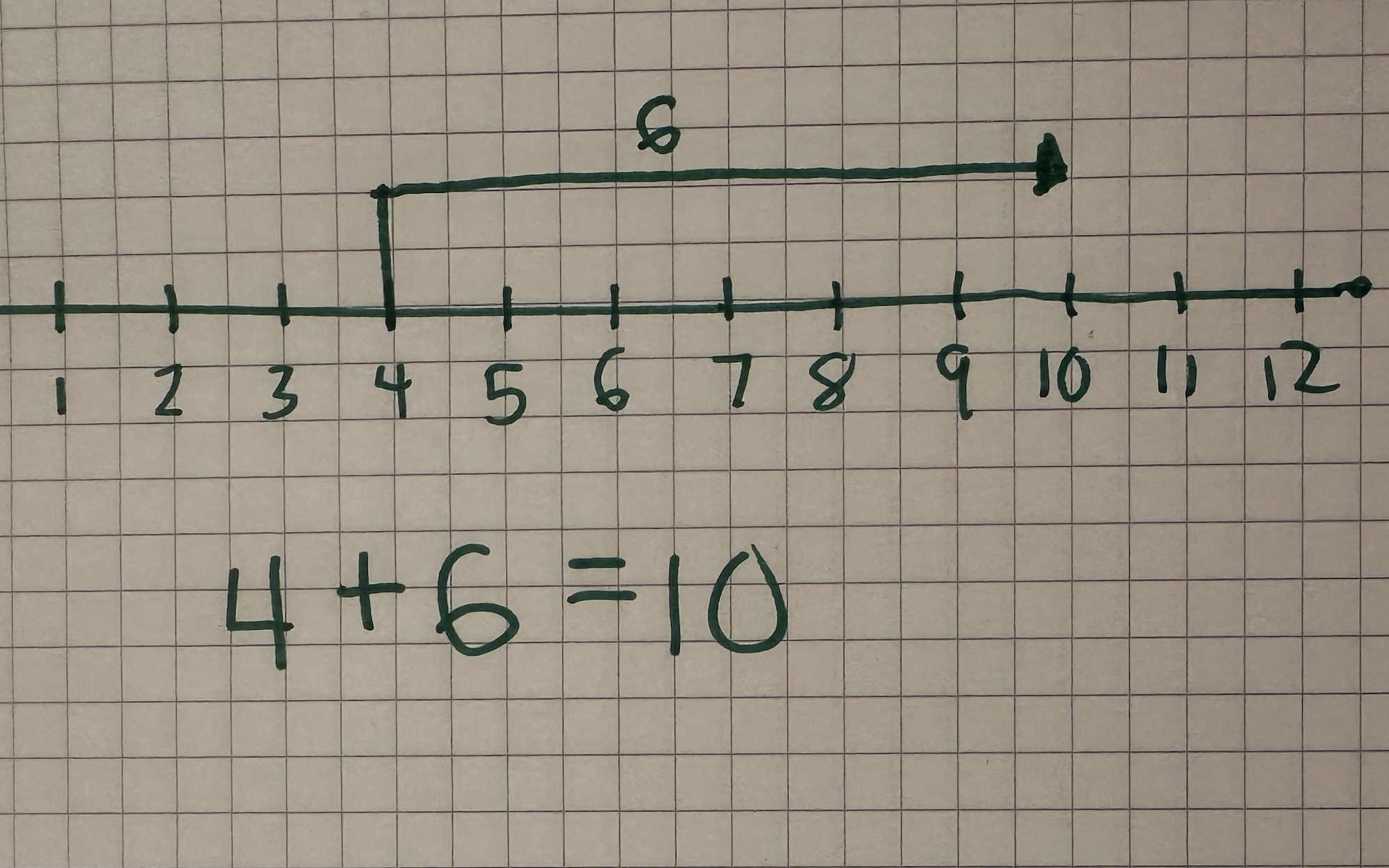
• Using the graph paper and a ruler, draw another number line counting by 1.
• Write the equation 4+6=10.
• Show this by starting an arrow at the 4 and drawing it 6 tics up toward 10.
• Have them try to replicate this, but with 3+2=5.
• Have them try a subtraction problem like 11-4=7. Now the arrow will count 4 to the left.
 L4Language
Longer Words — Reading by Syllables
I can read and write longer words.
RF.2.3a
Skill — Reading Words by Syllables
• The key to reading longer words is an understanding of how syllables work.
• Start by practicing with your student how to clap out syllables in words using:

hap/py read/ing ta/ble
• Point out that each syllable has a vowel sound.
• When the vowel comes at the end of a syllable, it becomes long (Open). If a vowel is followed by a consonant before the syllable break and it's alone, it's short (Closed).
• Use Listen and Write to practice spelling words by their syllables and have them write in a dividing line:
o/pen
si/lent
ta/ble
han/dy
re/mem/ber
Feb/ru/ar/y
• Have them point out the Open and Closed syllables in each.
• Practice words that use vowel teams to create long vowels inside closed syllables like:
sleep/y
rain/bow
clean/est
eat/ing
Use our Listen & Write Generator for grade-level dictation words, sentences, and paragraphs read aloud.
 L9Language
Making Connections — Prior Knowledge
I can see how the characters or events in the story are like things I have seen.
RL.2.5 · RL2.6 · RL 2.9 · RL 2.10
Skill 2 — Prior Knowledge of the World
• Making connections lets you tap into prior knowledge of the experience and get deeper into the story or article.
• If you are reading a story, ask something like:
"If you were around this character, what would you say to him?"
"How do you think she is feeling after she realized this?"
• If you are reading an article or informational text, ask something like:
"Have you heard of this behavior in butterflies?"
"Does this article challenge anything you thought was true about this topic?"
 Informational Text Generator
Use our Informational Text Generator to create a grade-level nonfiction passage on a topic they like.
P2Projects
A Small Moment Narrative
Turn a memory they have of an event in their life into a "Small Moment" story that includes a life lesson for the reader.
RL2.5 · W2.3 · L2.2c · L2.1a · RL2.2
Card A — Brainstorming

• Use the graphic organizer above to point out how:
• Their title shows they broke down a big idea like "Going to the beach" into a small moment like "Finding a sea turtle."
• They have a clear Beginning, Middle, and End to the memory.
• They found a Moral for the reader: "Don't lose hope and you can find something special."
• Have them use their notebook to recreate these sections by dividing the page into boxes (or visit our QR for a printable version).
• Prompt them to narrow their moment into something clear and focused, before writing the title.
• Work through the memory with them to define the clear beginning, middle and end.
• Did they learn something from this? Guide them to identify it.
Card B — Drafting with Details
• Review the exemplar narrative "Finding a Sea Turtle" on the website and point out how they took their notes from each section of the graphic organizer and expanded it with description in complete sentences.
• Point out how the account slows down and describes each moment when they find the sea turtle.
• Point out how they used the lesson to help create a satisfying ending for the reader.
• Review their graphic organizer and speak with them about how they want to expand these with description.
• Have them say the sentence to you first, and then when it sounds ready, let them write it down.
• Encourage your student to practice the "inventive" sound spelling and take risks in choosing new, more "scholarly" words in their writing.
• After a few sentences, have them practice saying it out loud to themselves before writing it down, and eventually fade into "You DO."
• Remind them to finish with their lesson for the reader.
Card C — Revising & Publishing
• Model reading over the two versions of the example story and think out loud on how you:
• Identify and fix mistakes.
• Identify basic words and pick better ones (e.g., changing "sad" to "discouraged").
Finding a Sea Turtle — Story 1
Me and my mom was walking on the beach and I was sad because we diddnt find any cool shells. I was gonna give up but then I sawed something move in the sand it was a baby sea turtle! It was so tiny and cool. I was so happy I diddnt lose hope. It was a special day because I found something truly special. I learned that you shouldnt lose hope because you can find something truly special if you keep looking.
Finding a Sea Turtle — Story 2
Last Saturday, my mom and I walked for hours along the shoreline, but I hadn't discovered a single interesting shell or treasure. I started to feel discouraged and wanted to go home, but my mom told me not to lose hope. Just as I was about to turn back, I spotted a tiny movement near a pile of seaweed. To my absolute amazement, a baby sea turtle was dragging itself across the sand! My eyes went wide with wonder at such a rare sight. That day, I learned that even when you feel like giving up, you shouldn't lose hope, because if you keep trying, you might just find something truly special.
• With this same lens, review their draft.
• Let them spot mistakes and find areas where they can enhance the word choice and add dialogue.
Publish: Create a final version with their best handwriting and a detailed illustration of the "Small Moment."
SEL 2SEL
Inclusive
I know how to be inclusive.
Look at the image. Miguel is playing handball with his friends at recess, when Jake asks to join. The group says there are too many people in the game, but Miguel knows they are being mean.

How do you think Jake feels?
How do you think Miguel feels?
What can Miguel do to solve this problem?
Why is it important to be inclusive at school?