
 Image 1 of 2
 Image 2 of 2
Our Digital Dashboard and Toolbox are built to give you exactly what you need to succeed with each card, right at your fingertips.

Here are a few sample cards to see how is easy this is. We have one from each habit, a sample project and an SEL activity.

Mixed Sampler
A custom sampler pulling one card or skill from each subject — Math, Language, Projects, and SEL — each keeping its own subject color.
 M3Math
Powers of 10 and Place Value — Rounding Decimals
I can round decimals to any place value.
5.NBT.A.1, 5.NBT.A.2, 5.NBT.A.3
Skill 3 — Rounding Decimals to Any Place
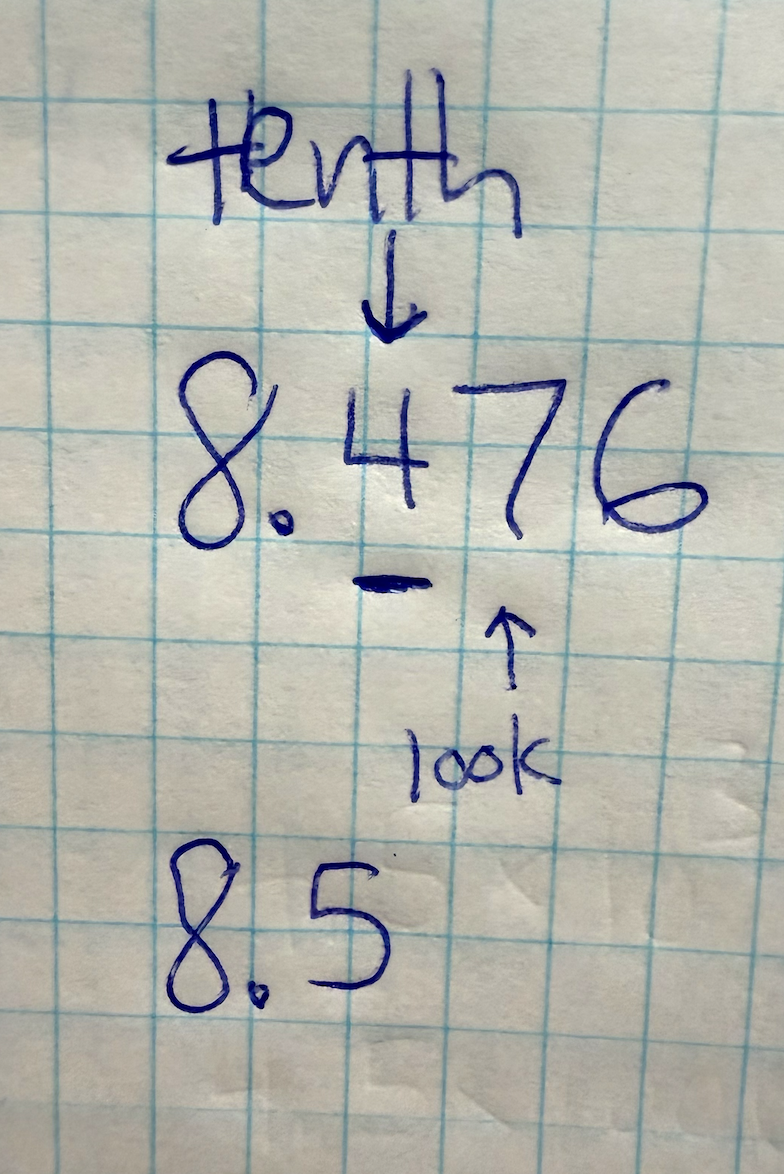
• Rounding should be a review, but now we want to explore decimal places.
• Round 8.476 to nearest tenth (8.5), hundredth (8.48), and whole number (8).
 Math Generator
Click to generate more problems like this.
M4Math
Division with Bigger Numbers — Traditional Method
I can find whole-number quotients using the traditional long division algorithm.
5.NBT.B.6
Skill 2 — Division the traditional way
• Let's walk through the traditional long division steps together.


Click to generate more problems like this.
 L2Language
Notetaking — Listening for Information
I can use Cornell Notes to capture and organize information while listening.
SL.5.1 · SL.5.2
Skill — Listening for Information
• Cornell Notes is a best practice, most every teacher uses to teach note-taking.
• Review how in the image the page is divided into three sections.
The Cues section is for jotting things down while listening.
The Notes section comes after the presentation is over where you scan the cues and capture learning.
At the bottom, your can summarize the learning in their own words.
• Use Listen and Write Generator or a podcast and ask your student to listen and take notes.
• After they are done, review the notes with them and discuss any parts they missed.
• This works really well if you listen and take notes together and compare!
 Listen & Write Generator
Use our Listen & Write Generator for grade-level dictation words, sentences, and paragraphs read aloud.
 L6Language
Determining A Central Idea — Theme vs. Topic
I can determine a theme of a story, drama, or poem from details in the text.
RL.5.2 · RI.5.2
Skill 1 — Theme vs. Topic
• One of the things to focus on in 5th grade is recognizing a theme.
A theme is more than just a topic, it is the author's deeper message they want to send to you.
• As you are reading together or checking in on their reading, use questions like:
What did (the character) learn from this challenge?
Why do you think the author had this happen to them?
 Socratic Chat
• Use the Socratic Chat method once they have an opinion.
 Book Quiz
Our Book Quiz will allow your student to quiz after they have read their book. We have included over 150 of the most popular books at their grade level.
P4Projects
Old Stories told from a New Lens
Draft a short narrative told from one character’s point of view, then rewrite the same events from a second character’s perspective, analyzing how point of view shapes what a reader knows and feels.
W.5.3 · RL.5.6 · RL.5.1 · L.5.3

Card A — Brainstorming which story and character lens
• Use a drive to discuss their favorite stories or movies, and how different characters would have viewed the events unfolding.
What would the story of Cinderella sound like if it were told by the stepmother?
• Choose a story and character to be the narrator. Encourage their humor and insights as they brainstorm how the story may go.
They would have been excited by (plot point), but how would they have felt when this (other plot point) happened?
Notebook Follow up
• Outline the major plot points of the story as they remember and let them start jotting notes on how they would adjust.
Card B — Outlining
• Using the notebook, begin creating an outline of the story with major the events summarized on one side of the page and this new characters feelings on the other.
If you see that this character was surprised by this, how could we write that into your version?
• After they are done outlining. Have them try and write a summary of each scene in their new story. Here is an example:
Cinderella: A Mother’s Perspective
The Tragic Burden: Following the untimely passing of my second husband, I was left solely responsible for managing an entire household and securing a future for my two biological daughters, Anastasia and Drizella. To protect our family's social standing and finite resources, I made the practical decision to assign routine domestic chores—such as cleaning, cooking, and hearth-tending—to my stepdaughter, whose idealistic demeanor made her unsuited for administrative responsibilities.
The Royal Opportunity: The King issued a decree inviting all eligible maidens to a royal ball, presenting the ideal avenue to marry my daughters into the aristocracy. I permitted my stepdaughter to attend only on the reasonable condition that she complete her assigned domestic duties and present herself in suitable, proper attire.
The Dress Dispute: Prior to our departure, my daughters observed that my stepdaughter’s dress was constructed using repurposed beads and ribbons that they had previously discarded. Outraged by what they perceived as theft of their property, my daughters rightfully reclaimed their belongings, leaving my stepdaughter in an unpresentable state. As time was short, I enforced the agreed-upon standards and departed for the palace without her.
The Intruder at the Ball: At the event, a mysterious, heavily veiled woman captivated the Prince, disrupting our strategic attempts to introduce Anastasia and Drizella. The unknown guest fled at midnight, leaving behind a single glass slipper, which prompted the Grand Duke to launch a kingdom-wide search to identify the maiden.
The Fitting and Escape: When the Grand Duke arrived at our estate, I confined my stepdaughter to her room to ensure the proceedings remained orderly and focused on my daughters. Despite my efforts, she escaped her quarters with the aid of household vermin and presented herself to the Duke. She produced the matching glass slipper, revealing herself as the unknown guest, and subsequently married the Prince, abandoning our family and leaving the management of the estate entirely in my hands.
Card C — Drafting and Revision
• Using these scene summaries, allow your student to draft their new complete narrative.
Set the scene with sentences about how the character who is narrating is feeling. Choosing the right words makes all the difference.
• After they are done, look over their writing with them.
It is great if they can read it to you, as often they will see their mistakes more easily when it's read aloud.
Look for places that are confusing or where they could add more details and dialogue.
When they are ready, they can publish either by typing or rewriting. Add pictures and a cover to the book as it may end up being a funny keepsake.
If they have a younger sibling, having this read at story time is a great way to celebrate.
SEL 2SEL
Navigating Exclusion & Group Dynamics
I know how to notice and address exclusion within a group.
Look at the image. Maya notices that three of her classmates created a group chat for a class project, but left out Sam, who is also assigned to their group.
Why might group work or group chats lead to unintentional (or intentional) exclusion?
How might Sam feel discovering they were left out of the group communication?
What steps can Maya take to fix the situation and make sure everyone is included?
What is one rule you can follow to ensure group communication remains respectful and fair?