
 Image 1 of 2
 Image 2 of 2
Our Digital Dashboard and Toolbox are built to give you exactly what you need to succeed with each card, right at your fingertips.


Here are a few sample cards to see how is easy this is. We have one from each habit, a sample project and an SEL activity.

Mixed Sampler
A custom sampler pulling one card or skill from each subject — Math, Language, Projects, and SEL — each keeping its own subject color.
 M6Math
Negative Numbers & Absolute Value — Ordering Numbers
I can order rational numbers, including negatives, and use absolute value as distance from zero.
6.NS.C.5 · 6.NS.C.6a · 6.NS.C.7
Prompt 3 — Ordering Numbers
Put these in order from least to greatest: -3, 5, -8, 0, 2 -> -8, -3, 0, 2, 5
Is -10 greater or less than -3? -> Less, since -10 sits further left on the number line

 M7Math
The Coordinate Plane — Finding Distance Between Points
I can graph points in all four quadrants and find horizontal or vertical distances between them.
6.NS.C.6b · 6.NS.C.6c · 6.NS.C.8
Skill 2 — Finding Distance Between Points
 Points (2,3) and (2,-4) share the same x-coordinate, so find the vertical distance: |3 - (-4)| = 7
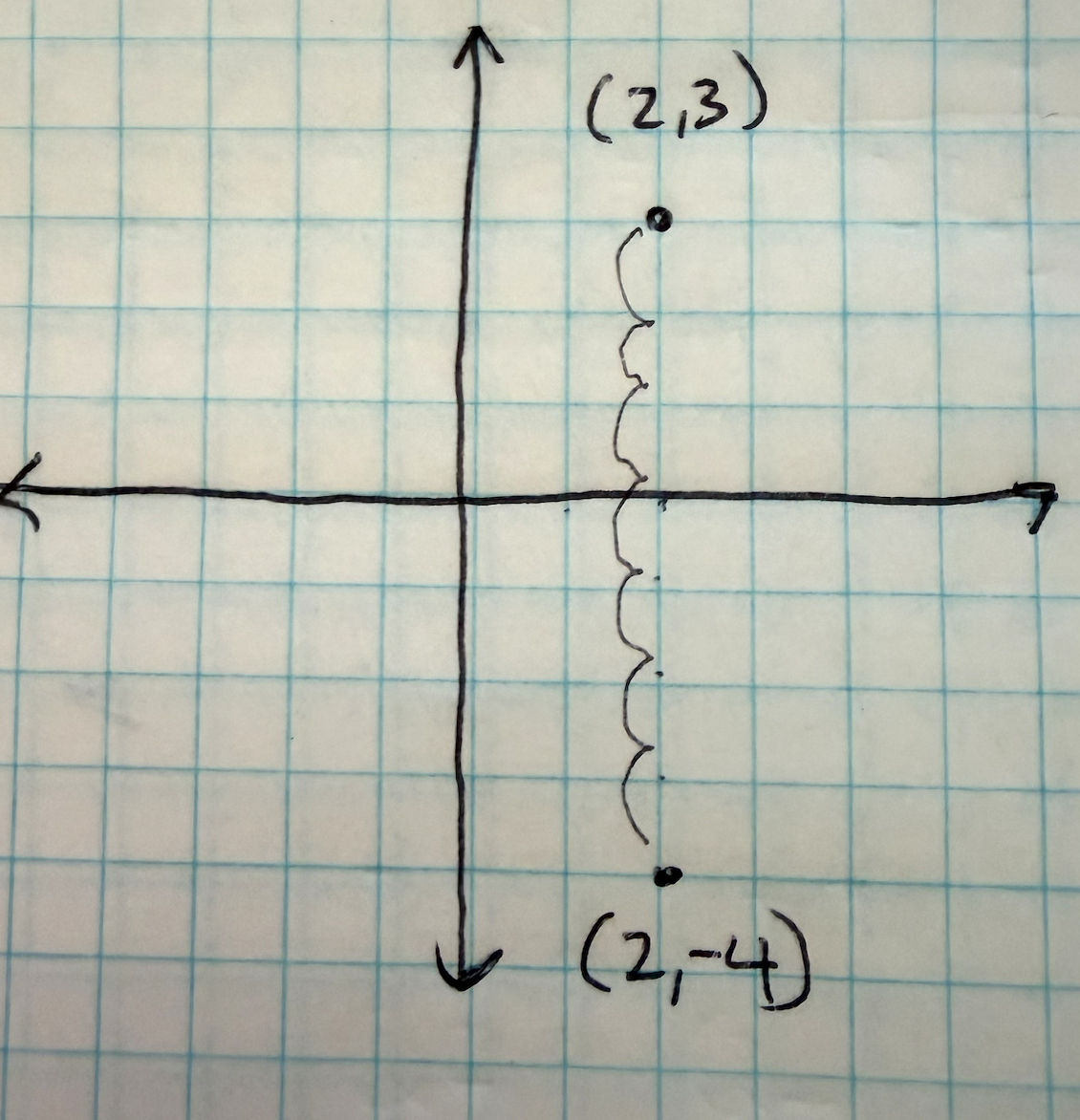
 Points (-3,5) and (6,5) share the same y-coordinate. Find the horizontal distance: |6 - (-3)| = 9
 Math Generator
Click to generate more problems like this.
 L5Language
Citing Evidence & Drawing Inferences — Precision Text Quotation
I can cite specific textual evidence to support answers about a text.
RL.6.1 · RI.6.1
Skill 1 — Precision Text Quotation
• When reading your next chapter book, practice answering questions only with the direct quotations from the story or text.
When (plot point) happened, what did (main character) do? Find your answer in the book and read it back to me.
• The Information Text Generator is a great place to practice this together or as they answer the questions independently.
It's good to use sentences starters like "According to the text" and "In chapter 7"
 Informational Text Generator
Use our Informational Text Generator to create a grade-level nonfiction passage on a topic they like.
 L10Language
Exploring Sentence Variety — Recognizing Fragments
I can recognize and revise sentence fragments to write complete thoughts.
L.6.1 · L.6.3a
Skill 1 — Recognizing Fragments
A fragment is missing a subject, a verb, or a complete thought.
Running down the street. -> "She was running down the street."
• Use Listen and Write Generator to have them identify correct and incorrect sentences.
• After they write something for school or for this notebook, always have them look for fragments.
Use our Listen & Write Generator for grade-level dictation words, sentences, and paragraphs read aloud.
P3Projects
Weather Station
Track daily temperature and precipitation data, plot readings on a negative-number coordinate grid, calculate measures of center and variability, and apply fraction division to precipitation totals.
6.NS.C.5 · 6.NS.C.6 · 6.NS.C.8 · 6.NS.A.1 · 6.SP.A.2 · 6.SP.A.3 · 6.SP.B.5
Card A — Tracking Negative Numbers on a Coordinate Grid
Look up a real record low temperature for your region (or a cold-climate city) and model recording it as a negative number (e.g., -8°F). Plot the day number (x-axis) against the temperature (y-axis, including negative values) on a 4-quadrant coordinate grid.
Have your child record the daily high temperature for 10 consecutive days (real data from a weather app, or historical data for a chosen city), plotting each day’s temperature as a coordinate point. Ask them to identify the two days farthest apart in temperature using absolute value.
Card B — Measures of Center & Variability
Using the 10-day temperature data set, model calculating the mean, median, and range. Explain what the range tells us about how much the temperature varied across the ten days.
Have your child calculate the mean and median of their own data set, then write one sentence comparing the two grades of the week that were “most typical” and one that was an outlier, using their statistics as evidence.
SEL 1SEL
Social Dynamics & Rumor Spreading
I know how to navigate gossip and rumors responsibly.
Look at the image. Marcus overhears two classmates sharing a rumor about a friend in the hallway between periods. They turn to Marcus and ask, "Did you hear about that?"
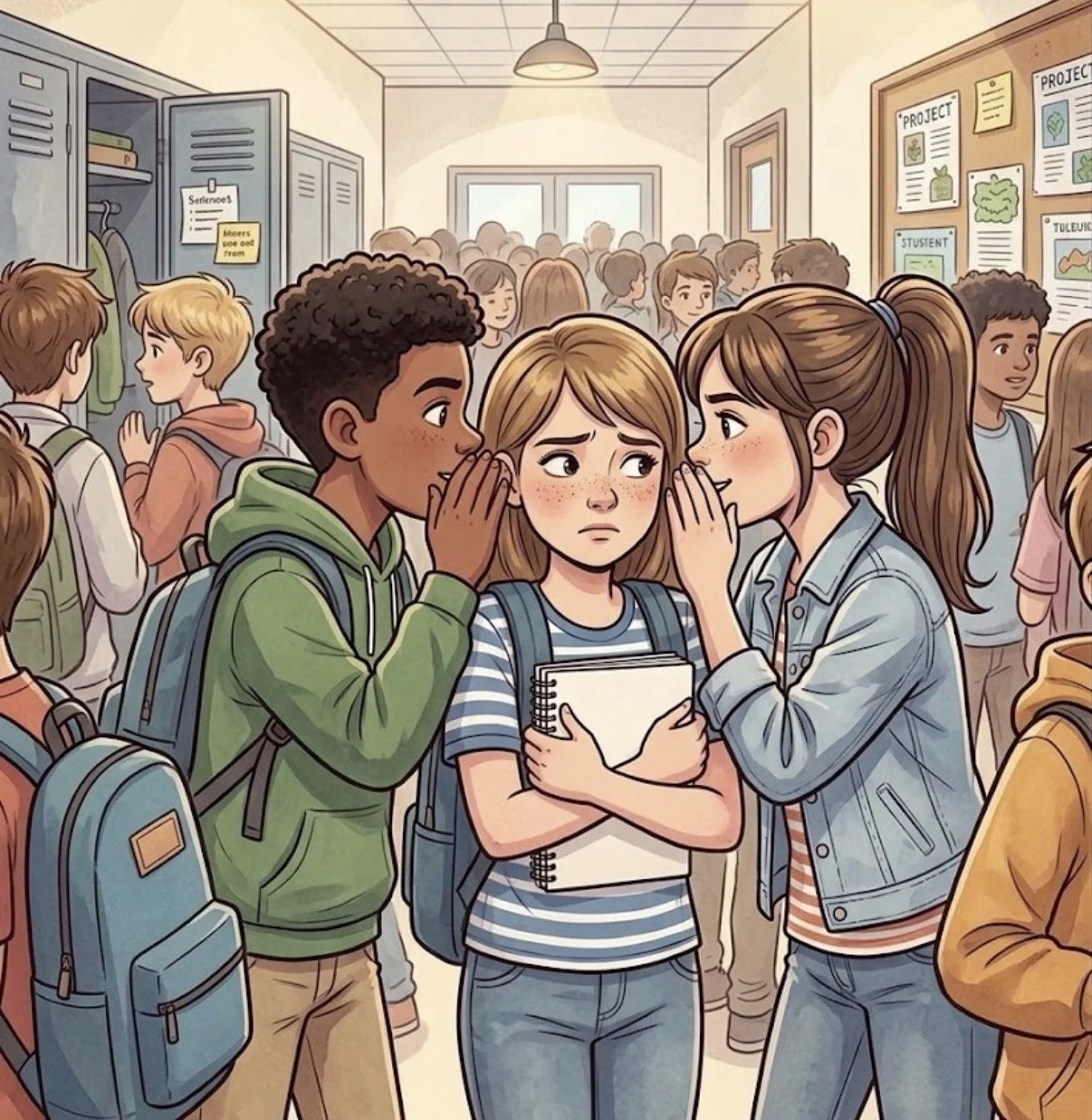
What are the social risks Marcus faces whether he agrees, stays quiet, or counters the rumor?
Why do rumors spread so quickly in middle school, and what damage do they cause to individuals and school culture?
How can Marcus redirect the conversation or walk away without creating unnecessary conflict?
How do you decide when to step in vs. when to distance yourself from gossip?